


Page 449 - Clinical Immunology_ Principles and Practice ( PDFDrive )
P. 449
428          ParT THrEE  Host Defenses to Infectious Agents


                                Leishmania promastigotes       gain the capacity to produce IFN-γ, and then migrate to the site
                                                               of infection. Thus T cm  cells act as a reserve of antigen-reactive
          NK                                                   T cells that can expand and become effector T cells in response
                        IL-12                                  to secondary antigenic challenge.
                                          DC
                                                                  The generation of RNI by activated macrophages is the primary
                       IFN-γ                                   mechanism of parasite killing in the murine model. Although
                                               IL-12           IFN-γ-induced production of NO may not be detectable in human
            IFN-γ  IFN-γ                                       macrophages, inhibition of nitric oxide synthase 2 (NOS2) was
                                    IFN-γ                      shown to impair killing of intracellular Leishmania.
                        IFN-γ                         Th1         Several adaptive immune mechanisms promote parasite
                                                                                  15
                        IL-4                                   replication and disease.  The progression of murine L. major
                        IL-10          IFN-γ                   infection has been correlated with the expansion of Th2 cells
          Th2
                       IL-10  TNF-α                            and the production of IL-4, IL-5, and IL-10. In susceptible mice,
                       TGF-β                                   IL-4 production within the first day of infection was shown to
                   IL-4                     IL-10
                  IL-10        Activation   TGF-β              downregulate IL-12 receptor β-chain expression and drive the
                                  RNI                          response to a Th2 phenotype. However, other nonsusceptible
                                  ROI                          mouse strains appear to be able to overcome an early IL-4 response
                   IL-10
                   TGF-β     Parasite killing                  and develop a resistant phenotype, and susceptibility to some
                   PGE 2  Deactivation                         L. major strains is not strictly mediated by IL-4 (IL-13 and/or
                                                               IL-10 may have a prominent role). The cytotoxic activity of CD8
                     Parasite            Macrophage            T cells may promote cutaneous inflammation and lesion pathol-
                                                                   14
                    replication                                ogy.  The macrophage production of immune suppressive
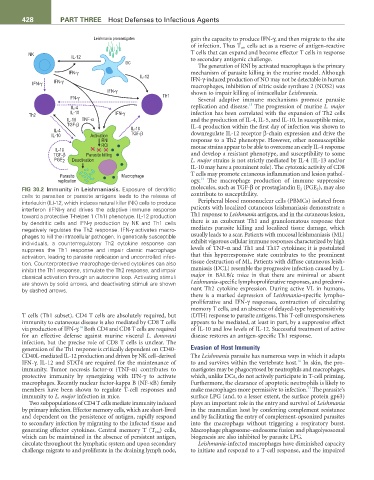
        FIG 30.2  Immunity in Leishmaniasis. Exposure of dendritic   molecules, such as TGF-β or prostaglandin E 2  (PGE 2 ), may also
        cells to parasites or parasite antigens leads to the release of   contribute to susceptibility.
        interleukin (IL)-12, which induces natural killer (NK) cells to produce   Peripheral blood mononuclear cells (PBMCs) isolated from
        interferon (IFN)-γ and drives the adaptive immune  response   patients with localized cutaneous leishmaniasis demonstrate a
        toward a protective T-helper 1 (Th1) phenotype. IL-12 production   Th1 response to Leishmania antigens, and in the cutaneous lesion,
        by dendritic cells and IFN-γ production by NK and Th1 cells   there is an exuberant Th1 and granulomatous response that
        negatively regulates the Th2 response. IFN-γ activates macro-  mediates parasite killing and localized tissue damage, which
        phages to kill the intracellular pathogen. In genetically susceptible   usually leads to a scar. Patients with mucosal leishmaniasis (ML)
        individuals, a counterregulatory Th2 cytokine response can   exhibit vigorous cellular immune responses characterized by high
        suppress the Th1 response and impair classic macrophage   levels of TNF-α and Th1 and Th17 cytokines; it is postulated
        activation, leading to parasite replication and uncontrolled infec-  that this hyperresponsive state contributes to the prominent
        tion. Counterprotective macrophage-derived cytokines can also   tissue destruction of ML. Patients with diffuse cutaneous leish-
        inhibit the Th1 response, stimulate the Th2 response, and impair   maniasis (DCL) resemble the progressive infection caused by L.
        classical activation through an autocrine loop. Activating stimuli   major in BALB/c mice in that there are minimal or absent
        are shown by solid arrows, and deactivating stimuli are shown   Leishmania-specific lymphoproliferative responses, and predomi-
        by dashed arrows.                                      nant Th2 cytokine expression. During active VL in humans,
                                                               there is a marked depression of Leishmania-specific lympho-
                                                               proliferative and IFN-γ responses, contraction of circulating
                                                               memory T cells, and an absence of delayed-type hypersensitivity
        T cells (Th1 subset). CD4 T cells are absolutely required, but   (DTH) response to parasite antigens. This T-cell unresponsiveness
        immunity to cutaneous disease is also mediated by CD8 T cells   appears to be mediated, at least in part, by a suppressive effect
                           14
        via production of IFN-γ.  Both CD4 and CD8 T cells are required   of IL-10 and low levels of IL-12. Successful treatment of active
        for an effective defense against murine visceral  L. donovani   disease restores an antigen-specific Th1 response.
        infection, but the precise role of CD8 T cells is unclear. The
        generation of the Th1 response is critically dependent on CD40-  Evasion of Host Immunity
        CD40L-mediated IL-12 production and driven by NK cell–derived   The Leishmania parasite has numerous ways in which it adapts
                                                                                                  16
        IFN-γ. IL-12 and STAT4 are required for the maintenance of   to and survives within the vertebrate host.  In skin, the pro-
        immunity. Tumor necrosis factor-α (TNF-α) contributes to   mastigotes may be phagocytosed by neutrophils and macrophages,
        protective immunity by synergizing with IFN-γ to activate   which, unlike DCs, do not actively participate in T-cell priming.
        macrophages. Recently nuclear factor-kappa B (NF-κB) family   Furthermore, the clearance of apoptotic neutrophils is likely to
                                                                                                      13
        members have been shown to regulate T-cell responses and   make macrophages more permissive to infection.  The parasite’s
        immunity to L. major infection in mice.                surface LPG (and, to a lesser extent, the surface protein gp63)
           Two subpopulations of CD4 T cells mediate immunity induced   plays an important role in the entry and survival of Leishmania
        by primary infection. Effector memory cells, which are short-lived   in the mammalian host by conferring complement resistance
        and dependent on the persistence of antigen, rapidly respond   and by facilitating the entry of complement-opsonized parasites
        to secondary infection by migrating to the infected tissue and   into the macrophage without triggering a respiratory burst.
        generating effector cytokines. Central memory T (T cm ) cells,   Macrophage phagosome–endosome fusion and phagolysosomal
        which can be maintained in the absence of persistent antigen,   biogenesis are also inhibited by parasite LPG.
        circulate throughout the lymphatic system and upon secondary   Leishmania-infected macrophages have diminished capacity
        challenge migrate to and proliferate in the draining lymph node,   to initiate and respond to a T-cell response, and the impaired

