


Page 450 - Clinical Immunology_ Principles and Practice ( PDFDrive )
P. 450
CHaPTEr 30  Host Defenses to Protozoa              429


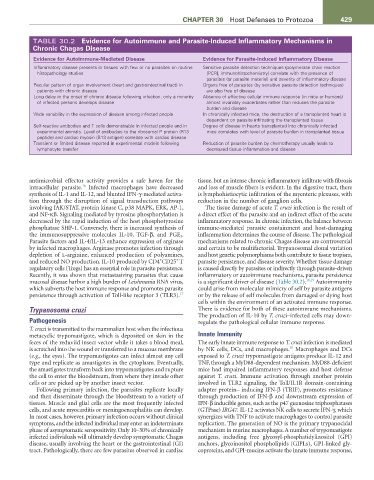
            TABLE 30.2  Evidence for autoimmune and Parasite-Induced Inflammatory Mechanisms in
            Chronic Chagas Disease
            Evidence for autoimmune-Mediated Disease               Evidence for Parasite-Induced Inflammatory Disease
            Inflammatory disease presents in tissues with few or no parasites on routine   Sensitive parasite detection techniques (polymerase chain reaction
             histopathology studies                                  [PCR], immunohistochemistry) correlate with the presence of
                                                                     parasites (or parasite material) and severity of inflammatory disease
            Peculiar pattern of organ involvement (heart and gastrointestinal tract) in   Organs free of parasites (by sensitive parasite detection techniques)
             patients with chronic disease                           are also free of disease
            Long delay in the onset of chronic disease following infection; only a minority   Absence of effective cellular immune response (in mice or humans)
             of infected persons develops disease                    almost invariably exacerbates rather than reduces the parasite
                                                                     burden and disease
            Wide variability in the expression of disease among infected people  In chronically infected mice, the destruction of a transplanted heart is
                                                                     dependent on parasite infiltrating the transplanted tissue
            Self-reactive antibodies and T cells demonstrable in infected people and in   Degree of disease in hearts transplanted into chronically infected
             experimental animals. Level of antibodies to the ribosomal P protein (R13   mice correlates with level of parasite burden in transplanted tissue
             peptide) and cardiac myosin (B13 antigen) correlate with cardiac disease
            Transient or limited disease reported in experimental models following   Reduction of parasite burden by chemotherapy usually leads to
             lymphocyte transfer                                     decreased tissue inflammation and disease


           antimicrobial effector activity provides a safe haven for the   tissue, but an intense chronic inflammatory infiltrate with fibrosis
                            16
           intracellular parasite.  Infected macrophages have decreased   and loss of muscle fibers is evident. In the digestive tract, there
           synthesis of IL-1 and IL-12, and blunted IFN-γ-mediated activa-  is lymphohistiocytic infiltration of the myenteric plexuses, with
           tion through the disruption of signal transduction pathways   reduction in the number of ganglion cells.
           involving JAK/STAT, protein kinase C, p38 MAPK, ERK, AP-1,   The tissue damage of acute T. cruzi infection is the result of
           and NF-κB. Signaling mediated by tyrosine phosphorylation is   a direct effect of the parasite and an indirect effect of the acute
           decreased by the rapid induction of the host phosphotyrosine   inflammatory response. In chronic infection, the balance between
           phosphatase SHP-1. Conversely, there is increased synthesis of   immune-mediated parasite  containment and  host-damaging
           the immunosuppressive molecules IL-10, TGF-β, and PGE 2 .   inflammation determines the course of disease. The pathological
           Parasite factors and IL-4/IL-13 enhance expression of arginase   mechanisms related to chronic Chagas disease are controversial
           by infected macrophages. Arginase promotes infection through   and certain to be multifactorial. Trypanosomal clonal variation
           depletion of l-arginine, enhanced production of polyamines,   and host genetic polymorphisms both contribute to tissue tropism,
                                                           +
                                                     +
           and reduced NO production. IL-10 produced by CD4 CD25  T   parasite persistence, and disease severity. Whether tissue damage
           regulatory cells (Tregs) has an essential role in parasite persistence.   is caused directly by parasites or indirectly through parasite-driven
           Recently, it was shown that metastasizing parasites that cause   inflammatory or autoimmune mechanisms, parasite persistence
           mucosal disease harbor a high burden of Leishmania RNA virus,   is a significant driver of disease (Table 30.2). 18,19  Autoimmunity
           which subverts the host immune response and promotes parasite   could arise from molecular mimicry of self by parasite antigens
           persistence through activation of Toll-like receptor 3 (TLR3). 17  or by the release of self molecules from damaged or dying host
                                                                  cells within the environment of an activated immune response.
           Trypanosoma cruzi                                      There is evidence for both of these autoimmune mechanisms.
                                                                  The production of IL-10 by T. cruzi–infected cells may down-
           Pathogenesis                                           regulate the pathological cellular immune response.
           T. cruzi is transmitted to the mammalian host when the infectious
           metacyclic trypomastigote, which is deposited on skin in the   Innate Immunity
           feces of the reduviid insect vector while it takes a blood meal,   The early innate immune response to T. cruzi infection is mediated
                                                                                                20
           is scratched into the wound or transferred to a mucous membrane   by NK cells, DCs, and macrophages.  Macrophages and DCs
           (e.g., the eyes). The trypomastigotes can infect almost any cell   exposed to T. cruzi trypomastigote antigens produce IL-12 and
           type and replicate as amastigotes in the cytoplasm. Eventually,   TNF, through a MyD88-dependent mechanism. MyD88-deficient
           the amastigotes transform back into trypomastigotes and rupture   mice had impaired inflammatory responses and host defense
           the cell to enter the bloodstream, from where they invade other   against  T. cruzi. Immune activation through another protein
           cells or are picked up by another insect vector.       involved in TLR2 signaling, the Toll/IL1R domain-containing
             Following primary infection, the parasites replicate locally   adapter protein– inducing IFN-β (TRIF), promotes resistance
           and then disseminate through the bloodstream to a variety of   through production of IFN-β and downstream expression of
           tissues. Muscle and glial cells are the most frequently infected   IFN-β inducible genes, such as the p47 guanosine triphosphatases
           cells, and acute myocarditis or meningoencephalitis can develop.   (GTPase) IRG47. IL-12 activates NK cells to secrete IFN-γ, which
           In most cases, however, primary infection occurs without clinical   synergizes with TNF to activate macrophages to control parasite
           symptoms, and the infected individual may enter an indeterminate   replication. The generation of NO is the primary trypanocidal
           phase of asymptomatic seropositivity. Only 10–30% of chronically   mechanism in murine macrophages. A number of trypomastigote
           infected individuals will ultimately develop symptomatic Chagas   antigens, including free glycosyl-phosphatidylinositol (GPI)
           disease, usually involving the heart or the gastrointestinal (GI)   anchors, glycoinositol phospholipids (GIPLs), GPI-linked gly-
           tract. Pathologically, there are few parasites observed in cardiac   coproteins, and GPI-mucins activate the innate immune response,

