


Page 453 - Clinical Immunology_ Principles and Practice ( PDFDrive )
P. 453
432          ParT THrEE  Host Defenses to Infectious Agents


                          Pathogen                 Innate immune response          Intestinal response

                                       Trophozoite
                                                    Complement                      Villous atrophy and
                          Giardia                                   Inflammatory    crypt hyperplasia
                                                    Macrophage      mediators
                                                                    IL-6, IL-8, IL-1
                                                    Neutrophil                        Epithelial
                                       Sporozoite                   GM-CSF, GROα,      damage
                                                    Eosinophil      prostaglandins
                          Cryptosporidium
                                                    NK cell         ROI, RNI
                                       Trophozoite
                                                                    Proteases
                                                                                     Erosions and
                                                    Enterocyte                        ulcerations
                          Entamoeba                 (Cryptosporidium)

                                                            Cytokines

                                                  B- and T-lymphocyte activation      Secretion
                                                                                     Malabsorption
                                                   Acquired immune response
                                                                                      Exudation
                                                      Host protection                 Diarrhea
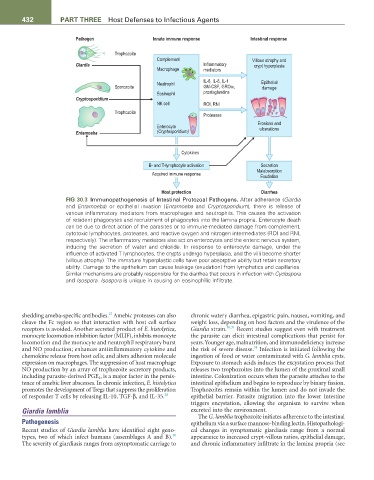
                       FIG 30.3  Immunopathogenesis of Intestinal Protozoal Pathogens. After adherence (Giardia
                       and  Entamoeba) or epithelial invasion (Entamoeba and  Cryptosporidium), there is release of
                       various inflammatory mediators from macrophages and neutrophils. This causes the activation
                       of resident phagocytes and recruitment of phagocytes into the lamina propria. Enterocyte death
                       can be due to direct action of the parasites or to immune-mediated damage from complement,
                       cytotoxic lymphocytes, proteases, and reactive oxygen and nitrogen intermediates (ROI and RNI,
                       respectively). The inflammatory mediators also act on enterocytes and the enteric nervous system,
                       inducing the secretion of water and chloride. In response to enterocyte damage, under the
                       influence of activated T lymphocytes, the crypts undergo hyperplasia, and the villi become shorter
                       (villous atrophy). The immature hyperplastic cells have poor absorptive ability but retain secretory
                       ability. Damage to the epithelium can cause leakage (exudation) from lymphatics and capillaries.
                       Similar mechanisms are probably responsible for the diarrhea that occurs in infection with Cyclospora
                       and Isospora. Isospora is unique in causing an eosinophilic infiltrate.


                                     27
        shedding ameba-specific antibodies.  Amebic proteases can also   chronic watery diarrhea, epigastric pain, nausea, vomiting, and
        cleave the Fc region so that interaction with host cell surface   weight loss, depending on host factors and the virulence of the
        receptors is avoided. Another secreted product of E. histolytica,   Giardia strain. 30,31  Recent studies suggest even with treatment
        monocyte locomotion inhibition factor (MLIF), inhibits monocyte   the parasite can elicit intestinal complications that persist for
        locomotion and the monocyte and neutrophil respiratory burst   years. Younger age, malnutrition, and immunodeficiency increase
                                                                                    31
        and NO production; enhances antiinflammatory cytokine and   the risk of severe disease.  Infection is initiated following the
        chemokine release from host cells; and alters adhesion molecule   ingestion of food or water contaminated with G. lamblia cysts.
        expression on macrophages. The suppression of host macrophage   Exposure to stomach acids induces the excystation process that
        NO production by an array of trophozoite secretory products,   releases two trophozoites into the lumen of the proximal small
        including parasite-derived PGE 2 , is a major factor in the persis-  intestine. Colonization occurs when the parasite attaches to the
        tence of amebic liver abscesses. In chronic infection, E. histolytica   intestinal epithelium and begins to reproduce by binary fission.
        promotes the development of Tregs that suppress the proliferation   Trophozoites remain within the lumen and do not invade the
        of responder T cells by releasing IL-10, TGF-β, and IL-35. 28  epithelial barrier. Parasite migration into the lower intestine
                                                               triggers encystation, allowing the organism to survive when
        Giardia lamblia                                        excreted into the environment.
                                                                  The G. lamblia trophozoite initiates adherence to the intestinal
        Pathogenesis                                           epithelium via a surface mannose-binding lectin. Histopathologi-
        Recent studies of Giardia lamblia have identified eight geno-  cal changes in symptomatic giardiasis range from a normal
                                                         30
        types, two of which infect humans (assemblages A and B).    appearance to increased crypt-villous ratios, epithelial damage,
        The severity of giardiasis ranges from asymptomatic carriage to   and chronic inflammatory infiltrate in the lamina propria (see

