


Page 494 - Clinical Immunology_ Principles and Practice ( PDFDrive )
P. 494
474          PARt fouR  Immunological Deficiencies


         TABLE 34.2  Laboratory Diagnosis of Primary Antibody Deficiency
          Level    test                                                                  Application(s)
          I        CBC with differential                                                 Primary screening tests
                   Complement (CH 50 , C3, C4, mannose-binding lectin [MBL] protein)
                   Erythrocyte sedimentation rate (ESR)
                   Quantitative serum immunoglobulin (Ig)M, IgG, and IgA levels
          Ia       Urinalysis, 24-hour urine for protein                                 Symptoms suggest protein loss
                   Stool for α-1-antitrypsin                                              through kidneys or
                                                                                          gastrointestinal (GI) tract
          II       B-cell functional evaluation                                          Level I normal but history suggests
                   Quantitative IgG subclasses, IgE                                      Antibody deficiency
                   Natural or commonly acquired antibodies (isohemagglutinins, rubella, rubeola, tetanus)  Better definition of a level I defect
                   Response to immunization
                   T cell–dependent antigens (tetanus)
                   T cell–independent antigens (unconjugated pneumococcal vaccine, unconjugated H. influenzae
                     B vaccine)
          III      Quantification of blood T-and B-cell subpopulations by immunofluorescence assays using   Panhypogammaglobulinemia or
                     monoclonal antibody markers                                          severely low IgM and IgA
                   T cells: CD3, CD4, CD8
                   B cells: CD19, CD20, CD21, Ig (µ, δ, κ, λ),
          IV        Disease-specific analysis                                            Gene-specific diagnosis
                    Gene expression                                                      Genetic counseling
                    Gene sequencing


                             1300
                                                                                 IgG
                             1100               Maternal IgG
                           Average serum immunoglobulin concentration (mg/dL)  500  Child’s IgG  IgA
                             900
                             700


                             300

                             250
                             200

                             150
                             100

                              50                                                        IgM
                              25
                               0
                                 0  2  4  6  8  2  4  6  810122  4  6  810  1525351255657585
                                    Months  Birth  Months                    Years
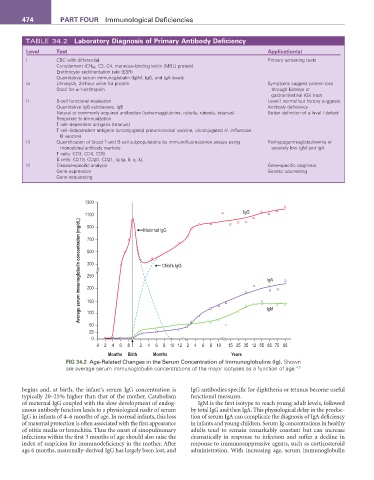
                       fIG 34.2  Age-Related Changes in the Serum Concentration of Immunoglobulins (Ig). Shown
                                                                                                  4,5
                       are average serum immunoglobulin concentrations of the major isotypes as a function of age.


        begins and, at birth, the infant’s serum IgG concentration is   IgG antibodies specific for diphtheria or tetanus become useful
        typically 20–25% higher than that of the mother. Catabolism   functional measures.
        of maternal IgG coupled with the slow development of endog-  IgM is the first isotype to reach young adult levels, followed
        enous antibody function leads to a physiological nadir of serum   by total IgG and then IgA. This physiological delay in the produc-
        IgG in infants of 4–6 months of age. In normal infants, this loss   tion of serum IgA can complicate the diagnosis of IgA deficiency
        of maternal protection is often associated with the first appearance   in infants and young children. Serum Ig concentrations in healthy
        of otitis media or bronchitis. Thus the onset of sinopulmonary   adults tend to remain remarkably constant but can increase
        infections within the first 3 months of age should also raise the   dramatically in response to infection and suffer a decline in
        index of suspicion for immunodeficiency in the mother. After   response to immunosuppressive agents, such as corticosteroid
        age 6 months, maternally-derived IgG has largely been lost, and   administration.  With increasing age, serum immunoglobulin

