


Page 492 - Clinical Immunology_ Principles and Practice ( PDFDrive )
P. 492
472          PARt fouR  Immunological Deficiencies


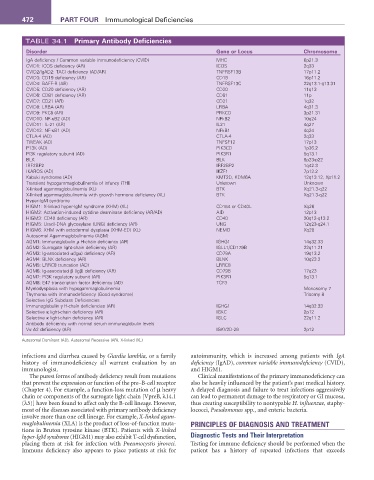
         TABLE 34.1  Primary Antibody Deficiencies
          Disorder                                                      Gene or Locus               Chromosome
          IgA deficiency / Common variable immunodeficiency (CVID)      MHC                         6p21.3
          CVID1: ICOS deficiency (AR)                                   ICOS                        2q33
          CVID2/IgAD2: TACI deficiency (AD/AR)                          TNFRSF13B                   17p11.2
          CVID3: CD19 deficiency (AR)                                   CD19                        16p11.2
          CVID4: BAFF-R (AR)                                            TNFRSF13C                   22q13.1-q13.31
          CVID5: CD20 deficiency (AR)                                   CD20                        11q13
          CVID6: CD81 deficiency (AR)                                   CD81                        11p
          CVID7: CD21 (AR)                                              CD21                        1q32
          CVID8: LRBA (AR)                                              LRBA                        4q31.3
          CVID9: PKCδ (AR)                                              PRKCD                       3p21.31
          CVID10: NF-κB2 (AD)                                           NFkB2                       10q24
          CVID11: IL-21 (AR)                                            IL21                        4q27
          CVID12: NF-κB1 (AD)                                           NFkB1                       4q24
          CTLA-4 (AD)                                                   CTLA-4                      2q33
          TWEAK (AD)                                                    TNFSF12                     17p13
          P13K (AD)                                                     PIK3CD                      1p36.2
          PI3K regulatory subunit (AD)                                  PIK3R1                      5q13.1
          BLK                                                           BLK                         8p23-p22
          IRF2BP2                                                       IRF2BP2                     1q42.3
          IKAROS (AD)                                                   IKZF1                       7p12.2
          Kabuki syndrome (AD)                                          KMT2D, KDM6A                12q13.12, Xp11.2
          Transient hypogammaglobulinemia of infancy (THI)              Unknown                     Unknown
          X-linked agammaglobulinemia (XL)                              BTK                         Xq21.3-q22
          X-linked agammaglobulinemia with growth hormone deficiency (XL)  BTK                      Xq21.3-q22
          Hyper-IgM syndrome
          HIGM1: X-linked hyper-IgM syndrome (XHM) (XL)                 CD154 or CD40L              Xq26
          HIGM2: Activation-induced cytidine deaminase deficiency (AR/AD)  AID                      12p13
          HIGM3: CD40 deficiency (AR)                                   CD40                        20q12-q13.2
          HIGM5: Uracil-DNA glycosylase (UNG) deficiency (AR)           UNG                         12q23-q24.1
          HIGM6: XHM with ectodermal dysplasia (XHM-ED) (XL)            NEMO                        Xq28
          Autosomal Agammaglobulinemia (AGM)
          AGM1: Immunoglobulin µ H-chain deficiency (AR)                IGHG1                       14q32.33
          AGM2: Surrogate light-chain deficiency (AR)                   IGLL1/CD179B                22q11.21
          AGM3: Ig-associated α(Igα) deficiency (AR)                    CD79A                       19q13.2
          AGM4: BLNK deficiency (AR)                                    BLNK                        10q23.2
          AGM5: LRRC8 truncation (AD)                                   LRRC8
          AGM6: Ig-associated β (Igβ) deficiency (AR)                   CD79B                       17q23
          AGM7: PI3K regulatory subunit (AR)                            PIK3R1                      5q13.1
          AGM8: E47 transcription factor deficiency (AD)                TCF3
          Myelodysplasia with hypogammaglobulinemia                                                 Monosomy 7
          Thymoma with immunodeficiency (Good syndrome)                                             Trisomy 8
          Selective IgG Subclass Deficiencies
          Immunoglobulin γ H-chain deficiencies (AR)                    IGHG1                       14q32.33
          Selective κ light-chain deficiency (AR)                       IGKC                        2p12
          Selective κ light-chain deficiency (AR)                       IGLC                        22q11.2
          Antibody deficiency with normal serum immunoglobulin levels
          Vκ A2 deficiency (AR)                                         IGKV2D-29                   2p12
        Autosomal Dominant (AD), Autosomal Recessive (AR), X-linked (XL)

        infections and diarrhea caused by Giardia lamblia, or a family   autoimmunity, which is increased among patients with  IgA
        history of immunodeficiency all warrant evaluation by an   deficiency (IgAD), common variable immunodeficiency (CVID),
        immunologist.                                          and HIGM1.
           The purest forms of antibody deficiency result from mutations   Clinical manifestations of the primary immunodeficiency can
        that prevent the expression or function of the pre–B-cell receptor   also be heavily influenced by the patient’s past medical history.
        (Chapter 4). For example, a function-loss mutation of µ heavy   A delayed diagnosis and failure to treat infections aggressively
        chain or components of the surrogate light chain [VpreB, λ14.1   can lead to permanent damage to the respiratory or GI mucosa,
        (λ5)] have been found to affect only the B-cell lineage. However,   thus creating susceptibility to nontypable H. influenzae, staphy-
        most of the diseases associated with primary antibody deficiency   lococci, Pseudomonas spp., and enteric bacteria.
        involve more than one cell lineage. For example, X-linked agam-
        maglobulinemia (XLA) is the product of loss-of-function muta-  PRINCIPLES OF DIAGNOSIS AND TREATMENT
        tions in Bruton tyrosine kinase (BTK). Patients with X-linked
        hyper-IgM syndrome (HIGM1) may also exhibit T-cell dysfunction,   Diagnostic Tests and Their Interpretation
        placing them at risk for infection with  Pneumocystis jiroveci.   Testing for immune deficiency should be performed when the
        Immune  deficiency  also  appears  to  place  patients  at  risk  for   patient has a history of repeated infections that exceeds

