


Page 510 - Clinical Immunology_ Principles and Practice ( PDFDrive )
P. 510
490          ParT fOur  Immunological Deficiencies


            KEY CONCEPTS                                          Regardless of the molecular cause, treatment with corticoster-
         Combined Immunodeficiency                             oids and cyclosporine are effective in controlling inflammation,
                                                               improving skin lesions, and reducing lymphadenopathy and
          •  Arbitrarily defined as a T-cell deficiency with >300–500 autologous   hepatosplenomegaly. Ultimately, a cure can be achieved only
           CD3 circulating cells/µL, which may be reduced or dysfunctional.  with HSCT. 11
          •  Circulating autologous T cells may be the typical feature of the defect
           or may be caused by genetic variants leading to an incomplete defect   SEVERE COMBINED IMMUNE DEFICIENCY
           (leaky severe combined immunodeficiency [SCID]).
          •  Clinical manifestations may be indistinguishable from SCID.  SCID is characterized by near complete absence of circulating
          •  Others may present with SCID and aberrant inflammatory syndrome
           (Omenn  syndrome)  consisting  of  erythroderma,  lymphadenopathy,   autologous T cells and impaired B-cell function. Defects in the
           and eosinophilia.                                   differentiation and maturation of T-lineage cells in the thymus
          •  Frequently, the predominant presenting manifestation can be autoim-  are a primary cause of T-cell deficiency (Fig. 35.1). In particular,
           munity or lymphoid malignancy.                      mutations affecting T-cell activation or downstream signaling
          •  In vitro responses to mitogens and T-cell receptor excision circle   molecules can result in SCID or CID (Fig. 35.2).
           (TREC) levels may be depressed or normal. The T-cell repertoire is
           often abnormal, as are T-cell subpopulations (regulatory T cells [Tregs]   SCID With T-Cell Lymphopenia (T B )
                                                                                             −
                                                                                               +
           and memory cells). Immunoglobulins and specific antibodies are   − +
           variable.                                           This T B  group of patients (Table 35.2) is the most frequently
                                                               identified phenotype of SCID (28 to 50% of all cases) and is
                                                               believed to occur at a frequency of 1:50,000 live births. 1
        restricted because of inefficient deletion and suppression of
        self-reactive T cells and dysregulated lymphostromal cross-talk   γc (IL-2Rγ) Deficiency
        in the thymus. The condition is associated with hypomorphic   Common gamma chain (γc) or interleukin-2 receptor gamma
        mutations of various SCID-causing genes, including RAG1/2,   (IL-2Rγ) deficiency (OMIM #300400) is transmitted in an
        Artemis, DNA ligase IV, RMRP, ZAP-70, IL2RG, IL7Rα, CD3δ,   X-linked manner. Affected males have mutations in the IL-2Rγ
        and ADA (Table 35.1). In addition to typical SCID manifestations,   chain, also known as the common gamma chain because of its
        patients present with features including generalized erythroderma,   critical role as a coreceptor in IL-4, IL-7, IL-9, IL-15, and IL-21
        which may be accompanied by alopecia, loss of eyebrows and   receptors. Multiple pathways downstream of these receptors are
        eyelashes. Marked enlargement of lymph nodes, liver, and spleen   essential for differentiation and growth of T cells and NK cells,
        are frequently present.                                hence the abnormal immune profile and profound defect in
           The hallmarks of laboratory findings are elevated serum   T-cell and NK-cell maturation. Affected males typically present
        immunoglobulin E (IgE) levels and increased eosinophil counts.   at 3–6 months of age, with failure to thrive and repeated microbial
        T-cell number may be normal or even elevated, but the T-cell   and fungal infections. Infections are fatal unless HSCT is
        repertoire is skewed with overrepresentation of a few T-cell clones   administered.
                                                          9
        and underexpression or absence of most other  Vβ families    Evaluation of the immune system typically reveals extremely
                                                                                                                −
                                                                                                           − +
        (Chapter 8). Skin biopsy reveals acanthosis and parakeratosis.   low to absent T and NK cells, while sparing B cells (T B NK ).
        Dyskeratosis and spongiosis are seen in the Malpighian layer,   In vitro responses to mitogens are profoundly depressed, TRECs
        and vacuolization is often observed in the basal layer. The thymus   are undetectable, and the thymus appears dysplastic with absence
        is dysplastic, and expression of the transcription factor auto-  of Hassall corpuscles and disrupted architecture.
        immune regulator (AIRE) in medullary thymic epithelial cells   γc deficiency may have an atypical presentation because of
        is reduced. 10                                         hypomorphic mutations. Various degrees of autologous T-cell
                                                               or NK-cell levels have been reported. Importantly, patients with
                                                               the R222C mutation can present with SCID-like symptoms but
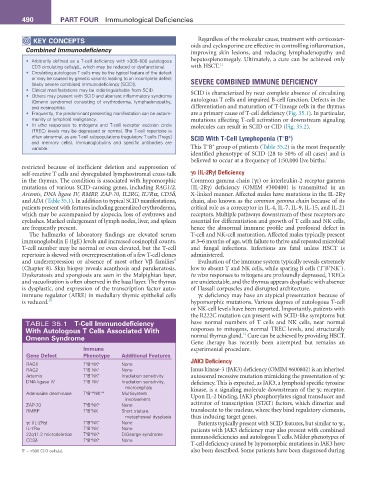
         TABLE 35.1  T-Cell Immunodeficiency                   have normal numbers of T cells and NK cells, near normal
         With autologous T Cells associated With               responses to mitogens, normal TREC  levels, and structurally
                                                                                12
         Omenn Syndrome                                        normal thymus gland.  Cure can be achieved by providing HSCT.
                                                               Gene therapy has recently been attempted but remains an
                            Immune                             experimental procedure.
          Gene Defect       Phenotype    additional features
                               −
                             +
          RAG1              T B NK +     None                  JAK3 Deficiency
          RAG2              T B NK +     None                  Janus kinase-3 (JAK3) deficiency (OMIM #600802) is an inherited
                               −
                             +
                               −
                             +
          Artemis           T B NK +     Irradiation sensitivity  autosomal recessive mutation mimicking the presentation of γc
          DNA ligase IV     T B NK +     Irradiation sensitivity,   deficiency. This is expected, as JAK3, a lymphoid specific tyrosine
                               −
                             +
                                          microcephaly         kinase, is a signaling molecule downstream of the γc receptor.
                               −/+
                             +
          Adenosine deaminase  T B NK −/+  Multisystem         Upon IL-2 binding, JAK3 phosphorylates signal transducer and
                                          involvement
          ZAP-70            T B NK +     None                  activator of transcription (STAT) factors, which dimerize and
                               +
                             +
                               +
                             +
          RMRP              T B NK −     Short stature,        translocate to the nucleus, where they bind regulatory elements,
                                          metaphyseal dysplasia  thus inducing target genes.
                             +
                               +
          γc (IL-2Rγ)       T B NK −     None                     Patients typically present with SCID features, but similar to γc,
          IL-7Rα            T B NK +     None                  patients with JAK3 deficiency may also present with combined
                               +
                             +
                             +
                               +
          22q11.2 microdeletion  T B NK +  DiGeorge syndrome   immunodeficiencies and autologous T cells. Milder phenotypes of
                             +
                               +
          CD3δ              T B NK +     None
                                                               T-cell deficiency caused by hypomorphic mutations in JAK3 have
         +
        T  = >500 CD3 cells/µL                                 also been described. Some patients have been diagnosed during

