


Page 513 - Clinical Immunology_ Principles and Practice ( PDFDrive )
P. 513
CHaPTEr 35  Primary T-Cell Immunodeficiencies               493


                                                                                                        −
                                                                                                          +
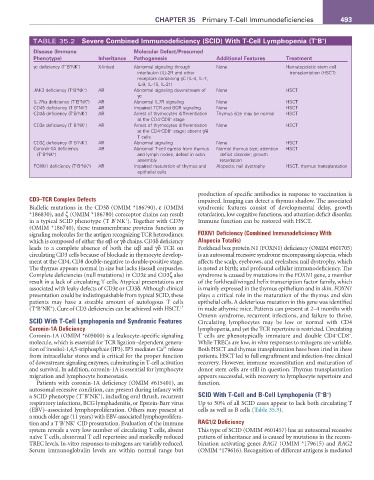
            TABLE 35.2  Severe Combined Immunodeficiency (SCID) With T-Cell Lymphopenia (T B )
            Disease (Immune                  Molecular Defect/Presumed
            Phenotype)           Inheritance  Pathogenesis              additional features    Treatment
                      −
                        +
            γc deficiency (T B NK ) −  X-linked  Abnormal signaling through   None             Hematopoietic stem cell
                                              interleukin (IL)-2R and other                     transplantation (HSCT)
                                              receptors containing γC (IL-4, IL-7,
                                              IL-9, IL-15, IL-21)
                          +
                            −
                         −
            JAK3 deficiency (T B NK )  AR    Abnormal signaling downstream of   None           HSCT
                                              γc
                             +
                         −
                           +
            IL-7Rα deficiency (T B NK )  AR  Abnormal IL7R signaling    None                   HSCT
            CD45 deficiency (T B NK ) +  AR  Impaired TCR and BCR signaling  None              HSCT
                         −
                          +
                             +
                          +
                         −
            CD3δ deficiency (T B NK )  AR    Arrest of thymocytes differentiation   Thymus size may be normal  HSCT
                                              at the CD4 CD8  stage
                                                     −
                                                         −
                          +
                         −
            CD3ε deficiency (T B NK ) +  AR  Arrest of thymocytes differentiation   None       HSCT
                                                     −
                                                         −
                                              at the CD4 CD8  stage; absent γ/δ
                                              T cells
                          +
                         −
            CD3ζ deficiency (T B NK )  AR    Abnormal signaling         None                   HSCT
                             +
            Coronin-1A deficiency   AR       Abnormal T-cell egress from thymus   Normal thymus size; attention   HSCT
              −
                +
             (T B NK )                        and lymph nodes; defect in actin   deficit disorder; growth
                  +
                                              assembly                   retardation
                              +
                          −
                           +
            FOXN1 deficiency (T B NK )  AR   Impaired maturation of thymus and   Alopecia; nail dystrophy  HSCT, thymus transplantation
                                              epithelial cells
                                                                  production of specific antibodies in response to vaccination is
           CD3–TCR Complex Defects                                impaired. Imaging can detect a thymus shadow. The associated
           Biallelic mutations in the CD3δ (OMIM *186790), ε (OMIM   syndromic  features  consist  of developmental  delay,  growth
           *186830), and ζ (OMIM *186780) coreceptor chains can result   retardation, low cognitive functions, and attention deficit disorder.
                                          +
                                     − +
           in a typical SCID phenotype (T B NK ). Together with CD3γ   Immune function can be restored with HSCT.
           (OMIM *186740), these transmembrane proteins function as
           signaling molecules for the antigen recognizing TCR heterodimer,   FOXN1 Deficiency (Combined Immunodeficiency With
           which is composed of either the αβ or γδ chains. CD3δ deficiency   Alopecia Totalis)
           leads to a complete absence of both the  αβ and  γδ TCR on   Forkhead box protein N1 (FOXN1) deficiency (OMIM #601705)
           circulating CD3 cells because of blockade in thymocyte develop-  is an autosomal recessive syndrome encompassing alopecia, which
           ment at the CD4, CD8 double-negative to double-positive stage.   affects the scalp, eyebrows, and eyelashes; nail dystrophy, which
           The thymus appears normal in size but lacks Hassall corpuscles.   is noted at birth; and profound cellular immunodeficiency. The
           Complete deficiencies (null mutations) in CD3ε and CD3ζ also   syndrome is caused by mutations in the FOXN1 gene, a member
           result in a lack of circulating T cells. Atypical presentations are   of the forkhead/winged helix transcription factor family, which
           associated with leaky defects of CD3ε or CD3δ. Although clinical   is mainly expressed in the thymus epithelium and in skin. FOXN1
           presentation could be indistinguishable from typical SCID, these   plays a critical role in the maturation of the thymus and skin
           patients may have a sizeable amount of autologous T cells   epithelial cells. A deleterious mutation in this gene was identified
            + +
                  +
           (T B NK ). Cure of CD3 deficiencies can be achieved with HSCT. 13  in nude athymic mice. Patients can present at 2–4 months with
                                                                  Omenn syndrome, recurrent infections, and failure to thrive.
           SCID With T-Cell Lymphopenia and Syndromic Features    Circulating lymphocytes may be low or normal with CD4
           Coronin-1A Deficiency                                  lymphopenia, and yet the TCR repertoire is restricted. Circulating
                                                                                                                   −
                                                                                                               −
           Coronin-1A (OMIM *605000) is a leukocyte-specific signaling   T cells are phenotypically immature and double CD4 CD8 .
           molecule, which is essential for TCR ligation–dependent genera-  While TRECs are low, in vitro responses to mitogens are variable.
                                                      2+
           tion of inositol-1,4,5-triphosphate (IP3). IP3 mediates Ca  release   Both HSCT and thymus transplantation have been tried in these
           from intracellular stores and is critical for the proper function   patients. HSCT led to full engraftment and infection-free clinical
           of downstream signaling enzymes, culminating in T-cell activation   recovery. However, immune reconstitution and maturation of
           and survival. In addition, coronin-1A is essential for lymphocyte   donor stem cells are still in question. Thymus transplantation
           migration and lymphocyte homeostasis.                  appears successful, with recovery to lymphocyte repertoire and
             Patients with coronin-1A deficiency (OMIM #615401), an   function.
           autosomal recessive condition, can present during infancy with                                 −  −
                            − +
                                 +
           a SCID phenotype (T B NK ), including oral thrush, recurrent   SCID With T-Cell and B-Cell Lymphopenia (T B )
           respiratory infections, BCG lymphadenitis, or Epstein-Barr virus   Up to 30% of all SCID cases appear to lack both circulating T
           (EBV)–associated lymphoproliferation. Others may present at   cells as well as B cells (Table 35.3).
           a much older age (11 years) with EBV-associated lymphoprolifera-
                         +
                    + +
           tion and a T B NK  CID presentation. Evaluation of the immune   RAG1/2 Deficiency
           system reveals a very low number of circulating T cells, absent   This type of SCID (OMIM #601457) has an autosomal recessive
           naïve T cells, abnormal T cell repertoire and markedly reduced   pattern of inheritance and is caused by mutations in the recom-
           TREC levels. In-vitro responses to mitogens are variably reduced.   bination activating genes RAG1 (OMIM *179615) and RAG2
           Serum immunoglobulin levels are within normal range but   (OMIM *179616). Recognition of different antigens is mediated

