


Page 514 - Clinical Immunology_ Principles and Practice ( PDFDrive )
P. 514
494          ParT fOur  Immunological Deficiencies


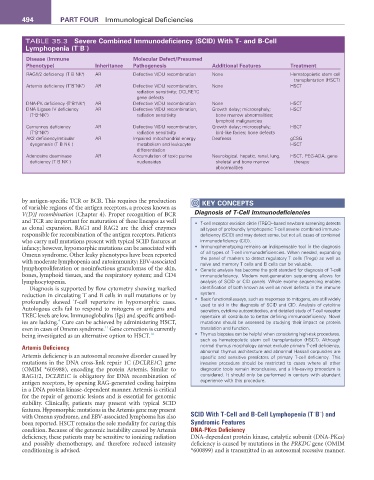
         TABLE 35.3  Severe Combined Immunodeficiency (SCID) With T- and B-Cell
                             −
                           −
         Lymphopenia (T B )
          Disease (Immune                    Molecular Defect/Presumed
          Phenotype)            Inheritance  Pathogenesis             additional features       Treatment
                         −
                        −
          RAG1/2 deficiency (T B NK ) +  AR  Defective V(D)J recombination  None                Hematopoietic stem cell
                                                                                                 transplantation (HSCT)
          Artemis deficiency (T B NK )  AR   Defective V(D)J recombination,   None              HSCT
                            +
                        −
                         −
                                              radiation sensitivity; DCLRE1C
                                              gene defects
                            +
                          −
          DNA-PK deficiency (T B NK )  AR    Defective V(D)J recombination  None                HSCT
                        −
          DNA Ligase IV deficiency   AR      Defective V(D)J recombination,   Growth delay; microcephaly;   HSCT
           (T B NK )                          radiation sensitivity     bone marrow abnormalities;
            −
                +
              −
                                                                        lymphoid malignancies
          Cernunnos deficiency   AR          Defective V(D)J recombination,   Growth delay; microcephaly;   HSCT
            −
                +
              −
           (T B NK )                          radiation sensitivity     bird-like facies; bone defects
          AK2 deficiency/reticular   AR      Impaired mitochondrial energy   Deafness           gCSG
                    −
                        −
                      −
           dysgenesis (T B NK )               metabolism and leukocyte                          HSCT
                                              differentiation
          Adenosine deaminase   AR           Accumulation of toxic purine   Neurological, hepatic, renal, lung,   HSCT, PEG-ADA, gene
           deficiency (T B NK )               nucleosides               skeletal and bone marrow   therapy
                   −
                       −
                     −
                                                                        abnormalities
        by antigen-specific TCR or BCR. This requires the production    KEY CONCEPTS
        of variable regions of the antigen receptors, a process known as
        V(D)J recombination (Chapter 4). Proper recognition of BCR   Diagnosis of T-Cell Immunodeficiencies
        and TCR are important for maturation of these lineages as well   •  T-cell receptor excision circle (TREC)–based newborn screening detects
        as clonal expansion. RAG1 and RAG2 are the chief enzymes   all types of profoundly lymphopenic T-cell severe combined immuno-
        responsible for recombination of the antigen receptors. Patients   deficiency (SCID) and may detect some, but not all, cases of combined
        who carry null mutations present with typical SCID features at   immunodeficiency (CID).
        infancy; however, hypomorphic mutations can be associated with   •  Immunophenotyping remains an indispensable tool in the diagnosis
        Omenn syndrome. Other leaky phenotypes have been reported   of all types of T-cell immunodeficiencies. When needed, expanding
        with moderate lymphopenia and autoimmunity; EBV-associated   the panel of markers to detect regulatory T cells (Tregs) as well as
                                                                   naïve and memory T cells and B cells can be valuable.
        lymphoproliferation or noninfectious granulomas of the skin,   •  Genetic analysis has become the gold standard for diagnosis of T-cell
        bones, lymphoid tissues, and the respiratory system; and CD4   immunodeficiency. Modern next-generation sequencing allows for
        lymphocytopenia.                                           analysis of SCID or CID panels. Whole exome sequencing enables
           Diagnosis is supported by flow cytometry showing marked   identification of both known as well as novel defects in the immune
        reduction in circulating T and B cells in null mutations or by   system.
        profoundly skewed T-cell repertoire in hypomorphic cases.   •  Basic functional assays, such as responses to mitogens, are still widely
                                                                   used to aid in the diagnosis of SCID and CID. Analysis of cytokine
        Autologous cells fail to respond to mitogens or antigens and   secretion, cytokine autoantibodies, and detailed study of T-cell receptor
        TREC levels are low. Immunoglobulins (Igs) and specific antibod-  repertoire all contribute to better defining immunodeficiency. Novel
                    4
        ies are lacking.  Cure can be achieved by administering HSCT,   mutations should be assessed by studying their impact on protein
                                   11
        even in cases of Omenn syndrome.  Gene correction is currently   translation and function.
        being investigated as an alternative option to HSCT. 14  •  Thymus biopsies can be helpful when considering high-risk procedures,
                                                                   such as hematopoietic stem cell transplantation (HSCT). Although
        Artemis Deficiency                                         normal thymus morphology cannot exclude primary T-cell deficiency,
                                                                   abnormal thymus architecture and abnormal Hassall corpuscles are
        Artemis deficiency is an autosomal recessive disorder caused by   specific and sensitive predictors of primary T-cell deficiency. This
        mutations in the DNA cross-link repair 1C (DCLRE1C) gene   invasive procedure should be restricted to cases where all other
        (OMIM *605988), encoding the protein  Artemis. Similar to   diagnostic tools remain inconclusive, and a life-saving procedure is
        RAG1/2,  DCLRE1C is obligatory for DNA recombination of    considered. It should only be performed in centers with abundant
        antigen receptors, by opening RAG-generated coding hairpins   experience with this procedure.
        in a DNA protein kinase-dependent manner. Artemis is critical
        for the repair of genomic lesions and is essential for genomic
        stability. Clinically, patients may present with typical SCID
        features. Hypomorphic mutations in the Artemis gene may present                                −  −
        with Omenn syndrome, and EBV-associated lymphoma has also   SCID With T-Cell and B-Cell Lymphopenia (T B ) and
        been reported. HSCT remains the sole modality for curing this   Syndromic Features
        condition. Because of the genomic instability caused by Artemis   DNA-PKcs Deficiency
        deficiency, these patients may be sensitive to ionizing radiation   DNA-dependent protein kinase, catalytic subunit (DNA-PKcs)
        and possibly chemotherapy, and therefore reduced intensity   deficiency is caused by mutations in the PRKDC gene (OMIM
        conditioning is advised.                               *600899) and is transmitted in an autosomal recessive manner.

