


Page 511 - Clinical Immunology_ Principles and Practice ( PDFDrive )
P. 511
CHaPTEr 35  Primary T-Cell Immunodeficiencies               491


                                                              ADA, γc, JAK3
                                                                deficiency

                                                                                                   NK cell


                                                      DN                                          γδ T cell
                                                    Pro/Pre-T
                                        Thymus                         CD3δ, CD3ε
                                                                       RAG, Artemis
                                                                       deficiencies
                                                                pTα    b        α    β  ZAP 70    αβ T cell
                                                                                                      +
                                                                                      deficiency   CD8
                                                                                 DP
                 Stem        Lymphoid                 DN          DN             CD4+
                  cell       progenitor             Pro/Pre-T     Pre-T
                                                                                 CD8+
                                            ADA, γc,                   CD45, PNP     IL2Rα, CD3γ
                                          JAK3. IL-7Rα                  deficiency    deficiency  αβ T cell
                                           deficiencies                                            CD4 +
                                                                                             HLA
                                                                                         Class II deficiency


                                                                                                   B cell

                                                             ADA, RAG, Artemis
                                                                deficiency
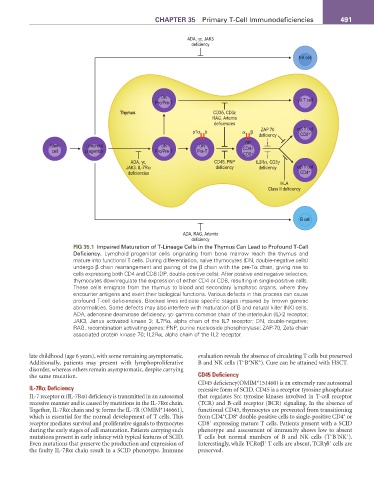
                         fIG 35.1  Impaired Maturation of T-Lineage Cells in the Thymus Can Lead to Profound T-Cell
                         Deficiency. Lymphoid progenitor cells originating from bone marrow reach the thymus and
                         mature into functional T cells. During differentiation, naïve thymocytes (DN, double-negative cells)
                         undergo β chain rearrangement and pairing of the β chain with the pre-Tα chain, giving rise to
                         cells expressing both CD4 and CD8 (DP, double-positive cells). After positive and negative selection,
                         thymocytes downregulate the expression of either CD4 or CD8, resulting in single-positive cells.
                         These cells emigrate from the thymus to blood and secondary lymphatic organs, where they
                         encounter antigens and exert their biological functions. Various defects in this process can cause
                         profound T-cell deficiencies. Blocked lines indicate specific stages impaired by known genetic
                         abnormalities. Some defects may also interfere with maturation of B and natural killer (NK) cells.
                         ADA, adenosine deaminase deficiency; γc- gamma common chain of the interleukin (IL)-2 receptor;
                         JAK3, Janus activated kinase 3; IL7Rα, alpha chain of the IL7 receptor; DN, double-negative;
                         RAG, recombination activating genes; PNP, purine nucleoside phosphorylase; ZAP-70, Zeta chain
                         associated protein kinase 70; IL2Rα, alpha chain of the IL2 receptor.


           late childhood (age 6 years), with some remaining asymptomatic.   evaluation reveals the absence of circulating T cells but preserved
                                                                                      +
                                                                                − +
           Additionally, patients may present with lymphoproliferative   B and NK cells (T B NK ). Cure can be attained with HSCT.
           disorder, whereas others remain asymptomatic, despite carrying
           the same mutation.                                     CD45 Deficiency
                                                                  CD45 deficiency(OMIM*151460) is an extremely rare autosomal
           IL-7Rα Deficiency                                      recessive form of SCID. CD45 is a receptor tyrosine phosphatase
           IL-7 receptor α (IL-7Rα) deficiency is transmitted in an autosomal   that regulates Src tyrosine kinases involved in T-cell receptor
           recessive manner and is caused by mutations in the IL-7Rα chain.   (TCR) and B-cell receptor (BCR) signaling. In the absence of
           Together, IL-7Rα chain and γc forms the IL-7R (OMIM*146661),   functional CD45, thymocytes are prevented from transitioning
                                                                                                                 +
                                                                              +
                                                                          +
           which is essential for the normal development of T cells. This   from CD4 CD8  double-positive cells to single-positive CD4  or
                                                                      +
           receptor mediates survival and proliferative signals to thymocytes   CD8  expressing mature T cells. Patients present with a SCID
           during the early stages of cell maturation. Patients carrying such   phenotype and assessment of immunity shows low to absent
                                                                                                             − +
                                                                                                                  +
           mutations present in early infancy with typical features of SCID.   T  cells  but  normal  numbers  of  B  and  NK  cells  (T B NK ).
                                                                                       +
                                                                                                             +
           Even mutations that preserve the production and expression of   Interestingly, while TCRαβ  T cells are absent, TCRγδ  cells are
           the faulty IL-7Rα chain result in a SCID phenotype. Immune   preserved.

