


Page 522 - Clinical Immunology_ Principles and Practice ( PDFDrive )
P. 522
502          ParT fOur  Immunological Deficiencies


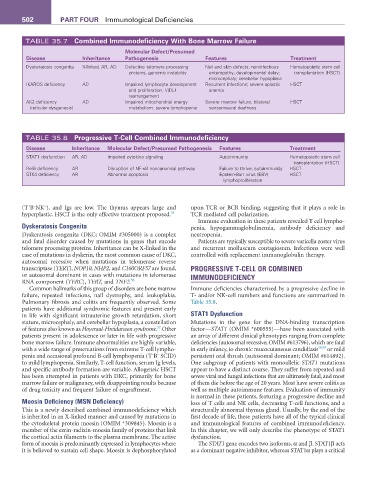
         TABLE 35.7  Combined Immunodeficiency With Bone Marrow failure
                                          Molecular Defect/Presumed
          Disease           Inheritance   Pathogenesis              features                    Treatment
          Dyskeratosis congenita  X-linked, AR, AD  Defective telomere processing   Nail and skin defects; noninfectious   Hematopoietic stem cell
                                           proteins, genomic instability  enteropathy; developmental delay;   transplantation (HSCT)
                                                                     microcephaly; cerebellar hypoplasia
          IKAROS deficiency  AD           Impaired lymphocyte development   Recurrent infections; severe aplastic   HSCT
                                           and proliferation, V(D)J   anemia
                                           rearrangement
          AK2 deficiency    AD            Impaired mitochondrial energy   Severe marrow failure; bilateral   HSCT
           (reticular dysgenesis)          metabolism, severe lymphopenia  sensorineural deafness


         TABLE 35.8  Progressive T-Cell Combined Immunodeficiency

          Disease        Inheritance  Molecular Defect/Presumed Pathogenesis  features          Treatment
          STAT1 dysfunction  AR, AD  Impaired cytokine signaling         Autoimmunity           Hematopoietic stem cell
                                                                                                 transplantation (HSCT)
          RelB deficiency  AR       Disruption of NF-κB noncanonical pathway  Failure to thrive; autoimmunity  HSCT
          STK4 deficiency  AR       Abnormal apoptosis                   Epstein-Barr virus (EBV)   HSCT
                                                                          lymphoproliferation


               −
          + −
        (T B NK ), and Igs are low. The thymus appears large and   upon TCR or BCR binding, suggesting that it plays a role in
        hyperplastic. HSCT is the only effective treatment proposed. 55  TCR mediated cell polarization.
                                                                  Immune evaluation in these patients revealed T cell lympho-
        Dyskeratosis Congenita                                 penia,  hypogammaglobulinemia, antibody deficiency  and
        Dyskeratosis congenita (DKC; OMIM #305000) is a complex   neutropenia.
        and  fatal disorder caused by mutations in  genes  that  encode   Patients are typically susceptible to severe varicella zoster virus
        telomere processing proteins. Inheritance can be X-linked in the   and recurrent molluscum contagiosum. Infections were well
        case of mutations in dyskerin, the most common cause of DKC,   controlled with replacement immunoglobulin therapy.
        autosomal recessive when mutations in telomerase reverse
        transcriptase (TERT), NOP10, NHP2, and C160ORF57 are found,   PROGRESSIVE T-CELL OR COMBINED
        or autosomal dominant in cases with mutations in telomerase   IMMUNODEFICIENCY
        RNA component (TERC), TERT, and TNF2. 56
           Common hallmarks of this group of disorders are bone marrow   Immune deficiencies characterized by a progressive decline in
        failure, repeated infections, nail dystrophy, and leukoplakia.   T- and/or NK-cell numbers and functions are summarized in
        Pulmonary fibrosis and colitis are frequently observed. Some   Table 35.8.
        patients have additional syndromic features and present early
        in life with significant intrauterine growth retardation, short   STAT1 Dysfunction
        stature, microcephaly, and cerebellar hypoplasia, a constellation   Mutations in the gene for the DNA-binding transcription
                                                    57
        of features also known as Hoyeraal-Hreidarsson syndrome.  Other   factor—STAT1 (OMIM *600555)—have been associated with
        patients present in adolescence or later in life with progressive   an array of different clinical phenotypes ranging from complete
        bone marrow failure. Immune abnormalities are highly variable,   deficiencies (autosomal recessive; OMIM #613796), which are fatal
        with a wide range of presentations from extreme T-cell lympho-  in early infancy, to chronic mucocutaneous candidiasis 58,59  or mild
                                                   − −
        penia and occasional profound B-cell lymphopenia (T B  SCID)   persistent oral thrush (autosomal dominant; OMIM #614892).
        to mild lymphopenia. Similarly, T-cell function, serum Ig levels,   One subgroup of patients with monoallelic STAT1 mutations
        and specific antibody formation are variable. Allogeneic HSCT   appear to have a distinct course. They suffer from repeated and
        has been attempted in patients with DKC, primarily for bone   severe viral and fungal infections that are ultimately fatal, and most
        marrow failure or malignancy, with disappointing results because   of them die before the age of 20 years. Most have severe colitis as
        of drug toxicity and frequent failure of engraftment.  well as multiple autoimmune features. Evaluation of immunity
                                                               is normal in these patients, featuring a progressive decline and
        Moesin Deficiency (MSN Deficiency)                     loss of T cells and NK cells, decreasing T-cell functions, and a
        This is a newly described combined immunodeficiency which   structurally abnormal thymus gland. Usually, by the end of the
        is inherited in an X-linked manner and caused by mutations in   first decade of life, these patients have all of the typical clinical
        the cytoskeletal protein moesin (OMIM *309845). Moesin is a   and immunological features of combined immunodeficiency.
        member of the ezrin-radixin-moesin family of proteins that link   In this chapter, we will only describe the phenotype of STAT1
        the cortical actin filaments to the plasma membrane. The active   dysfunction.
        form of moesin is predominantly expressed in lymphocytes where   The STAT1 gene encodes two isoforms, α and β. STAT1β acts
        it is believed to sustain cell shape. Moesin is dephosphorylated   as a dominant negative inhibitor, whereas STAT1α plays a critical

