


Page 518 - Clinical Immunology_ Principles and Practice ( PDFDrive )
P. 518
498          ParT fOur  Immunological Deficiencies


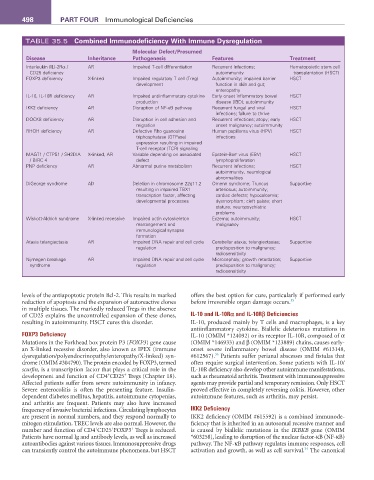
         TABLE 35.5  Combined Immunodeficiency With Immune Dysregulation
                                            Molecular Defect/Presumed
          Disease             Inheritance   Pathogenesis              features                  Treatment
          Interleukin (IL)-2Rα /   AR       Impaired T-cell differentiation  Recurrent infections;   Hematopoietic stem cell
           CD25 deficiency                                              autoimmunity             transplantation (HSCT)
          FOXP3 deficiency    X-linked      Impaired regulatory T cell (Treg)   Autoimmunity; impaired barrier   HSCT
                                              development               function in skin and gut;
                                                                        enteropathy
          IL-10, IL-10R deficiency  AR      Impaired antiinflammatory cytokine   Early onset inflammatory bowel   HSCT
                                              production                disease (IBD); autoimmunity
          IKK2 deficiency     AR            Disruption of NF-κB pathway  Recurrent fungal and viral   HSCT
                                                                        infections; failure to thrive
          DOCK8 deficiency    AR            Disruption in cell adhesion and   Recurrent infections; atopy; early   HSCT
                                              migration                 onset malignancy; autoimmunity
          RHOH deficiency     AR            Defective Rho guanosine   Human papilloma virus (HPV)   HSCT
                                              triphosphatase (GTPase)   infections
                                              expression resulting in impaired
                                              T-cell receptor (TCR) signaling
          MAGT1 / CTPS1 / SH2DIA   X-linked, AR  Variable depending on associated   Epstein-Barr virus (EBV)   HSCT
           / BIRC 4                           defect                    lymphoproliferation
          PNP deficiency      AR            Abnormal purine metabolism  Recurrent infections;   HSCT
                                                                        autoimmunity, neurological
                                                                        abnormalities
          DiGeorge syndrome   AD            Deletion in chromosome 22q11.2   Omenn syndrome; Truncus   Supportive
                                              resulting in impaired TBX1   arteriosus; autoimmunity;
                                              transcription factor, affecting   cardiac defects; hypocalcemia;
                                              developmental processes   dysmorphism; cleft palate; short
                                                                        stature; neuropsychiatric
                                                                        problems
          Wiskott-Aldrich syndrome  X-linked recessive  Impaired actin cytoskeleton   Eczema; autoimmunity;   HSCT
                                              rearrangement and         malignancy
                                              immunological synapse
                                              formation
          Ataxia telangiectasia  AR         Impaired DNA repair and cell cycle   Cerebellar ataxia; telangiectasias;   Supportive
                                              regulation                predisposition to malignancy;
                                                                        radiosensitivity
          Nijmegen breakage   AR            Impaired DNA repair and cell cycle   Microcephaly; growth retardation;   Supportive
           syndrome                           regulation                predisposition to malignancy;
                                                                        radiosensitivity


        levels of the antiapoptotic protein Bcl-2. This results in marked   offers the best option for cure, particularly if performed early
        reduction of apoptosis and the expansion of autoreactive clones   before irreversible organ damage occurs. 35
        in multiple tissues. The markedly reduced Tregs in the absence
        of CD25 explains the uncontrolled expansion of these clones,   IL-10 and IL-10Rα and IL-10Rβ Deficiencies
        resulting in autoimmunity. HSCT cures this disorder.   IL-10, produced mainly by T cells and macrophages, is a key
                                                               antiinflammatory cytokine. Biallelic deleterious mutations in
        FOXP3 Deficiency                                       IL-10 (OMIM *124092) or its receptor IL-10R, composed of α
        Mutations in the Forkhead box protein P3 (FOXP3) gene cause   (OMIM *146933) and β (OMIM *123889) chains, causes early-
        an X-linked recessive disorder, also known as IPEX (immune   onset  severe  inflammatory bowel  disease  (OMIM  #613148,
                                                                       36
        dysregulation/polyendocrinopathy/enteropathy/X-linked) syn-  #612567).  Patients suffer perianal abscesses and fistulas that
        drome (OMIM #304790). The protein encoded by FOXP3, termed   often require surgical intervention. Some patients with IL-10/
        scurfin, is a transcription factor that plays a critical role in the   IL-10R deficiency also develop other autoimmune manifestations,
                                    +
                                          +
        development and function of CD4 CD25  Tregs (Chapter 18).   such as rheumatoid arthritis. Treatment with immunosuppressive
        Affected patients suffer from severe autoimmunity in infancy.   agents may provide partial and temporary remission. Only HSCT
        Severe enterocolitis is often the presenting feature. Insulin-  proved effective in completely reversing colitis. However, other
        dependent diabetes mellitus, hepatitis, autoimmune cytopenias,   autoimmune features, such as arthritis, may persist.
        and arthritis are frequent. Patients may also have increased
        frequency of invasive bacterial infections. Circulating lymphocytes   IKK2 Deficiency
        are present in normal numbers, and they respond normally to   IKK2 deficiency (OMIM #615592) is a combined immunode-
        mitogen stimulation. TREC levels are also normal. However, the   ficiency that is inherited in an autosomal recessive manner and
                                            +
                                      +
                                +
        number and function of CD4 CD25 FOXP3  Tregs is reduced.   is caused by biallelic mutations in the  IKBKB gene (OMIM
        Patients have normal Ig and antibody levels, as well as increased   *603258), leading to disruption of the nuclear factor-κB (NF-κB)
        autoantibodies against various tissues. Immunosuppressive drugs   pathway. The NF-κB pathway regulates immune responses, cell
                                                                                                     34
        can transiently control the autoimmune phenomena, but HSCT   activation and growth, as well as cell survival.  The canonical

