


Page 521 - Clinical Immunology_ Principles and Practice ( PDFDrive )
P. 521
CHaPTEr 35  Primary T-Cell Immunodeficiencies               501


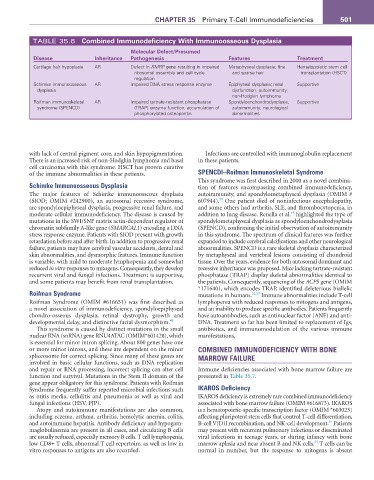
            TABLE 35.6  Combined Immunodeficiency With Immunoosseous Dysplasia
                                            Molecular Defect/Presumed
            Disease             Inheritance  Pathogenesis                   features              Treatment
            Cartilage hair hypoplasia  AR   Defect in RMRP gene resulting in impaired   Metaphyseal dysplasia; fine   Hematopoietic stem cell
                                             ribosomal assembly and cell cycle   and sparse hair   transplantation (HSCT)
                                             regulation
            Schimke immunoosseous   AR      Impaired DNA stress response enzyme  Epiphyseal dysplasia; renal   Supportive
             dysplasia                                                       dysfunction; autoimmunity;
                                                                             non-Hodgkin lymphoma
            Roifman immunoskeletal   AR     Impaired tartrate-resistant phosphatase   Spondyloenchondrodysplasia;   Supportive
             syndrome (SPENCD)               (TRAP) enzyme function, accumulation of   autoimmunity; neurological
                                             phosphorylated osteopontin      abnormalities


           with lack of central pigment core, and skin hypopigmentation.   Infections are controlled with immunoglobulin replacement
           There is an increased risk of non-Hodgkin lymphoma and basal   in these patients.
           cell carcinoma with this syndrome. HSCT has proven curative
           of the immune abnormalities in these patients.         SPENCDI–Roifman Immunoskeletal Syndrome
                                                                  This syndrome was first described in 2000 as a novel combina-
           Schimke Immunoosseous Dysplasia                        tion of features encompassing combined immunodeficiency,
           The major features of Schimke immunoosseous dysplasia   autoimmunity, and spondylometaphyseal dysplasia (OMIM #
                                                                         50
           (SIOD; OMIM #242900), an autosomal recessive syndrome,   607944).  One patient died of noninfectious encephalopathy,
           are spondyloepiphyseal dysplasia, progressive renal failure, and   and some others had arthritis, SLE, and thrombocytopenia, in
                                                                                                45
           moderate cellular immunodeficiency. The disease is caused by   addition to lung disease. Renella et al.  highlighted the type of
           mutations in the SWI/SNF matrix actin-dependent regulator of   spondylometaphyseal dysplasia as spondyloenchondrodysplasia
           chromatin subfamily A-like gene (SMARCAL1) encoding a DNA   (SPENCD), confirming the initial observation of autoimmunity
           stress response enzyme. Patients with SIOD present with growth   in this syndrome. The spectrum of clinical features was further
           retardation before and after birth. In addition to progressive renal   expanded to include cerebral calcifications and other neurological
           failure, patients may have cerebral vascular accidents, dental and   abnormalities. SPENCD is a rare skeletal dysplasia characterized
           skin abnormalities, and dysmorphic features. Immune function   by metaphyseal and vertebral lesions consisting of chondroid
           is variable, with mild to moderate lymphopenia and somewhat   tissue. Over the years, evidence for both autosomal dominant and
           reduced in vitro responses to mitogens. Consequently, they develop   recessive inheritance was proposed. Mice lacking tartrate-resistant
           recurrent viral and fungal infections. Treatment is supportive,   phosphatase (TRAP) display skeletal abnormalities identical to
           and some patients may benefit from renal transplantation.  the patients. Consequently, sequencing of the ACP5 gene (OMIM
                                                                  *171640), which encodes TRAP, identified deleterious biallelic
           Roifman Syndrome                                       mutations in humans. 52,53  Immune abnormalities include T-cell
           Roifman Syndrome (OMIM #616651) was first described as   lymphopenia with reduced responses to mitogens and antigens,
           a novel association of immunodeficiency, spondyloepiphyseal   and an inability to produce specific antibodies. Patients frequently
           chondro-osseous dysplasia, retinal dystrophy, growth and   have autoantibodies, such as antinuclear factor (ANF) and anti-
           developmental delay, and distinctive facial dysmorphism. 49  DNA. Treatment so far has been limited to replacement of Igs,
             This syndrome is caused by distinct mutations in the small   antibiotics, and immunomodulation of the various immune
           nuclear RNA (snRNA) gene RNU4ATAC (OMIM*601428), which   manifestations.
           is essential for minor intron splicing. About 800 genes have one
           or more minor introns, and these are dependent on the minor   COMBINED IMMUNODEFICIENCY WITH BONE
           spliceosome for correct splicing. Since many of these genes are   MARROW FAILURE
           involved in basic cellular functions, such as DNA replication
           and repair or RNA processing, incorrect splicing can alter cell   Immune deficiencies associated with bone marrow failure are
           function and survival. Mutations in the Stem II domain of the   presented in Table 35.7.
           gene appear obligatory for this syndrome. Patients with Roifman
           Syndrome frequently suffer repeated microbial infections such   IKAROS Deficiency
           as otitis media, cellulitis and pneumonia as well as viral and   IKAROS deficiency is extremely rare combined immunodeficiency
           fungal infections (HSV, PJP).                          associated with bone marrow failure (OMIM #616873). IKAROS
             Atopy and autoimmune manifestations are also common,   is a hematopoietic-specific transcription factor (OMIM *603023)
           including eczema, asthma, arthritis, hemolytic anemia, colitis,   affecting pluripotent stem cells that control T-cell differentiation,
                                                                                                             54
           and autoimmune hepatitis. Antibody deficiency and hypogam-  B-cell V(D)J recombination, and NK-cell development.  Patients
           maglobulinemia are present in all cases, and circulating B cells   may present with recurrent pulmonary infections or disseminated
           are usually reduced, especially memory B cells. T cell lymphopenia,   viral infections in teenage years, or during infancy with bone
                                                                                                        55
           low CD8+ T cells, abnormal T cell repertoire, as well as low in   marrow aplasia and near absent B and NK cells.  T cells can be
           vitro responses to antigens are also recorded.         normal in number, but the response to mitogens is absent

