


Page 638 - Clinical Immunology_ Principles and Practice ( PDFDrive )
P. 638
CHaPter 44  Atopic and Contact Dermatitis              613


           and severe bacterial infections. Hyper-IgE syndrome (HIES) with   immunity, interleukin-1 (IL-1) family signaling, Tregs, the vitamin
           mutations in the signal transducer and activator of transcription   D pathway, and the nerve growth factor pathway in the pathogenesis
                                                                       9
           3 gene (STAT3) is an autosomal dominant multisystem disorder   of AD.  Thus a combination of varied genetic factors may influence
           characterized by recurrent deep-seated bacterial infections,   a wide range of phenotypes of AD among individuals.
           including cutaneous cold abscesses and pneumonias caused by
           S. aureus. Patients with mutations in the gene encoding dedicator   Immune Abnormalities in Atopic Dermatitis
           of cytokinesis 8 protein (DOCK8) have an immunodeficiency   Immunohistology
           with eczema, recurrent viral infections, including some with   On the basis of clinical appearance and duration of illness, AD
           CNS  involvement,  and  many  have  associated  food  allergies.   skin can be characterized as nonlesional AD, acute AD lesions
           Patients with tyrosine kinase 2 (TYK2) deficiency can also present   (≤3 days after onset), and chronic skin lesions. Nonlesional AD
           with an eczematous rash with high serum IgE and recurrent   skin is not normal and is characterized by a sparse perivascular
           cutaneous staphylococcal infections. Other diseases to consider   T-cell infiltrate, suggesting the presence of minimal inflammation
           in the differential diagnosis of  AD include cutaneous T-cell   at baseline. Langerhans cells (LCs) also exhibit surface-bound
           lymphoma, especially in adults with no history of childhood   IgE molecules, which have enhanced capacity to present allergen
           eczema and without other atopic features, human immunode-  to T cells. In acute lesions, there is epidermal spongiosis with
           ficiency virus (HIV) infection, and CD (see section on ACD).   an increased infiltration of activated memory T cells bearing
           Contact allergy can also complicate AD, especially in patients   the skin-homing cutaneous lymphocyte-associated antigen
                                                                      +
           whose AD does not respond to or worsens with therapy.  (CLA ). Eosinophils, basophils, and neutrophils are rare. Mast
                                                                  cells are seen in various stages of degranulation.
           PATHOGENESIS OF ATOPIC DERMATITIS                        Chronic lichenified AD lesions are characterized by epidermal
                                                                  hyperplasia, prominent hyperkeratosis, and an increased number
           Genetics                                               of dendritic cells (DCs) bearing surface IgE. Macrophages domi-
           The genetics of AD are complex with key roles played by skin   nate the dermal mononuclear cell infiltrate, but lymphocytes
           barrier or epidermal differentiation genes and immune response   remain prominent. Although intact eosinophils are rarely seen,
           or host defense genes.                                 eosinophil product deposition can be readily identified, suggesting
                                                                  they contribute to allergic skin inflammation.
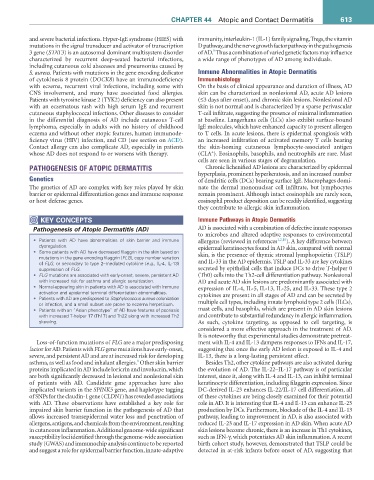
               KeY CONCePtS                                       Immune Pathways in Atopic Dermatitis
            Pathogenesis of Atopic Dermatitis (AD)                AD is associated with a combination of defective innate responses
                                                                  to microbes and altered adaptive responses to environmental
            •  Patients with AD have abnormalities of skin barrier and immune   allergens (reviewed in references 1,2,10 ). A key difference between
              dysregulation.                                      epidermal keratinocytes found in AD skin, compared with normal
            •  Some patients with AD have decreased filaggrin in the skin based on   skin, is the presence of thymic stromal lymphopoietin (TSLP)
              mutations in the gene encoding filaggrin (FLG), copy number variation
              of FLG, or secondary to type 2–mediated cytokine (e.g., IL-4, IL-13)   and IL-33 in the AD epidermis. TSLP and IL-33 are key cytokines
              suppression of FLG.                                 secreted by epithelial cells that induce DCs to drive T-helper 0
            •  FLG mutations are associated with early-onset, severe, persistent AD   (Th0) cells into the Th2-cell differentiation pathway. Nonlesional
              with increased risk for asthma and allergic sensitization.  AD and acute AD skin lesions are predominantly associated with
            •  Normal-appearing skin in patients with AD is associated with immune   expression of IL-4, IL-5, IL-13, IL-25, and IL-33. These type 2
              activation and epidermal terminal differentiation abnormalities.  cytokines are present in all stages of AD and can be secreted by
            •  Patients with AD are predisposed to Staphylococcus aureus colonization
              or infection, and a small subset are prone to eczema herpeticum.  multiple cell types, including innate lymphoid type 2 cells (ILCs),
            •  Patients with an “Asian phenotype” of AD have features of psoriasis   mast cells, and basophils, which are present in AD skin lesions
              with increased T-helper 17 (Th17) and Th22 along with increased Th2   and contribute to substantial redundancy in allergic inflammation.
              skewing.                                            As  such,  cytokine  targeting,  as  opposed  to  cell  targeting,  is
                                                                  considered a more effective approach in the treatment of AD.
                                                                  It is noteworthy that experimental studies demonstrate pretreat-
             Loss-of-function mutations of FLG are a major predisposing   ment with IL-4 and IL-13 dampens responses to IFNs and IL-17,
           factor for AD. Patients with FLG gene mutations have early-onset,   suggesting that once the early AD lesion is exposed to IL-4 and
           severe, and persistent AD and are at increased risk for developing   IL-13, there is a long-lasting persistent effect.
                                              8
           asthma, as well as food and inhalant allergies.  Other skin barrier   Besides Th2, other cytokine pathways are also activated during
           proteins implicated in AD include loricrin and involucrin, which   the evolution of AD. The IL-22–IL-17 pathway is of particular
           are both significantly decreased in lesional and nonlesional skin   interest, since it, along with IL-4 and IL-13, can inhibit terminal
           of patients with  AD. Candidate gene approaches have also   keratinocyte differentiation, including filaggrin expression. Since
           implicated variants in the SPINK5 gene, and haplotype tagging   DC-derived IL-23 enhances IL-22/IL-17 cell differentiation, all
           of SNPs for the claudin-1 gene (CLDN1) has revealed associations   of these cytokines are being closely examined for their potential
           with  AD. These observations have established a key role for   role in AD. It is interesting that IL-4 and Il-13 can enhance IL-23
           impaired skin barrier function in the pathogenesis of AD that   production by DCs. Furthermore, blockade of the IL-4 and IL-13
           allows increased transepidermal water loss and penetration of   pathway, leading to improvement in AD, is also associated with
           allergens, antigens, and chemicals from the environment, resulting   reduced IL-23 and IL-17 expression in AD skin. When acute AD
           in cutaneous inflammation. Additional genome-wide significant   skin lesions become chronic, there is an increase in Th1 cytokines,
           susceptibility loci identified through the genome-wide association   such as IFN-γ, which potentiates AD skin inflammation. A recent
           study (GWAS) and immunochip analysis continue to be reported   birth cohort study, however, demonstrated that TSLP could be
           and suggest a role for epidermal barrier function, innate-adaptive   detected in at-risk infants before onset of AD, suggesting that

