


Page 653 - Clinical Immunology_ Principles and Practice ( PDFDrive )
P. 653
CHaPTEr 45  Food Allergy             627


             FPIES is a non–IgE-mediated disease usually occurring in    KEY CONCEPTS
                10
           infants.  Characteristic symptoms of FPIES manifest as repetitive
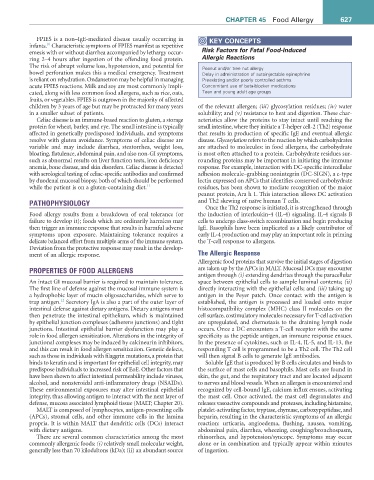
           emesis with or without diarrhea accompanied by lethargy occur-  Risk Factors for Fatal Food-Induced
           ring 2–4 hours after ingestion of the offending food protein.   Allergic Reactions
           The risk of abrupt volume loss, hypotension, and potential for   Peanut and/or tree nut allergy
           bowel perforation makes this a medical emergency. Treatment   Delay in administration of autoinjectable epinephrine
           is reliant on rehydration. Ondansetron may be helpful in managing   Preexisting and/or poorly controlled asthma
           acute FPIES reactions. Milk and soy are most commonly impli-  Concomitant use of beta-blocker medications
           cated, along with less common food allergens, such as rice, oats,   Teen and young adult age groups
           fruits, or vegetables. FPIES is outgrown in the majority of affected
           children by 3 years of age but may be protracted for many years   of the relevant allergen; (iii) glycosylation residues; (iv) water
           in a smaller subset of patients.                       solubility; and (v) resistance to heat and digestion. These char-
             Celiac disease is an immune-based reaction to gluten, a storage   acteristics allow the proteins to stay intact until reaching the
           protein for wheat, barley, and rye. The small intestine is typically   small intestine, where they initiate a T-helper cell-2 (Th2) response
           affected in genetically predisposed individuals, and symptoms   that results in production of specific IgE and eventual allergic
           resolve with gluten avoidance. Symptoms of celiac disease are   disease. Glycosylation refers to the reaction by which carbohydrates
           variable and may include diarrhea, steatorrhea, weight loss,   are attached to molecules: in food allergens, the carbohydrate
           bloating, flatulence, abdominal pain, and also non-GI symptoms,   is most often attached to a protein. Carbohydrate residues sur-
           such as abnormal results on liver function tests, iron deficiency   rounding proteins may be important in initiating the immune
           anemia, bone disease, and skin disorders. Celiac disease is detected   response. For example, interaction with DC-specific intercellular
           with serological testing of celiac-specific antibodies and confirmed   adhesion molecule–grabbing nonintegrin (DC-SIGN), a c-type
           by duodenal mucosal biopsy, both of which should be performed   lectin expressed on APCs that identifies conserved carbohydrate
           while the patient is on a gluten-containing diet. 11   residues, has been shown to mediate recognition of the major
                                                                  peanut protein, Ara h 1. This interaction allows DC activation
           PATHOPHYSIOLOGY                                        and Th2 skewing of naïve human T cells.
                                                                    Once the Th2 response is initiated, it is strengthened through
           Food allergy results from a breakdown of oral tolerance (or   the induction of interleukin-4 (IL-4) signaling. IL-4 signals B
           failure to develop it); foods which are ordinarily harmless may   cells to undergo class-switch recombination and begin producing
           then trigger an immune response that results in harmful adverse   IgE. Basophils have been implicated as a likely contributor of
           symptoms upon exposure. Maintaining tolerance requires a   early IL-4 production and may play an important role in priming
           delicate balanced effort from multiple arms of the immune system.   the T-cell response to allergens.
           Deviation from the protective response may result in the develop-
           ment of an allergic response.                          The Allergic Response
                                                                  Allergenic food proteins that survive the initial stages of digestion
           PROPERTIES OF FOOD ALLERGENS                           are taken up by the APCs in MALT. Mucosal DCs may encounter
                                                                  antigen through (i) extending dendrites through the paracellular
           An intact GI mucosal barrier is required to maintain tolerance.   space between epithelial cells to sample luminal contents; (ii)
           The first line of defense against the mucosal immune system is   directly interacting with the epithelial cells; and (iii) taking up
           a hydrophobic layer of mucin oligosaccharides, which serve to   antigen in the Peyer patch. Once contact with the antigen is
                     12
           trap antigen.  Secretory IgA is also a part of the outer layer of   established, the  antigen  is processed  and  loaded  onto  major
           intestinal defense against dietary antigens. Dietary antigens must   histocompatibility complex (MHC) class II molecules on the
           then penetrate the intestinal epithelium, which is maintained   cell surface, costimulatory molecules necessary for T-cell activation
           by epithelial junction complexes (adherens junctions) and tight   are upregulated, and chemotaxis to the draining lymph node
           junctions. Intestinal epithelial barrier dysfunction may play a   occurs. Once a DC encounters a T-cell receptor with the same
           role in food allergen sensitization. Alterations in the integrity of   specificity as the peptide antigen, an immune response ensues.
           junctional complexes may be induced by calcineurin inhibitors,   In the presence of cytokines, such as IL-4, IL-5, and IL-13, the
           and this can result in food allergen sensitization. Genetic defects,   responding T cell is programmed to be a Th2 cell. The Th2 cell
           such as those in individuals with filaggrin mutations, a protein that   will then signal B cells to generate IgE antibodies.
           binds to keratin and is important for epithelial cell integrity, may   Soluble IgE that is produced by B cells circulates and binds to
           predispose individuals to increased risk of EoE. Other factors that   the surface of mast cells and basophils. Mast cells are found in
           have been shown to affect intestinal permeability include viruses,   skin, the gut, and the respiratory tract and are located adjacent
           alcohol, and nonsteroidal anti-inflammatory drugs (NSAIDs).   to nerves and blood vessels. When an allergen is encountered and
           These environmental exposures may alter intestinal epithelial   recognized by cell-bound IgE, calcium influx ensues, activating
           integrity, thus allowing antigen to interact with the next layer of   the mast cell. Once activated, the mast cell degranulates and
           defense, mucosa associated lymphoid tissue (MALT; Chapter 20).  releases vasoactive compounds and proteases, including histamine,
             MALT is composed of lymphocytes, antigen-presenting cells   platelet-activating factor, tryptase, chymase, carboxypeptidase, and
           (APCs), stromal cells, and other immune cells in the lamina   heparin, resulting in the characteristic symptoms of an allergic
           propria. It is within MALT that dendritic cells (DCs) interact   reaction: urticaria, angioedema, flushing, nausea, vomiting,
           with dietary antigens.                                 abdominal pain, diarrhea, wheezing, coughing/bronchospasm,
             There are several common characteristics among the most   rhinorrhea, and hypotension/syncope. Symptoms may occur
           commonly allergenic foods: (i) relatively small molecular weight,   alone or in combination and typically appear within minutes
           generally less than 70 kilodaltons (kDa); (ii) an abundant source   of ingestion.

