


Page 652 - Clinical Immunology_ Principles and Practice ( PDFDrive )
P. 652
626          ParT FIVE  Allergic Diseases


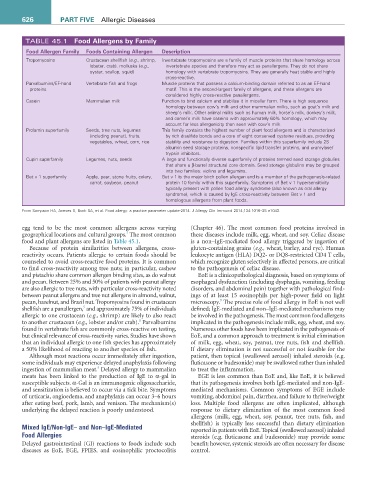
         TABLE 45.1  Food allergens by Family
          Food allergen Family  Foods Containing allergen  Description
          Tropomyosins       Crustacean shellfish (e.g., shrimp,   Invertebrate tropomyosins are a family of muscle proteins that share homology across
                              lobster, crab), mollusks (e.g.,   invertebrate species and therefore may act as panallergens. They do not share
                              oyster, scallop, squid)  homology with vertebrate tropomyosins. They are generally heat stable and highly
                                                       cross-reactive.
          Parvalbumins/EF-hand   Vertebrate fish and frogs  Muscle proteins that possess a calcium-binding domain referred to as an EF-hand
           proteins                                    motif. This is the second-largest family of allergens, and these allergens are
                                                       considered highly cross-reactive panallergens.
          Casein             Mammalian milk           Function to bind calcium and stabilize it in micellar form. There is high sequence
                                                       homology between cow’s milk and other mammalian milks, such as goat’s milk and
                                                       sheep’s milk. Other animal milks such as human milk, horse’s milk, donkey’s milk,
                                                       and camel’s milk have caseins with approximately 60% homology, which may
                                                       account for less allergenicity than seen with cow’s milk.
          Prolamin superfamily  Seeds, tree nuts, legumes   This family contains the highest number of plant food allergens and is characterized
                              (including peanut), fruits,   by rich disulfide bonds and a core of eight conserved cysteine residues, providing
                              vegetables, wheat, corn, rice  stability and resistance to digestion. Families within this superfamily include 2S
                                                       albumin seed storage proteins, nonspecific lipid transfer proteins, and α-amylase/
                                                       trypsin inhibitors.
          Cupin superfamily  Legumes, nuts, seeds     A large and functionally diverse superfamily of proteins termed seed storage globulins
                                                       that share a β-barrel structural core domain. Seed storage globulins may be grouped
                                                       into two families: vicilins and legumins.
          Bet v 1 superfamily  Apple, pear, stone fruits, celery,   Bet v 1 is the major birch pollen allergen and is a member of the pathogenesis-related
                              carrot, soybean, peanut  protein 10 family within this superfamily. Symptoms of Bet v 1 hypersensitivity
                                                       typically present with pollen food allergy syndrome (also known as oral allergy
                                                       syndrome), which is caused by IgE cross-reactivity between Bet v 1 and
                                                       homologous allergens from plant foods.
        From Sampson HA, Aceves S, Bock SA, et al. Food allergy: a practice parameter update-2014. J Allergy Clin Immunol 2014;134:1016–25 e1043.


        egg tend to be the most common allergens across varying   (Chapter 46). The most common food proteins involved in
                                          7
        geographical locations and cultural groups.  The most common   these diseases include milk, egg, wheat, and soy. Celiac disease
        food and plant allergens are listed in Table 45.1.     is a non–IgE-mediated food allergy triggered by ingestion of
           Because of protein similarities between allergens, cross-  gluten-containing grains (e.g., wheat, barley, and rye). Human
        reactivity occurs. Patients allergic to certain foods should be   leukocyte antigen (HLA) DQ2- or DQ8-restricted CD4 T cells,
        counseled to avoid cross-reactive food proteins. It is common   which recognize gluten selectively in affected persons, are critical
        to find cross-reactivity among tree nuts; in particular, cashew   to the pathogenesis of celiac disease.
        and pistachio share common allergen binding sites, as do walnut   EoE is a clinicopathological diagnosis, based on symptoms of
        and pecan. Between 25% and 50% of patients with peanut allergy   esophageal dysfunction (including dysphagia, vomiting, feeding
        are also allergic to tree nuts, with particular cross-reactivity noted   disorders, and abdominal pain) together with pathological find-
        between peanut allergens and tree nut allergens in almond, walnut,   ings of at least 15 eosinophils per high-power field on light
                                                                         9
        pecan, hazelnut, and Brazil nut. Tropomyosins found in crustacean   microscopy.  The precise role of food allergy in EoE is not well
                            5
        shellfish are a panallergen,  and approximately 75% of individuals   defined; IgE-mediated and non–IgE-mediated mechanisms may
        allergic to one crustacean (e.g., shrimp) are likely to also react   be involved in the pathogenesis. The most common food allergens
                                               8
        to another crustacean (e.g., lobster and/or crab).  Parvalbumins   implicated in the pathogenesis include milk, egg, wheat, and soy.
        found in vertebrate fish are commonly cross-reactive on testing,   Numerous other foods have been implicated in the pathogenesis of
        but clinical relevance of cross-reactivity varies. Studies have shown   EoE, and a common approach to treatment is initial elimination
        that an individual allergic to one fish species has approximately   of milk, egg, wheat, soy, peanut, tree nuts, fish and shellfish.
        a 50% likelihood of reacting to another species of fish.  If dietary elimination is not successful or not feasible for the
           Although most reactions occur immediately after ingestion,   patient, then topical (swallowed aerosol) inhaled steroids (e.g.
        some individuals may experience delayed anaphylaxis following   fluticasone or budesonide) may be swallowed rather than inhaled
                                 5
        ingestion of mammalian meat.  Delayed allergy to mammalian   to treat the inflammation.
        meats has been linked to the production of IgE to  α-gal in   EGE is less common than EoE and, like EoE, it is believed
        susceptible subjects. α-Gal is an immunogenic oligosaccharide,   that its pathogenesis involves both IgE-mediated and non-IgE-
        and sensitization is believed to occur via a tick bite. Symptoms   mediated mechanisms. Common symptoms of EGE include
        of urticaria, angioedema, and anaphylaxis can occur 3–6 hours   vomiting, abdominal pain, diarrhea, and failure to thrive/weight
        after eating beef, pork, lamb, and venison. The mechanism(s)   loss. Multiple food allergens are often implicated, although
        underlying the delayed reaction is poorly understood.  response to dietary elimination of the most common food
                                                               allergens (milk, egg, wheat, soy, peanut, tree nuts, fish, and
        Mixed IgE/Non-IgE– and Non–IgE-Mediated                shellfish)  is  typically  less  successful  than  dietary  elimination
                                                               reported in patients with EoE. Topical (swallowed aerosol) inhaled
        Food Allergies                                         steroids (e.g. fluticasone and budesonide) may provide some
        Delayed gastrointestinal (GI) reactions to foods include such   benefit; however, systemic steroids are often necessary for disease
        diseases as EoE, EGE, FPIES, and eosinophilic proctocolitis   control.

