


Page 656 - Clinical Immunology_ Principles and Practice ( PDFDrive )
P. 656
630          ParT FIVE  Allergic Diseases


        of potentially deficient nutrients in the diet of the patient with   Few studies have compared SLIT with OIT; current evidence
        a food allergy. Allergen-specific immunotherapies are currently   indicates that SLIT has fewer side effects compared with OIT,
        under investigation utilizing the oral, sublingual, and epicutaneous   but SLIT does not appear to induce a similar level of desensitiza-
        routes for the application of the allergen. Although currently no   tion or achieve SU as often as OIT. Ongoing compliance with
        therapies have been approved by the US Food and Drug Admin-  SLIT has also been reported as challenging. Additional studies
        istration for the treatment of food allergy, several of those being   are needed to reveal whether adjuvant therapy with SLIT increases
        investigated are promising.                            efficacy and to understand whether SLIT could be combined
                                                               with OIT to improve its safety.
        Oral Immunotherapy
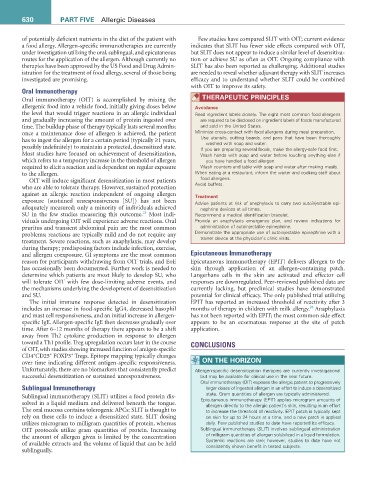
        Oral immunotherapy (OIT) is  accomplished by mixing the    THEraPEUTIC PrINCIPLES
        allergenic food into a vehicle food, initially giving doses below   avoidance
        the level that would trigger reactions in an allergic individual   Read ingredient labels closely. The eight most common food allergens
        and gradually increasing the amount of protein ingested over   are required to be disclosed on ingredient labels of foods manufactured
        time. The buildup phase of therapy typically lasts several months;   and sold in the United States.
        once a maintenance dose of allergen is achieved, the patient     Minimize cross-contact with food allergens during meal preparation.
        has to ingest the allergen for a certain period (typically ≥1 years,   Use utensils, cutting boards, and pans that have been thoroughly
                                                                    washed with soap and water.
        possibly indefinitely) to maintain a protected, desensitized state.   If you are preparing several foods, make the allergy-safe food first.
        Most studies have focused on achievement of desensitization,   Wash hands with soap and water before touching anything else if
        which refers to a temporary increase in the threshold of allergen   you have handled a food allergen.
        required to elicit a reaction and is dependent on regular exposure   Wash counters and table with soap and water after making meals.
        to the allergen.                                         When eating at a restaurant, inform the waiter and cooking staff about
           OIT will induce significant desensitization in most patients   food allergens.
        who are able to tolerate therapy. However, sustained protection   Avoid buffets.
        against  an  allergic  reaction  independent  of  ongoing  allergen   Treatment
        exposure (sustained unresponsiveness [SU]) has not been   Advise patients at risk of anaphylaxis to carry two autoinjectable epi-
        adequately measured; only a minority of individuals achieved   nephrine devices at all times.
                                                25
        SU in the few studies measuring this outcome.  Most indi-  Recommend a medical identification bracelet.
        viduals undergoing OIT will experience adverse reactions. Oral   Provide an anaphylaxis emergency plan, and review indications for
        pruritus and transient abdominal pain are the most common   administration of autoinjectable epinephrine.
        problems; reactions are typically mild and do not require any   Demonstrate the appropriate use of autoinjectable epinephrine with a
        treatment. Severe reactions, such as anaphylaxis, may develop   trainer device at the physician’s clinic visits.
        during therapy; predisposing factors include infection, exercise,
        and allergen coexposure. GI symptoms are the most common   Epicutaneous Immunotherapy
        reason for participants withdrawing from OIT trials, and EoE   Epicutaneous immunotherapy (EPIT) delivers allergen to the
        has occasionally been documented. Further work is needed to   skin through application of an allergen-containing patch.
        determine which patients are most likely to develop SU, who   Langerhans cells in the skin are activated and effector cell
        will tolerate OIT with few dose-limiting adverse events, and   responses are downregulated. Peer-reviewed published data are
        the mechanisms underlying the development of desensitization    currently  lacking, but  preclinical  studies  have  demonstrated
        and SU.                                                potential for clinical efficacy. The only published trial utilizing
           The initial immune response detected in desensitization   EPIT has reported an increased threshold of reactivity after 3
                                                                                                      26
        includes an increase in food-specific IgG4, decreased basophil   months of therapy in children with milk allergy.  Anaphylaxis
        and mast cell responsiveness, and an initial increase in allergen-  has not been reported with EPIT; the most common side effect
        specific IgE. Allergen-specific IgE then decreases gradually over   appears to be an eczematous response at the site of patch
        time. After 6–12 months of therapy there appears to be a shift   application.
        away  from  Th2  cytokine  production  in  response  to  allergen
        toward a Th1 profile. Treg upregulation occurs later in the course   CONCLUSIONS
        of OIT, with studies showing increased function of antigen-specific
                 +
                        +
            +
        CD4 CD25  FOXP3  Tregs. Epitope mapping typically changes
        over time indicating different antigen-specific responsiveness.    ON THE HOrIZON
        Unfortunately, there are no biomarkers that consistently predict   Allergen-specific desensitization therapies are currently investigational
        successful desensitization or sustained unresponsiveness.  but may be available for clinical use in the near future.
                                                                   Oral immunotherapy (OIT) exposes the allergic patient to progressively
        Sublingual Immunotherapy                                    larger doses of ingested allergen in an effort to induce a desensitized
                                                                    state. Gram quantities of allergen are typically administered.
        Sublingual immunotherapy (SLIT) utilizes a food protein dis-  Epicutaneous immunotherapy (EPIT) applies microgram amounts of
        solved in a liquid medium and delivered beneath the tongue.   allergen directly to the allergic patient’s skin, resulting in an effort
        The oral mucosa contains tolerogenic APCs: SLIT is thought to   to increase the threshold of reactivity. EPIT patch is typically kept
        rely on these cells to induce a desensitized state. SLIT dosing   on skin for up to 24 hours at a time, and a new patch is applied
        utilizes microgram to milligram quantities of protein, whereas   daily. Few published studies to date have reported its efficacy.
        OIT  protocols  utilize  gram  quantities  of  protein.  Increasing    Sublingual immunotherapy (SLIT) involves sublingual administration
        the amount of allergen given is limited by the concentration     of milligram quantities of allergen solubilized in a liquid formulation.
        of available extracts and the volume of liquid that can be held   Systemic reactions are rare; however, studies to date have not
                                                                    consistently shown benefit in tested subjects.
        sublingually.

