


Page 735 - Clinical Immunology_ Principles and Practice ( PDFDrive )
P. 735
CHaPtEr 52  Rheumatoid Arthritis              707


             A comparison of the microbial genomes from the small intes-  prospect of fecal transplantation to prevent or treat established
           tine and colon of mice housed in conventional versus germ-free   disease is an intriguing one.
           facilities suggests that a single gut-residing species, in this case
           segmented filamentous bacteria, can profoundly influence the   Immunogenetics
           clinical expression of inflammatory arthritis in mouse models of   RA is a clinically heterogeneous disease, and so comprehensive
           autoimmune arthritis. In the K/B x N serum transfer model of   identification of disease susceptibility genes has been challenging,
           arthritis, segmented filamentous bacteria enhanced generation   in spite of heritability estimates of at least 60%. With the exception
                                                            12
           of interleukin (IL)-17 expressing T cells in lamina propria.    of the MHC, where extensive gene polymorphism contributes
           Together with rapid advances in sequencing technologies, these   about one-third of genetic susceptibility, and  PTPN22 (odds
           data have prompted a systematic analysis of the symbiont   ratio 1.8), individual genetic variants confer low to moderate
           microbial communities in patients with RA in comparison to   risk and have low penetrance (odds ratios in the range 1.1–1.5).
           those derived from healthy control populations. Microbiota are   Numerous genome-wide linkage scans of multiplex families with
           attractive environmental risk factors because they are acquired   RA have established and confirmed an important contribution
           at around the time of birth and are modified by diet as well   of the MHC (Chapter 5). This lends support to a wealth of
           as the host genome. Studies from several groups have demon-  epidemiological and genetic data describing associations between
           strated irrefutable evidence of dysbiosis, with distinct patterns of   RA and specific HLA-DRB1 alleles, in particular HLA-DR4
           microbiota depending on the stage of disease and the population   subtypes. Although this association was first described by Stastny
           studied. For example, the first US study reported enrichment   in the 1970s, it was shown more than a decade later that sus-
           of Prevotella spp. and Bacteroides spp., gram-negative anaerobes     ceptibility to RA across different ethnic populations correlated
           in the gut of patients with early but not established RA. Metage-  closely with the expression of a specific consensus amino acid
           nomic sequencing of oral and fecal microbiota from a cohort   sequence (referred to as the “shared epitope,” hereafter SE) within
                                                                                                   14
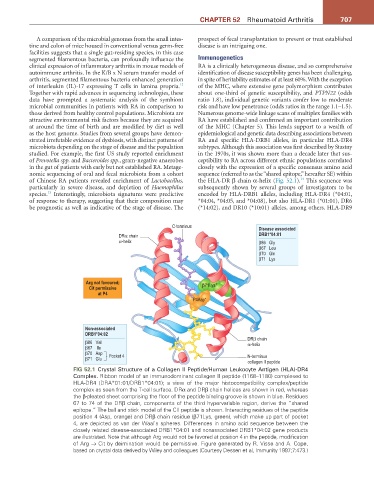
           of Chinese RA patients revealed enrichment of  Lactobacillus,   the HLA-DR β chain α-helix (Fig. 52.1).  This sequence was
           particularly  in  severe  disease,  and  depletion  of  Haemophilus   subsequently shown by several groups of investigators to be
                 13
           species.  Interestingly, microbiota signatures were predictive   encoded by HLA-DRB1 alleles, including HLA-DR4 (*04:01,
           of response to therapy, suggesting that their composition may   *04:04, *04:05, and *04:08), but also HLA-DR1 (*01:01), DR6
           be prognostic as well as indicative of the stage of disease. The   (*14:02), and DR10 (*10:01) alleles, among others. HLA-DR9


                                                         C-terminus                   Disease associated
                                        DRα chain                                     DRB1*04:01
                                        α-helix                                       β86   Gly
                                                                                      β67   Leu
                                                                                      β70   Gln
                                                                                      β71   Lys


                             Arg not favoured;                         +
                              Cit permissive                       β71Lys
                                 at P4
                                                                P4Asp -


                             Non-associated
                             DRB1*04:02
                                                                                  DRβ chain
                             β86   Val                                            α-helix
                             β67    Ile
                             β70   Asp  Pocket 4
                             β71   Glu                                            N-terminus
                                                                                  collagen II peptide
                         FIG 52.1  Crystal Structure of a Collagen II Peptide/Human Leukocyte Antigen (HLA)-DR4
                         Complex. Ribbon model of an immunodominant collagen II peptide (1168–1180) complexed to
                         HLA-DR4  (DRA*01:01/DRB1*04:01);  a  view  of  the  major  histocompatibility  complex/peptide
                         complex as seen from the T-cell surface. DRα and DRβ chain helices are shown in red, whereas
                         the β-pleated sheet comprising the floor of the peptide binding groove is shown in blue. Residues
                         67 to 74 of the DRβ chain, components of the third hypervariable region, derive the “shared
                         epitope.” The ball and stick model of the CII peptide is shown. Interacting residues of the peptide
                         position 4 (Asp, orange) and DRβ chain residue (β71Lys, green), which make up part of pocket
                         4, are depicted as van der Waal’s spheres. Differences in amino acid sequence between the
                         closely related disease-associated DRB1*04:01 and nonassociated DRB1*04:02 gene products
                         are illustrated. Note that although Arg would not be favored at position 4 in the peptide, modification
                         of Arg → Cit by deimination would be permissive. Figure generated by R. Visse and A. Cope,
                         based on crystal data derived by Wiley and colleagues (Courtesy Dessen et al, Immunity 1997;7:473.)

