


Page 739 - Clinical Immunology_ Principles and Practice ( PDFDrive )
P. 739
CHaPtEr 52  Rheumatoid Arthritis              711


           proteins, fibrinogen fragments, antibody-DNA complexes, high-  of inflammatory leukocytes, including polymorphonuclear
           mobility group box (HMGB)-1, and hyaluronan oligosaccharides.   leukocytes and immature or undifferentiated monocytes, orches-
           Recent  data  suggest  that  synovial  FLSs,  as  well  as  synovial   trated by chemokines produced by resident stromal as well as
           macrophages, express TLR2 in situ. Expression is upregulated   infiltrating cells (Fig. 52.3). CXC, CC, C, and CX 3 C chemokines
           after stimulation with IL-1 and the TLR2 ligand peptidoglycan.   all play a role, exerting chemotactic activity toward neutrophils,
           TLR2 engagement induces cytokines such as IL-6, matrix metal-  lymphocytes, and monocytes but also influencing the topology
           loproteinases, adhesion molecules, and an array of chemokines   of inflammatory infiltrates. They are invariably early activation
           including granulocyte chemotactic protein (GCP)-2, RANTES,   genes (e.g., type I IFN response genes), in response to inflam-
           monocyte chemoattractant protein (MCP)-2, IL-8, growth-related   matory stimuli. Besides the homeostatic chemokines described
           oncogene-2 and, to a lesser extent, macrophage-inflammatory   above, the key players include IL-8/CXCL8, RANTES/CCL5,
           protein 1α, MCP-1, EXODUS, and CXCL-16. Data suggest that   MIP-1α/CCL3, SDF-1/CXCL12, IP-10/CXCL10, and MCP-1/
                                                                       27
           TLR3, TLR4, TLR7, and TLR9 are also expressed at messenger   CCL2.  Upregulation on endothelium of cell surface adhesion
                                                    25
           ribonucleic acid (mRNA) and possibly protein level  and may   molecules, including ICAM-1, VCAM-1, and E-selectin, permits
           augment inflammatory cytokine expression by DCs from patients   the rolling and adhesion of leukocytes as they migrate. In synovial
           with RA.                                               joints, resident stromal cells and infiltrating macrophages are a
             DCs are thought to be the most important antigen-presenting   dominant source of such factors. Crucially, the expression of
           cells in RA. Indeed, the proinflammatory environment favors   cognate chemokine receptors such as CCR4, CCR5, CCR6, CXCR3,
           DC maturation in regional lymph nodes as well as inflamed   and CX3CR1 on inflammatory cell subsets contribute selectivity
                26
                                                                                    27
           tissue.  Thus in peripheral blood, DC precursors express either   of cellular recruitment.  Within the T-cell compartment, there
                                      −
                         dim
                                dim
           an immature CD33 CD14 CD16  phenotype or a more mature   exist distinct profiles of chemokine receptor expression, patterns
                               +
                                            dim
           MHC class II bright  CD11c CD33 bright CD14  surface phenotype   evolved perhaps to facilitate eradication of pathogens. For
           typical of conventional myeloid DC (mDC); neither population   example, T-helper 1 cells preferentially express CXCR3 and CCR5;
           expresses costimulatory molecules. In contrast, synovial fluid   Th2 cells express CCR3; Th17 cells express CCR6 and CCR4;
           and tissue DC subsets resemble mature peripheral blood cells;   and Tfh cells express CXCR5. Data suggest that CCR5, CCR6,
           in addition, a subset expresses high levels of CD86 and can   CCR7, CXCR3, CXCR4, and CXCR5 may all be important for
           support allogeneic mixed leukocyte reactions. More recent data   B-cell migration into synovium. Together, these events characterize
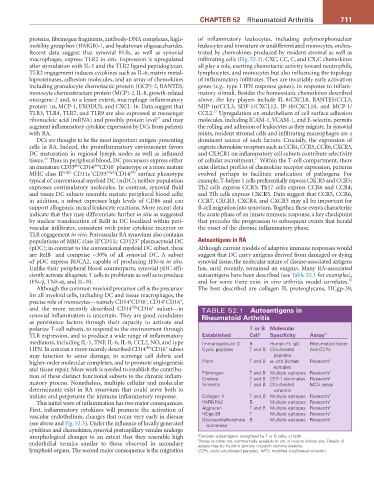
           indicate that they may differentiate further in situ as suggested   the acute phase of an innate immune response, a key checkpoint
           by nuclear translocation of RelB in DC localized within peri-  that precedes the progression to subsequent events that herald
           vascular infiltrates, consistent with prior cytokine receptor or   the onset of the chronic inflammatory phase.
           TLR engagement in vivo. Perivascular RA synovium also contains
                                              +
                                        −
                                 +
           populations of MHC class II CD11c CD123  plasmacytoid DC   Autoantigens in RA
           (pDC); in contrast to the conventional myeloid DC subset, these   Although current models of adaptive immune responses would
                  −
           are RelB  and comprise ~30% of all synovial DC.  A subset    suggest that DC carry antigens derived from damaged or dying
           of pDC express BDCA2, capable of producing IFN-α in situ.   synovial tissue, the molecular nature of disease-associated antigens
           Unlike their peripheral blood counterparts, synovial pDC effi-  has, until recently, remained an enigma. Many RA-associated
           ciently activate allogeneic T cells to proliferate as well as to produce   autoantigens have been described (see Table 52.1 for examples),
                                                                                                                   28
           IFN-γ, TNF-α, and IL-10.                               and for some there exist  in vivo arthritis model correlates.
             Although the common myeloid precursor cell is the precursor   The best described are collagen II, proteoglycans, HCgp-39,
           for all myeloid cells, including DC and tissue macrophages, the
                                           +
                                                       +
                                                            +
                                                 −
           precise role of monocytes—namely CD14 CD16 , CD14 CD16 ,
                                                   +
                                            dim
           and  the  more  recently  described  CD14 CD16   subset—in   TABLE 52.1  autoantigens in
           synovial inflammation is uncertain. They are good candidates   rheumatoid arthritis
           as persistence factors through their capacity to activate and
           polarize T-cell subsets, to respond to the environment through          t or B  Molecular
           TLR expression, and to produce a wide range of inflammatory   Established  Cell a  Specificity  assay b
           mediators, including IL-1, TNF, IL-6, IL-8, CCL2, NO, and type   Immunoglobulin G  B  Human Fc IgG  Rheumatoid factor
                                                       +
                                                 dim
           I IFN. In contrast a more recently described CD14 CD16  subset   Cyclic peptides  T and B Citrullinated   Anti-CCPs
           may function to  sense damage,  to scavenge cell  debris and                    peptides
           higher-order molecular complexes, and to promote angiogenesis   Fibrin  T and B α- and β-chain   Research b
           and tissue repair. More work is needed to establish the contribu-               epitopes          b
           tion of these distinct functional subsets to the chronic inflam-  Fibrinogen  T and B Multiple epitopes Research b
                                                                                   T and B CEP-1 dominates Research
                                                                   Enolase
           matory process. Nonetheless, multiple cellular and molecular   Vimentin  T and B Citrullinated   MCV assay
           determinants  exist in  RA  synovium that  could serve both  to                 vimentin
           initiate and perpetuate the immune inflammatory response.  Collagen II  T and B Multiple epitopes Research b
             This initial wave of inflammation has two major consequences.   HnRNPA2  B  Multiple epitopes Research b
           First, inflammatory cytokines will promote the activation of   Aggrecan  T and B Multiple epitopes Research b b
           vascular endothelium, changes that occur very early in disease   HCgp-39  T   Multiple epitopes Research b
                                                                                         Multiple epitopes Research
                                                                   Glucose-6-phosphate  B
           (see above and Fig. 52.3). Under the influence of locally generated   isomerase
           cytokines and chemokines, synovial postcapillary venules undergo
           morphological changes to an extent that they resemble high   a b Denotes autoantigens recognized by T or B cells, or both.
                                                                  Assay is either not commercially available or not in routine clinical use. Details of
           endothelial venules similar to those observed in secondary   assays may be found in primary research communications.
           lymphoid organs. The second major consequence is the migration   CCPs, cyclic citrullinated peptides; MCV, modified citrullinated vimentin.

