


Page 738 - Clinical Immunology_ Principles and Practice ( PDFDrive )
P. 738
710          Part SIX  Systemic Immune Diseases


                                                               further evidence of disease heterogeneity. This strategy assumes
                                                               that each disease phenotype should be represented in gene
                                                               expression signatures of multiple genes. Remarkable variation
                                                               in  gene  expression  signatures  has  been  observed,  and  initial
                                                               reports seemed to suggest that these signatures could be divided
                                                                                   23
                                                               broadly into two groups.  The first is characterized by upregula-
                                                               tion of immune response and inflammatory genes; these tissues
                                                               are enriched for MHC and immunoglobulin gene products. In
                                                               some tissues this signature may resemble an antiviral response
                                                               consistent with prior infectious insult and, more specifically, a
                                                               signal transducer and activator of transcription 1 (STAT1)–depen-
                                                               dent gene signature (promoting protective or proinflammatory
                                                                      23
                                                               effects).  This has also been observed in peripheral blood
                                                               lymphocytes (PBL) from patients. The second group is more
                                                               indicative of tissue remodeling, more reminiscent of that seen
                                                               in osteoarthritis. Most interestingly, distinct fibroblast-like
                                                               synoviocytes (FLSs), genotypes, and phenotypes match the type
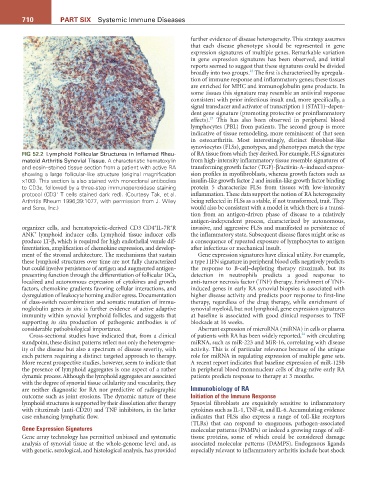
        FIG 52.2  Lymphoid Follicular Structures in Inflamed Rheu-  of RA tissue from which they derived. For example, FLS signatures
        matoid Arthritis Synovial Tissue. A characteristic hematoxylin   from high-intensity inflammatory tissue resemble signatures of
        and eosin–stained tissue section from a patient with active RA   transforming growth factor (TGF)-β/activin-A–induced expres-
        showing a large follicular-like structure (original magnification   sion profiles in myofibroblasts, whereas growth factors such as
        ×100). This section is also stained with monoclonal antibodies   insulin-like growth factor 2 and insulin-like growth factor binding
        to CD3ε, followed by a three-step immunoperoxidase staining   protein  5  characterize  FLSs  from  tissues  with  low-intensity
                   +
        protocol (CD3  T cells stained dark red). (Courtesy Tak, et al.   inflammation. These data support the notion of RA heterogeneity
        Arthritis Rheum 1996;39:1077, with permission from J. Wiley   being reflected in FLSs as a stable, if not transformed, trait. They
        and Sons, Inc.)                                        would also be consistent with a model in which there is a transi-
                                                               tion from an antigen-driven phase of disease to a relatively
                                                               antigen-independent process, characterized by autonomous,
                                                         +
                                                    +
                                               −
        organizer cells, and hematopoietic-derived CD3 CD4 IL-7R R  invasive, and aggressive FLSs and manifested as persistence of
            +
        ANK  lymphoid inducer cells. Lymphoid tissue inducer cells   the inflammatory state. Subsequent disease flares might arise as
        produce LT-β, which is required for high endothelial venule dif-  a consequence of repeated exposure of lymphocytes to antigen
        ferentiation, amplification of chemokine expression, and develop-  after infectious or mechanical insult.
        ment of the stromal architecture. The mechanisms that sustain   Gene expression signatures have clinical utility. For example,
        these lymphoid structures over time are not fully characterized   a type I IFN signature in peripheral blood cells negatively predicts
        but could involve persistence of antigen and augmented antigen-  the response to B-cell–depleting therapy rituximab, but its
        presenting function through the differentiation of follicular DCs,   detection in neutrophils predicts a good response to
        localized and autonomous expression of cytokines and growth   anti-tumor necrosis factor (TNF) therapy. Enrichment of TNF-
        factors, chemokine gradients favoring cellular interactions, and   induced genes in early RA synovial biopsies is associated with
        dysregulation of leukocyte homing and/or egress. Documentation   higher disease activity and predicts poor response to first-line
        of class-switch recombination and somatic mutation of immu-  therapy,  regardless  of  the  drug therapy,  while enrichment  of
        noglobulin genes  in situ is further evidence of active adaptive   synovial myeloid, but not lymphoid, gene expression signatures
        immunity within synovial lymphoid follicles, and suggests that   at baseline is associated with good clinical responses to TNF
        supporting  in situ production of pathogenic antibodies is of   blockade at 16 weeks.
        considerable pathobiological importance.                  Aberrant expression of microRNA (miRNA) in cells or plasma
                                                                                                    24
           Cross-sectional studies have indicated that, from a clinical   of patients with RA has been widely reported,  with circulating
        standpoint, these distinct patterns reflect not only the heterogene-  miRNA, such as miR-223 and MiR-16, correlating with disease
        ity of the disease but also a spectrum of disease severity, with   activity. This is of particular relevance because of the unique
        each pattern requiring a distinct targeted approach to therapy.   role for miRNA in regulating expression of multiple gene sets.
        More recent prospective studies, however, seem to indicate that   A recent report indicates that baseline expression of miR-125b
        the presence of lymphoid aggregates is one aspect of a rather   in peripheral blood mononuclear cells of drug-naïve early RA
        dynamic process. Although the lymphoid aggregates are associated   patients predicts response to therapy at 3 months.
        with the degree of synovial tissue cellularity and vascularity, they
        are  neither  diagnostic  for  RA nor  predictive of  radiographic   Immunobiology of RA
        outcome such as joint erosions. The dynamic nature of these   Initiation of the Immune Response
        lymphoid structures is supported by their dissolution after therapy   Synovial  fibroblasts  are exquisitely sensitive to  inflammatory
        with rituximab (anti-CD20) and TNF inhibitors, in the latter   cytokines such as IL-1, TNF-α, and IL-6. Accumulating evidence
        case enhancing lymphatic flow.                         indicates  that FLSs also  express a range of toll-like  receptors
                                                               (TLRs) that can respond to exogenous, pathogen-associated
        Gene Expression Signatures                             molecular patterns (PAMPs) or indeed a growing range of self-
        Gene array technology has permitted unbiased and systematic   tissue proteins, some of which could be considered damage
        analysis of synovial tissue at the whole-genome level and, as   associated molecular patterns (DAMPS). Endogenous ligands
        with genetic, serological, and histological analysis, has provided   especially relevant to inflammatory arthritis include heat shock

