


Page 813 - Clinical Immunology_ Principles and Practice ( PDFDrive )
P. 813
784          Part six  Systemic Immune Diseases


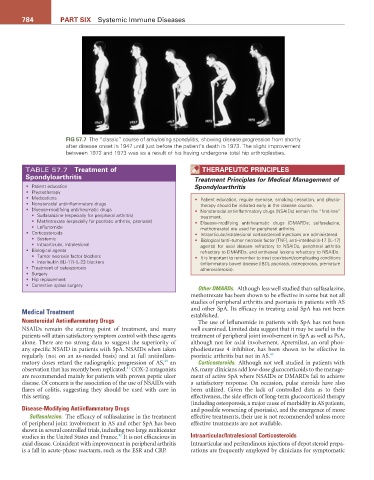
                       FiG 57.7  The “classic” course of ankylosing spondylitis, showing disease progression from shortly
                       after disease onset in 1947 until just before the patient’s death in 1973. The slight improvement
                       between 1972 and 1973 was as a result of his having undergone total hip arthroplasties.


         TABLE 57.7  treatment of                                  tHEraPEUtiC PriNCiPLEs
         spondyloarthritis                                       Treatment Principles for Medical Management of
          •  Patient education                                   Spondyloarthritis
          •  Physiotherapy
          •  Medications                                         •  Patient education, regular exercise, smoking cessation, and physio-
          •  Nonsteroidal antiinflammatory drugs                   therapy should be initiated early in the disease course.
          •  Disease-modifying antirheumatic drugs               •  Nonsteroidal antiinflammatory drugs (NSAIDs) remain the “first-line”
           •  Sulfasalazine (especially for peripheral arthritis)  treatment.
           •  Methotrexate (especially for psoriatic arthritis, psoriasis)  •  Disease-modifying antirheumatic drugs (DMARDs: sulfasalazine,
           •  Leflunomide                                          methotrexate) are used for peripheral arthritis.
          •  Corticosteroids                                     •  Intraarticular/intralesional corticosteroid injections are administered.
           •  Systemic                                           •  Biological (anti–tumor necrosis factor [TNF], anti–interleukin-17 [IL-17]
           •  Intraarticular, intralesional                        agents) for axial disease refractory to NSAIDs, peripheral arthritis
          •  Biological agents                                     refractory to DMARDs, and entheseal lesions refractory to NSAIDs.
           •  Tumor necrosis factor blockers                     •  It is important to remember to treat coexistent/complicating conditions
           •  Interleukin (IL)-17/-IL-23 blockers                  (inflammatory bowel disease [IBD], psoriasis, osteoporosis, premature
          •  Treatment of osteoporosis                             atherosclerosis).
          •  Surgery
          •  Hip replacement
          •  Corrective spinal surgery
                                                                  Other DMARDs.  Although less well studied than sulfasalazine,
                                                               methotrexate has been shown to be effective in some but not all
                                                               studies of peripheral arthritis and psoriasis in patients with AS
        Medical Treatment                                      and other SpA. Its efficacy in treating axial SpA has not been
                                                               established.
        Nonsteroidal Antiinflammatory Drugs                       The use of leflunomide in patients with SpA has not been
        NSAIDs remain the starting point of treatment, and many   well examined. Limited data suggest that it may be useful in the
        patients will attain satisfactory symptom control with these agents   treatment of peripheral joint involvement in SpA as well as PsA,
        alone. There are no strong data to suggest the superiority of   although not for axial involvement. Apremilast, an oral phos-
        any specific NSAID in patients with SpA. NSAIDs when taken   phodiesterase 4 inhibitor, has been shown to be effective in
        regularly (not  on an as-needed basis) and  at full antiinflam-  psoriatic arthritis but not in AS. 43
                                                       40
        matory doses retard the radiographic progression of AS,  an   Corticosteroids.  Although not well studied in patients with
                                          41
        observation that has recently been replicated.  COX-2 antagonists   AS, many clinicians add low-dose glucocorticoids to the manage-
        are recommended mainly for patients with proven peptic ulcer   ment of active SpA where NSAIDs or DMARDs fail to achieve
        disease. Of concern is the association of the use of NSAIDs with   a satisfactory response. On occasion, pulse steroids have also
        flares of colitis, suggesting they should be used with care in     been utilized. Given the lack of controlled data as to their
        this setting.                                          effectiveness, the side effects of long-term glucocorticoid therapy
                                                               (including osteoporosis, a major cause of morbidity in AS patients,
        Disease-Modifying Antiinflammatory Drugs               and possible worsening of psoriasis), and the emergence of more
           Sulfasalazine.  The efficacy of sulfasalazine in the treatment   effective treatments, their use is not recommended unless more
        of peripheral joint involvement in AS and other SpA has been   effective treatments are not available.
        shown in several controlled trials, including two large multicenter
                                        42
        studies in the United States and France.  It is not efficacious in   Intraarticular/Intralesional Corticosteroids
        axial disease. Coincident with improvement in peripheral arthritis   Intraarticular and peritendinous injections of depot steroid prepa-
        is a fall in acute-phase reactants, such as the ESR and CRP.  rations are frequently employed by clinicians for symptomatic

