


Page 814 - Clinical Immunology_ Principles and Practice ( PDFDrive )
P. 814
CHaPtEr 57  Spondyloarthritis             785


           relief of local flare-ups, although they have not been extensively   infusion of a chimeric mAb to TNF-α (infliximab) at 5 mg/kg
           studied in controlled trials. Injecting around the  Achilles   of infliximab every 6–8 weeks; etanercept, given 50 mg subcutane-
           tendon is generally not recommended because of the risk of     ously weekly; adalimumab, which is used at a dose of 40 mg
           tendon rupture.                                        administered subcutaneously every other week; golimumab, at
                                                                  a dose of 50 mg administered subcutaneously monthly; and
           Antibiotics                                            certolizumab, at either 200 mg administered subcutaneously
                                                                               45
           Early data suggested that a 3-month course of antibiotics in the   every other week  or 400 mg once a month. The onset of action
           acute phase after disease onset may have a beneficial effect on   is quite rapid, usually following the first infusion or injection.
                                                                                              46
           the course of ReA, specifically in those with  Chlamydia   These agents are effective also in PsA  and axial SpA. 45,47  Improve-
           trachomatis–triggered ReA, but not in other patients. Recent   ment was seen not only clinically but also radiographically, with
           long-term follow-up data, however, suggest that tetracycline   clearing of lesions suggestive of disease activity on MRI, and, in
           treatment did not change the natural history of the disease. In   studies extending >4 years, radiographically. Although earlier
           another recent study, however, a 6-month course of azithromycin   studies following up patients for 2 years did not demonstrate
           and rifampin in the acute phase was found to have a beneficial   that anti-TNF agents affect radiographic severity in AS, data
           effect on the long-term prognosis, although this has not been   from observational cohorts from North America and Europe
                              44
           reproduced in all studies.  It is clear that early antibiotic therapy   spanning longer periods have shown they do, indeed, slow
           for chlamydial genital infections can prevent ReA, although the   radiographic progression, especially in those with shorter disease
           same is not true for enteric pathogens. For patients at risk for   duration treated for an extended period. 48
           enteric infections and ReA, prophylactic antibiotics should be
           considered. There is no evidence that antibiotics have any place   Interleukin-17 Blockers (Secukinumab)
           in the management of other SpA.                        Secukinumab is an anti–IL-17A mAb that has been shown to
                                                                  control the symptoms of active AS in one phase II trial and two
           TNF-α Blockers                                         phase III clinical trials  and has been approved by the FDA. The
                                                                                   49
           This category of medications has been shown to be effective in   impact of this medication on other disease features, such as
           controlling inflammation and improving function in patients   radiographic progression, remains to be determined.
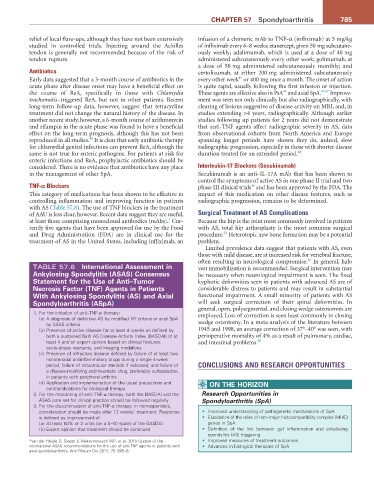
           with AS (Table 57.8). The use of TNF blockers in the treatment
           of AAU is less clear, however. Recent data suggest they are useful,   Surgical Treatment of AS Complications
                                                        1
           at least those comprising monoclonal antibodies (mAbs).  Cur-  Because the hip is the joint most commonly involved in patients
           rently five agents that have been approved for use by the Food   with AS,  total  hip  arthroplasty  is  the  most  common  surgical
                                                                          24
           and  Drug  Administration  (FDA)  are  in  clinical  use  for  the   procedure.  Heterotopic new bone formation may be a potential
           treatment of AS in the United States, including infliximab, an   problem.
                                                                    Limited prevalence data suggest that patients with AS, even
                                                                  those with mild disease, are at increased risk for vertebral fracture,
                                                                                                      25
                                                                  often resulting in neurological compromise.  In general, halo
            TABLE 57.8  international assessment in               vest immobilization is recommended. Surgical intervention may
            ankylosing spondylitis (asas) Consensus               be necessary when neurological impairment is seen. The fixed
            statement for the Use of anti–tumor                   kyphotic deformities seen in patients with advanced AS are of
            Necrosis Factor (tNF) agents in Patients              considerable distress to patients and may result in substantial
            With ankylosing spondylitis (as) and axial            functional impairment. A small minority of patients with AS
            spondyloarthritis (aspa)*                             will seek surgical correction of their spinal deformities. In
                                                                  general, open, polysegmental, and closing wedge osteotomies are
            1. For the initiation of anti–TNF-α therapy:          employed. Loss of correction is seen least commonly in closing
              (a) A diagnosis of definitive AS by modified NY criteria or axial SpA
                by ASAS criteria                                  wedge osteotomy. In a meta-analysis of the literature between
              (b) Presence of active disease for at least 4 weeks as defined by   1945 and 1998, an average correction of 37°–40° was seen, with
                both a sustained Bath AS Disease Activity Index (BASDAI) of at   perioperative mortality of 4% as a result of pulmonary, cardiac,
                least 4 and an expert opinion based on clinical features,   and intestinal problems. 50
                acute-phase reactants, and imaging modalities
              (c)  Presence of refractory disease defined by failure of at least two
                nonsteroidal antiinflammatory drugs during a single 4-week
                period, failure of intraarticular steroids if indicated, and failure of   CONCLUSIONS AND RESEARCH OPPORTUNITIES
                a disease-modifying antirheumatic drug, preferably sulfasalazine,
                in patients with peripheral arthritis
              (d) Application and implementation of the usual precautions and    ON tHE HOriZON
                contraindications for biological therapy
            2. For the monitoring of anti–TNF-α therapy: both the BASDAI and the   Research Opportunities in
              ASAS core set for clinical practice should be followed regularly  Spondyloarthritis (SpA)
            3. For the discontinuation of anti-TNF-α therapy: in nonresponders,
              consideration should be made after 12 weeks’ treatment. Response   •  Improved understanding of pathogenetic mechanisms of SpA
              is defined as improvement of:                        •  Elucidation of the roles of non–major histocompatibility complex (MHC)
              (a) At least 50% or 2 units (on a 0–10 scale) of the BASDAI  genes in SpA
              (b) Expert opinion that treatment should be continued  •  Definition of the link between gut inflammation and ankylosing
                                                                     spondylitis (AS) triggering
           *van der Heijde D, Sieper J, Maksymowych WP, et al. 2010 Update of the   •  Improved measures of treatment outcomes
           international ASAS recommendations for the use of anti-TNF agents in patients with   •  Advances in biological therapies of SpA
           axial spondyloarthritis. Ann Rheum Dis 2011; 70 :905–8.

