


Page 808 - Clinical Immunology_ Principles and Practice ( PDFDrive )
P. 808
CHaPtEr 57  Spondyloarthritis             779


           occasionally progresses to episcleritis, scleritis, or keratitis. Other   Finally, pustular psoriasis is the type most closely associated
           findings seen in AS, such as cardiac involvement, rarely occur.   with HLA-B27. Usually, the disease appears coincident with or
           Although renal involvement is mainly described in the context   after the onset of skin manifestations, although approximately
           of the urogenital triggering infectious process, sterile pyuria in   15–20% of patients will have preexisting arthritis. The joint
           conjunction with proteinuria and microscopic hematuria are   disease likewise occurs in different subtypes, as defined by the
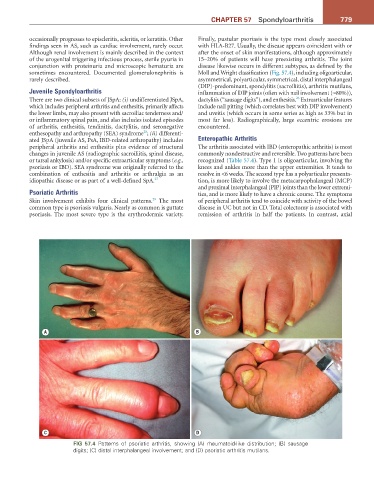
           sometimes encountered. Documented glomerulonephritis is   Moll and Wright classification (Fig. 57.4), including oligoarticular,
           rarely described.                                      asymmetrical, polyarticular, symmetrical, distal interphalangeal
                                                                  (DIP)-predominant, spondylitis (sacroiliitis), arthritis mutilans,
           Juvenile Spondyloarthritis                             inflammation of DIP joints (often with nail involvement (≈80%)),
                                                                                                  26
           There are two clinical subsets of JSpA: (i) undifferentiated JSpA,   dactylitis (“sausage digits”), and enthesitis.  Extraarticular features
           which includes peripheral arthritis and enthesitis, primarily affects   include nail pitting (which correlates best with DIP involvement)
           the lower limbs, may also present with sacroiliac tenderness and/  and uveitis (which occurs in some series as high as 33% but in
           or inflammatory spinal pain, and also includes isolated episodes   most far less). Radiographically, large eccentric erosions are
           of arthritis, enthesitis, tendinitis, dactylitis, and seronegative   encountered.
                                                28
           enthesopathy and arthropathy (SEA) syndrome ; (ii) differenti-
           ated JSpA (juvenile AS, PsA, IBD-related arthropathy) includes   Enteropathic Arthritis
           peripheral arthritis and enthesitis plus evidence of structural   The arthritis associated with IBD (enteropathic arthritis) is most
           changes in juvenile AS (radiographic sacroiliitis, spinal disease,   commonly nondestructive and reversible. Two patterns have been
           or tarsal ankylosis) and/or specific extraarticular symptoms (e.g.,   recognized (Table 57.4). Type 1 is oligoarticular, involving the
           psoriasis or IBD). SEA syndrome was originally referred to the   knees and ankles more than the upper extremities. It tends to
           combination of enthesitis and arthritis or arthralgia as an   resolve in <6 weeks. The second type has a polyarticular presenta-
           idiopathic disease or as part of a well-defined SpA. 27  tion, is more likely to involve the metacarpophalangeal (MCP)
                                                                  and proximal interphalangeal (PIP) joints than the lower extremi-
           Psoriatic Arthritis                                    ties, and is more likely to have a chronic course. The symptoms
                                                   29
           Skin involvement exhibits four clinical patterns.  The most   of peripheral arthritis tend to coincide with activity of the bowel
           common type is psoriasis vulgaris. Nearly as common is guttate   disease in UC but not in CD. Total colectomy is associated with
           psoriasis. The most severe type is the erythrodermic variety.   remission of arthritis in half the patients. In contrast, axial


               $                                                 %


               &                                                 '
                         FiG  57.4  Patterns  of  psoriatic  arthritis,  showing  (A)  rheumatoid-like  distribution;  (B)  sausage
                         digits; (C) distal interphalangeal involvement; and (D) psoriatic arthritis mutilans.

