


Page 818 - Clinical Immunology_ Principles and Practice ( PDFDrive )
P. 818
790          Part SIX  Systemic Immune Diseases


         TABLE 58.1  Diagnosis, Incidence and Prevalence in KD, PaN, aaV and
         Leukocytoclastic Vasculitis
          Diagnosis                 Incidence                           Prevalence         references/ reviews
          KD                        For children <5 years old:          Not applicable
                                    2431/million (Japan)                                   Makino N, et al., 2015 96
                                    1131 per million (Korea)
                                    690 per million (Taiwan)
                                    36–185/million (Italy)
          PAN                       3.6/million adults                  2.6–14/million adults  Nesher G, et al., 2016 5
                                                                                           Mohammad AJ, et al., 2007 4
          ANCA-associated vasculitides  9.5–16/million/year (Germany)   149/million        Reinhold-Keller E, et al., 2005 10
                                    22.6/million (Japan)                                   Herlyn K, et al., 2014 11
                                    21.8/million (UK)                                      Fujimoto S, et al., 2011 94
          Leukocytoclastic vasculitis  45/million (equal male and female; increased   No data  Arora A, et al., 2014 7
                                     incidence with age)
        AAV, ANCA-associated vasculitis; ANCA, antineutrophil cytoplasmic antibody; KD, Kawasaki disease; PAN, polyarteritis nodosa.


                            6
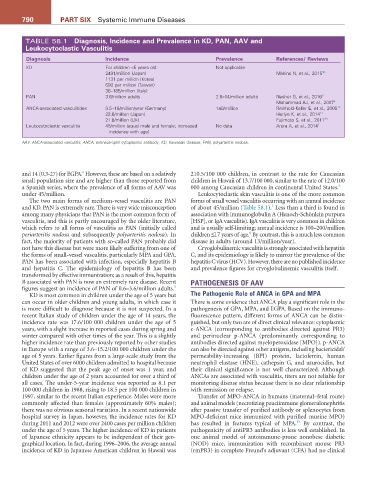
        and 14 (0.3-27) for EGPA.  However, these are based on a relatively   210.5/100 000 children, in contrast to the rate for Caucasian
        small population size and are higher than those reported from   children in Hawaii of 13.7/100 000, similar to the rate of 12.0/100
        a Spanish series, where the prevalence of all forms of AAV was   000 among Caucasian children in continental United States. 6
        under 45/million.                                         Leukocytoclastic skin vasculitis is one of the more common
           The two main forms of medium-vessel vasculitis are PAN   forms of small vessel vasculitis occurring with an annual incidence
                                                                                          7
        and KD. PAN is extremely rare. There is very wide misconception   of about 45/million (Table 58.1).  Less than a third is found in
        among many physicians that PAN is the most common form of   association with immunoglobulin A (Henoch-Schönlein purpura
        vasculitis, and this is partly encouraged by the older literature,   [HSP], or IgA vasculitis). IgA vasculitis is very common in children
        which refers to all forms of vasculitis as PAN (initially called   and is usually self-limiting; annual incidence is 100–200/million
                                                                                   8
        periarteritis nodosa and subsequently  polyarteritis nodosa). In   children ≤17 years of age.  By contrast, this is a much less common
        fact, the majority of patients with so-called PAN probably did   disease in adults (around 13/million/year).
        not have this disease but were more likely suffering from one of   Cryoglobulinemic vasculitis is strongly associated with hepatitis
        the forms of small-vessel vasculitis, particularly MPA and GPA.   C, and its epidemiology is likely to mirror the prevalence of the
        PAN has been associated with infection, especially hepatitis B   hepatitis C virus (HCV). However, there are no published incidence
        and hepatitis C. The epidemiology of hepatitis B has been   and prevalence figures for cryoglobulinemic vasculitis itself.
        transformed by effective immunization; as a result of this, hepatitis
        B associated with PAN is now an extremely rare disease. Recent   PATHOGENESIS OF AAV
        figures suggest an incidence of PAN of 0.6–3.6/million adults. 5
           KD is most common in children under the age of 5 years but   The Pathogenic Role of ANCA in GPA and MPA
        can occur in older children and young adults, in which case it   There is some evidence that ANCA play a significant role in the
        is more difficult to diagnose because it is not suspected. In a   pathogenesis of GPA, MPA, and EGPA. Based on the immuno-
        recent Italian study of children under the age of 14 years, the   fluorescence pattern, different forms of ANCA can be distin-
        incidence rate was 17.6/100 000 children under the age of 5   guished, but only two are of direct clinical relevance: cytoplasmic
        years, with a slight increase in reported cases during spring and   c-ANCA (corresponding to antibodies directed against PR3)
        winter compared with other times of the year. This is a slightly   and perinuclear p-ANCA (predominantly corresponding to
        higher incidence rate than previously reported by other studies   antibodies directed against myeloperoxidase [MPO]). p-ANCA
        in Europe with a range of 3.6–15.2/100 000 children under the   can also be directed against other antigens, including bactericidal/
        age of 5 years. Earlier figures from a large-scale study from the   permeability-increasing (BPI) protein, lactoferrin, human
        United States of over 6000 children admitted to hospital because   neutrophil elastase (HNE), cathepsin G, and azurocidin, but
        of KD suggested that the peak age of onset was 1 year, and   their clinical significance is not well characterized.  Although
        children under the age of 2 years accounted for over a third of   ANCAs are associated with vasculitis, titers are not reliable for
        all cases. The under-5-year incidence was reported as 8.1 per   monitoring disease status because there is no clear relationship
        100 000 children in 1988, rising to 18.5 per 100 000 children in   with remission or relapse.
        1997, similar to the recent Italian experience. Males were more   Transfer of MPO-ANCA in humans (maternal–fetal route)
        commonly affected than females (approximately 60% males);   and animal models (necrotizing pauciimmune glomerulonephritis
        there was no obvious seasonal variation. In a recent nationwide   after passive transfer of purified antibody or splenocytes from
        hospital survey in Japan, however, the incidence rates for KD   MPO-deficient mice immunized with purified murine MPO)
                                                                                                  13
        during 2011 and 2012 were over 2400 cases per million children   has resulted in features typical of MPA.  By contrast, the
        under the age of 5 years. The higher incidence of KD in patients   pathogenicity of antiPR3 antibodies is less well established. In
        of Japanese ethnicity appears to be independent of their geo-  one animal model of autoimmune-prone nonobese diabetic
        graphical location. In fact, during 1996–2006, the average annual   (NOD) mice, immunization with recombinant mouse PR3
        incidence of KD in Japanese American children in Hawaii was   (rmPR3) in complete Freund’s adjuvant (CFA) had no clinical

