


Page 819 - Clinical Immunology_ Principles and Practice ( PDFDrive )
P. 819
CHaPtEr 58  Small- and Medium-Vessel Primary Vasculitis                791


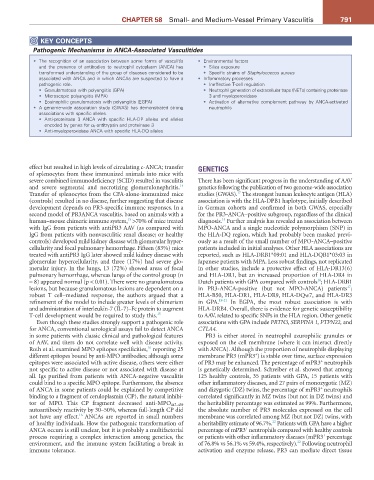
               KEY CONCEPtS
            Pathogenic Mechanisms in ANCA-Associated Vasculitides

            •  The recognition of an association between some forms of vasculitis   •  Environmental factors
              and the presence of antibodies to neutrophil cytoplasm (ANCA) has   •  Silica exposure
              transformed understanding of the group of diseases considered to be   •  Specific strains of Staphylococcus aureus
              associated with ANCA and in which ANCAs are suspected to have a   •  Inflammatory processes
              pathogenic role.                                      •  Ineffective T-cell regulation
              •  Granulomatosis with polyangiitis (GPA)             •  Neutrophil generation of extracellular traps (NETs) containing proteinase
              •  Microscopic polyangiitis (MPA)                      3 and myeloperoxidase
              •  Eosinophilic granulomatosis with polyangiitis (EGPA)  •  Activation of alternative complement pathway by ANCA-activated
            •  A  genome-wide association  study (GWAS) has  demonstrated  strong   neutrophils
              associations with specific alleles.
              •  Anti-proteinase 3 ANCA with specific HLA-DP alleles and alleles
                encoded by genes for α 1 -antitrypsin and proteinase 3
              •  Anti-myeloperoxidase ANCA with specific HLA-DQ alleles


           effect but resulted in high levels of circulating c-ANCA; transfer   GENETICS
           of splenocytes from these immunized animals into mice with
           severe combined immunodeficiency (SCID) resulted in vasculitis   There has been significant progress in the understanding of AAV
                                                            14
           and severe segmental and necrotizing glomerulonephritis.    genetics following the publication of two genome-wide association
                                                                               17
           Transfer of splenocytes from the CFA-alone-immunized mice   studies (GWAS).  The strongest human leukocyte antigen (HLA)
           (controls) resulted in no disease, further suggesting that disease   association is with the HLA-DPB1 haplotype, initially described
           development depends on PR3-specific immune responses. In a   in German cohorts and confirmed in both GWAS, especially
           second model of PR3ANCA vasculitis, based on animals with a   for the PR3-ANCA–positive subgroup, regardless of the clinical
                                                                          14
                                           15
           human–mouse chimeric immune system,  >70% of mice treated   diagnosis.  Further analysis has revealed an association between
           with IgG from patients with antiPR3 AAV (as compared with   MPO-ANCA and a single nucleotide polymorphism (SNP) in
           IgG from patients with nonvasculitic renal disease; or healthy   the HLA-DQ region, which had probably been masked previ-
           controls) developed mild kidney disease with glomerular hyper-  ously as a result of the small number of MPO-ANCA–positive
           cellularity and focal pulmonary hemorrhage. Fifteen (83%) mice   patients included in initial analyses. Other HLA associations are
           treated with antiPR3 IgG later showed mild kidney disease with   reported, such as HLA-DRB1*09:01 and HLA-DQB1*03:03 in
           glomerular hypercellularity, and three (17%) had severe glo-  Japanese patients with MPA. Less robust findings, not replicated
           merular injury. In the lungs, 13 (72%) showed areas of focal   in other studies, include a protective effect of HLA-DR13(6)
           pulmonary hemorrhage, whereas lungs of the control group (n   and HLA-DR1, but an increased proportion of HLA-DR4 in
                                                                                                         18
           = 8) appeared normal (p < 0.01). There were no granulomatous   Dutch patients with GPA compared with controls ; HLA-DRB1
                                                                                                                   17
           lesions, but because granulomatous lesions are dependent on a   in PR3-ANCA-positive (but not MPO-ANCA) patients ;
           robust T cell–mediated response, the authors argued that a   HLA-B50, HLA-DR1, HLA-DR9, HLA-DQw7, and HLA-DR3
           refinement of the model to include greater levels of chimerism   in GPA. 19-21  In EGPA, the most robust association is with
           and administration of interleukin-7 (IL-7)–Fc protein to augment   HLA-DRB4. Overall, there is evidence for genetic susceptibility
           T-cell development would be required to study this. 15  to AAV, related to specific SNPs in the HLA region. Other genetic
             Even though these studies strongly support a pathogenic role   associations with GPA include PRTN3, SERPINA 1, PTPN22, and
           for ANCA, conventional serological assays fail to detect ANCA   CTLA4.
           in some patients with classic clinical and pathological features   PR3 is either stored in neutrophil azurophilic granules or
           of AAV, and titers do not correlate well with disease activity.   exposed on the cell membrane (where it can interact directly
                                                 16
           Roth et al. examined MPO epitopes specificities,  reporting 25   with ANCA). Although the proportion of neutrophils displaying
                                                                                    +
           different epitopes bound by anti-MPO antibodies; although some   membrane PR3 (mPR3 ) is stable over time, surface expression
                                                                                                          +
           epitopes were associated with active disease, others were either   of PR3 may be enhanced. The percentage of mPR3  neutrophils
           not specific to active disease or not associated with disease at   is genetically determined. Schreiber et al. showed that among
           all. Igs purified from patients with ANCA-negative vasculitis   125 healthy controls, 35 patients with GPA, 15 patients with
           could bind to a specific MPO epitope. Furthermore, the absence   other inflammatory diseases, and 27 pairs of monozygotic (MZ)
                                                                                                          +
           of ANCA in some patients could be explained by competitive   and dizygotic (DZ) twins, the percentage of mPR3  neutrophils
           binding to a fragment of ceruloplasmin (CP), the natural inhibi-  correlated significantly in MZ twins (but not in DZ twins) and
           tor of MPO. This  CP fragment decreased anti-MPO 447–459    the heritability percentage was estimated as 99%. Furthermore,
           autoantibody reactivity by 30–50%, whereas full-length CP did   the absolute number of PR3 molecules expressed on the cell
                           16
           not have any effect.  ANCAs are reported in small numbers     membrane was correlated among MZ (but not DZ) twins, with
                                                                                          22
           of healthy individuals. How the pathogenic transformation of   a heritability estimate of 96.7%.  Patients with GPA have a higher
                                                                                 +
           ANCA occurs is still unclear, but it is probably a multifactorial   percentage of mPR3  neutrophils compared with healthy controls
                                                                                                           +
           process requiring a complex interaction among genetics, the   or patients with other inflammatory diseases (mPR3  percentage
                                                                                                  22
           environment, and  the  immune  system  facilitating  a break  in   of 76.8% vs 56.1% vs 59.4%, respectively).  Following neutrophil
           immune tolerance.                                      activation and enzyme release, PR3 can mediate direct tissue

