


Page 866 - Clinical Immunology_ Principles and Practice ( PDFDrive )
P. 866
836          ParT Six  Systemic Immune Diseases


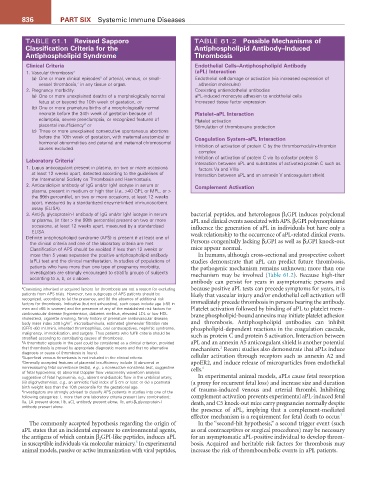
         TABLE 61.1  revised Sapporo                             TABLE 61.2  Possible Mechanisms of
         Classification Criteria for the                         antiphospholipid antibody–induced
         antiphospholipid Syndrome     1                         Thrombosis

          Clinical Criteria                                      Endothelial Cells–antiphospholipid antibody
          1. Vascular thrombosis a                               (aPL) interaction
           (a)  One or more clinical episodes  of arterial, venous, or small-  Endothelial cell damage or activation (via increased expression of
                                  b
              vessel thrombosis,  in any tissue or organ.         adhesion molecules)
                          c
          2. Pregnancy morbidity:                                Coexisting antiendothelial antibodies
           (a)  One or more unexplained deaths of a morphologically normal   aPL-induced monocyte adhesion to endothelial cells
              fetus at or beyond the 10th week of gestation, or  Increased tissue factor expression
             (b)  One or more premature births of a morphologically normal
              neonate before the 34th week of gestation because of   Platelet–aPL interaction
              eclampsia, severe preeclampsia, or recognized features of   Platelet activation
                            d
              placental insufficiency  or                        Stimulation of thromboxane production
             (c)  Three or more unexplained consecutive spontaneous abortions
              before the 10th week of gestation, with maternal anatomical or   Coagulation System–aPL interaction
              hormonal abnormalities and paternal and maternal chromosomal   Inhibition of activation of protein C by the thrombomodulin–thrombin
              causes excluded.
                                                                  complex
                                                                 Inhibition of activation of protein C via its cofactor protein S
          Laboratory Criteria e                                  Interaction between aPL and substrates of activated protein C such as
          1. Lupus anticoagulant present in plasma, on two or more occasions   factors Va and VIIIa
           at least 12 weeks apart, detected according to the guidelines of   Interaction between aPL and an annexin V anticoagulant shield
           the International Society on Thrombosis and Haemostasis.
          2. Anticardiolipin antibody of IgG and/or IgM isotype in serum or   Complement activation
           plasma, present in medium or high titer (i.e., >40 GPL or MPL, or >
           the 99th percentile), on two or more occasions, at least 12 weeks
           apart, measured by a standardized enzyme-linked immunosorbent
           assay (ELISA).
          3. Anti-β 2  glycoprotein-I antibody of IgG and/or IgM isotype in serum   bacterial peptides, and heterologous β 2 GPI induces polyclonal
           or plasma, (in titer > the 99th percentile) present on two or more   aPL and clinical events associated with APS. β 2 GPI polymorphisms
           occasions, at least 12 weeks apart, measured by a standardized   influence the generation of aPL in individuals but have only a
           ELISA.
          Definite antiphospholipid syndrome (APS) is present if at least one of   weak relationship to the occurrence of aPL-related clinical events.
           the clinical criteria and one of the laboratory criteria are met.   Persons congenitally lacking β 2 GPI as well as β 2 GPI knock-out
           Classification of APS should be avoided if less than 12 weeks or   mice appear normal.
           more than 5 years separates the positive antiphospholipid antibody   In humans, although cross-sectional and prospective cohort
           (aPL) test and the clinical manifestation. In studies of populations of   studies demonstrate that aPL can predict future thrombosis,
           patients who have more than one type of pregnancy morbidity,   the pathogenic mechanism remains unknown; more than one
           investigators are strongly encouraged to stratify groups of subjects   mechanism may be involved (Table 61.2). Because high-titer
           according to a, b, or c above.
                                                               antibody can persist for years in asymptomatic persons and
        a Coexisting inherited or acquired factors for thrombosis are not a reason for excluding   because positive aPL tests can precede symptoms for years, it is
        patients from APS trials. However, two subgroups of APS patients should be   likely that vascular injury and/or endothelial cell activation will
        recognized, according to (a) the presence, and (b) the absence of additional risk
        factors for thrombosis. Indicative (but not exhaustive), such cases include age (>55 in   immediately precede thrombosis in persons bearing the antibody.
        men and >65 in women) and the presence of any of the established risk factors for   Platelet activation followed by binding of aPL to platelet mem-
        cardiovascular disease (hypertension, diabetes mellitus, elevated LDL or low HDL   brane phospholipid-bound annexins may initiate platelet adhesion
        cholesterol, cigarette smoking, family history of premature cardiovascular disease,
        body mass index ≥30 kg/m , microalbuminuria, estimated glomerular filtration rate   and thrombosis.  Antiphospholipid antibodies can inhibit
                        2
        (GFR) <60 mL/min), inherited thrombophilias, oral contraceptives, nephritic syndrome,   phospholipid-dependent reactions in the coagulation cascade,
        malignancy, immobilization, and surgery. Thus patients who fulfill criteria should be   such as protein C and protein S activation. Interaction between
        stratified according to contributing causes of thrombosis.
        b A thrombotic episode in the past could be considered as a clinical criterion, provided   aPL and an annexin A5 anticoagulant shield is another potential
        that thrombosis is proved by appropriate diagnostic means and that no alternative   mechanism.  Recent studies also demonstrate that aPLs induce
                                                                         2
        diagnosis or cause of thrombosis is found.
        c Superficial venous thrombosis is not included in the clinical criteria.  cellular activation through receptors such as annexin A2 and
        d Generally accepted features of placental insufficiency include (i) abnormal or   apoER2, and induce release of microparticles from endothelial
        nonreassuring fetal surveillance test(s), e.g., a nonreactive nonstress test, suggestive   cells. 6
        of fetal hypoxemia; (ii) abnormal Doppler flow velocimetry waveform analysis
        suggestive of fetal hypoxemia, e.g., absent end-diastolic flow in the umbilical artery;   In experimental animal models, aPLs cause fetal resorption
        (iii) oligohydramnios, e.g., an amniotic fluid index of 5 cm or less; or (iv) a postnatal   (a proxy for recurrent fetal loss) and increase size and duration
        birth weight less than the 10th percentile for the gestational age.
        e Investigators are strongly advised to classify APS patients in studies into one of the   of trauma-induced venous and arterial thrombi. Inhibiting
        following categories: I, more than one laboratory criteria present (any combination);   complement activation prevents experimental aPL-induced fetal
        IIa, LA present alone; IIb, aCL antibody present alone; IIc, anti-β 2-glycoprotein-I   death, and C5 knock-out mice carry pregnancies normally despite
        antibody present alone.
                                                               the presence of aPL, implying that a complement-mediated
                                                               effector mechanism is a requirement for fetal death to occur. 7
           The commonly accepted hypothesis regarding the origin of   In the “second-hit hypothesis,” a second trigger event (such
        aPL states that an incidental exposure to environmental agents,   as oral contraceptives or surgical procedures) may be necessary
        the antigens of which contain β 2 GPI-like peptides, induces aPL   for an asymptomatic aPL-positive individual to develop throm-
                                             5
        in susceptible individuals via molecular mimicry.  In experimental   bosis. Acquired and heritable risk factors for thrombosis may
        animal models, passive or active immunization with viral peptides,   increase the risk of thromboembolic events in aPL patients.

