


Page 867 - Clinical Immunology_ Principles and Practice ( PDFDrive )
P. 867
CHaPTEr 61  Antiphospholipid Syndrome                837


             A proposed pathogenesis for aPL-mediated thrombosis and
           placental injury begins with activation or apoptosis (by unknown
           triggers, possibly infectious or traumatic) of platelets, endothelial
           cells, or trophoblasts. Negatively charged phosphatidylserine
           migrates from the inner to the outer cell membrane. Circulating
           β 2 GPI binds to phosphatidylserine, which is followed by aPL
           binding to a β 2 GPI dimer, activating a complement and, through
           C5a, initiating a signaling cascade that induces cell surface tissue
           factor (TF) expression and adhesion molecules (e.g., ICAM-1).
           Other components of the innate immune system may also be
           activated, leading to a milieu that promotes platelet activation
           and thrombosis. In addition, aPL adversely affects formation of
           a trophoblast syncytium, placental apoptosis, and trophoblast
           invasion, all processes required for the normal establishment of
           placental function. In vitro, pathogenic aPL induces adhesion
           molecules and enhances adherence of leukocytes to cultured
           endothelial cells.

           DIAGNOSIS
           Clinical Manifestations
           The clinical manifestations associated with aPL represent a
           spectrum from asymptomatic to catastrophic APS (Table 61.3).
           The principal manifestations are venous or arterial thromboses
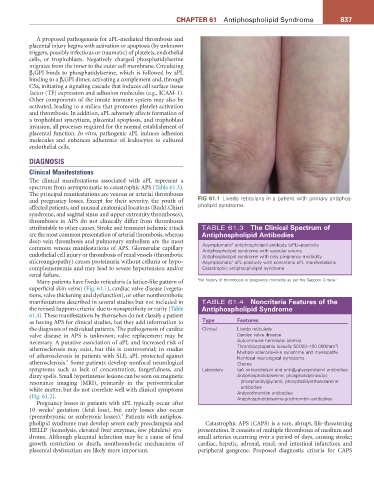
           and pregnancy losses. Except for their severity, the youth of   FiG 61.1  Livedo reticularis in a patient with primary antiphos-
           affected patients, and unusual anatomical locations (Budd-Chiari   pholipid syndrome.
           syndrome, and sagittal sinus and upper extremity thromboses),
           thromboses in  APS do not clinically differ from thromboses
           attributable to other causes. Stroke and transient ischemic attack   TABLE 61.3  The Clinical Spectrum of
           are the most common presentation of arterial thrombosis, whereas   antiphospholipid antibodies
           deep vein thrombosis and pulmonary embolism are the most          a
           common venous manifestations of APS. Glomerular capillary   Asymptomatic  antiphospholipid antibody (aPL)–positivity
                                                                   Antiphospholipid syndrome with vascular events
           endothelial cell injury or thrombosis of renal vessels (thrombotic   Antiphospholipid syndrome with only pregnancy morbidity
           microangiopathy) causes proteinuria without celluria or hypo-  Asymptomatic  aPL-positivity with noncriteria aPL manifestations
                                                                             a
           complementemia and may lead to severe hypertension and/or   Catastrophic antiphospholipid syndrome
           renal failure.
                                                                  a No history of thrombosis or pregnancy morbidity as per the Sapporo Criteria. 1
             Many patients have livedo reticularis (a lattice-like pattern of
           superficial skin veins) (Fig. 61.1), cardiac valve disease (vegeta-
           tions, valve thickening and dysfunction), or other nonthrombotic
           manifestations described in several studies but not included in   TABLE 61.4  Noncriteria Features of the
                                1
           the revised Sapporo criteria  due to nonspecificity or rarity (Table   antiphospholipid Syndrome
           61.4). These manifestations by themselves do not classify a patient
           as having APS for clinical studies, but they add information to   Type  Features
           the diagnosis of individual patients. The pathogenesis of cardiac   Clinical  Livedo reticularis
           valve disease in  APS is unknown; valve replacement may be          Cardiac valve disease
           necessary. A putative association of aPL and increased risk of      Autoimmune hemolytic anemia     3
           atherosclerosis may exist, but this is controversial; in studies    Thrombocytopenia (usually 50 000–100 000/mm )
                                                                               Multiple sclerosis–like syndrome and myelopathy
           of atherosclerosis in patients with SLE, aPL protected against      Nonfocal neurological symptoms
                       8
           atherosclerosis.  Some patients develop nonfocal neurological       Chorea
           symptoms such as lack of concentration, forgetfulness, and   Laboratory  IgA anticardiolipin and anti-β 2 -glycoprotein-I antibodies
           dizzy spells. Small hyperintense lesions can be seen on magnetic    Antiphosphatidylserine, phosphatidylinositol,
           resonance imaging (MRI), primarily in the periventricular            phosphatidylglycerol, phosphatidylethanolamine
                                                                                antibodies
           white matter, but do not correlate well with clinical symptoms      Antiprothrombin antibodies
           (Fig. 61.2).                                                        Antiphosphatidylserine-prothrombin antibodies
             Pregnancy losses in patients with aPL typically occur after
           10 weeks’ gestation (fetal loss), but early losses also occur
                                         9
           (preembryonic or embryonic losses).  Patients with antiphos-
           pholipid syndrome may develop severe early preeclampsia and   Catastrophic APS (CAPS) is a rare, abrupt, life-threatening
           HELLP (hemolysis, elevated liver enzymes, low platelets) syn-  presentation. It consists of multiple thromboses of medium and
           drome. Although placental infarction may be a cause of fetal   small arteries occurring over a period of days, causing stroke;
           growth restriction or death, nonthrombotic mechanisms of   cardiac, hepatic, adrenal, renal, and intestinal infarction; and
           placental dysfunction are likely more important.       peripheral gangrene. Proposed diagnostic criteria for CAPS

