


Page 868 - Clinical Immunology_ Principles and Practice ( PDFDrive )
P. 868
838          ParT Six  Systemic Immune Diseases


                                                                 TABLE 61.5  Preliminary Criteria for the
                                                                 Classification of Catastrophic
                                                                 antiphospholipid Syndrome

                                                                 1. Evidence of involvement of three or more organs, systems, and/or
                                                                   tissues a
                                                                 2. Development of manifestations simultaneously or in less than 1
                                                                   week
                                                                 3. Confirmation by histopathology of small-vessel occlusion in at least
                                                                   one organ or tissue b
                                                                 4. Laboratory confirmation of the presence of antiphospholipid
                                                                   antibody (aPL) c

                                                                 Definite Catastrophic antiphospholipid Syndrome (aPS):
                                                                 •  All 4 criteria
                                                                 Probable Catastrophic aPS:
                                                                 •  Criteria 2–4 and two organs, systems, and/or tissues involved;
                                                                 •  Criteria 1–3, except no aPL confirmation 6 weeks apart due to the
                                                                   early death of a patient not tested before catastrophic episode;
                                                                 •  Criteria 1, 2, 4; or
                                                                 •  Criteria 1, 3, 4, and development of a third event more than 1
                                                                   week but less than 1 month after first despite anticoagulation.
                                                               a Usually, clinical evidence of vessel occlusions, confirmed by imaging techniques
                                                               when appropriate. Renal involvement is defined by a 50% rise in serum creatinine,
                                                               severe systemic hypertension, and/or proteinuria.
                                                               b For histopathological confirmation, significant evidence of thrombosis must be
                                                               present, although vasculitis may coexist occasionally.
                                                               c If the patient had not been previously diagnosed as having APS, laboratory
                                                               confirmation requires that the presence of aPL must be detected on two or more
                                                               occasions at least 12 weeks apart (not necessarily at the time of the event),
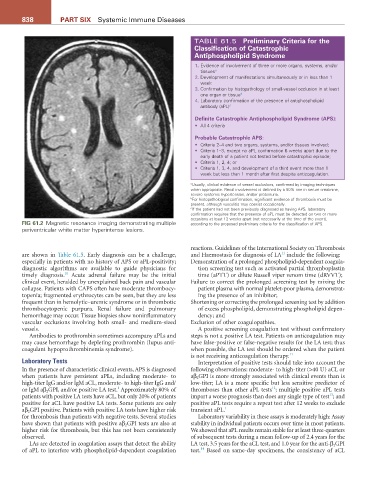
        FiG 61.2  Magnetic resonance imaging demonstrating multiple   according to the proposed preliminary criteria for the classification of APS.
        periventricular white matter hyperintense lesions.


                                                               reactions. Guidelines of the International Society on Thrombosis
                                                                                             11
        are shown in  Table 61.5. Early diagnosis can be a challenge,   and Haemostasis for diagnosis of LA  include the following:
        especially in patients with no history of APS or aPL-positivity;   Demonstration of a prolonged phospholipid-dependent coagula-
        diagnostic algorithms are available to guide physicians for   tion screening test such as activated partial thromboplastin
                      10
        timely diagnosis.   Acute adrenal failure may be the initial   time (aPTT) or dilute Russell viper venom time (dRVVT);
        clinical event, heralded by unexplained back pain and vascular   Failure to correct the prolonged screening test by mixing the
        collapse. Patients with CAPS often have moderate thrombocy-  patient plasma with normal platelet-poor plasma, demonstrat-
        topenia; fragmented erythrocytes can be seen, but they are less   ing the presence of an inhibitor;
        frequent than in hemolytic–uremic syndrome or in thrombotic   Shortening or correcting the prolonged screening test by addition
        thrombocytopenic purpura. Renal failure and pulmonary     of excess phospholipid, demonstrating phospholipid depen-
        hemorrhage may occur. Tissue biopsies show noninflammatory   dency; and
        vascular occlusions involving both small- and medium-sized     Exclusion of other coagulopathies.
        vessels.                                                  A positive screening coagulation test without confirmatory
           Antibodies to prothrombin sometimes accompany aPLs and   steps is not a positive LA test. Patients on anticoagulation may
        may cause hemorrhage by depleting prothrombin (lupus anti-  have false-positive or false-negative results for the LA test; thus
        coagulant hypoprothrombinemia syndrome).               when possible, the LA test should be ordered when the patient
                                                               is not receiving anticoagulation therapy. 11
        Laboratory Tests                                          Interpretation of positive tests should take into account the
        In the presence of characteristic clinical events, APS is diagnosed   following observations: moderate- to high-titer (>40 U) aCL or
        when patients have persistent aPLs, including moderate- to   aβ 2 GPI is more strongly associated with clinical events than is
        high-titer IgG and/or IgM aCL, moderate- to high-titer IgG and/  low-titer; LA is a more specific but less sensitive predictor of
                                                                                          12
                                       1
        or IgM aβ 2 GPI, and/or positive LA test.  Approximately 80% of   thromboses than other aPL tests ; multiple positive aPL tests
                                                                                                             13
        patients with positive LA tests have aCL, but only 20% of patients   impart a worse prognosis than does any single type of test ; and
        positive for aCL have positive LA tests. Some patients are only   positive aPL tests require a repeat test after 12 weeks to exclude
        aβ 2 GPI positive. Patients with positive LA tests have higher risk   transient aPL. 1
        for thrombosis than patients with negative tests. Several studies   Laboratory variability in these assays is moderately high: Assay
        have shown that patients with positive aβ 2 GPI tests are also at   stability in individual patients occurs over time in most patients.
        higher risk for thrombosis, but this has not been consistently   We showed that aPL results remain stable for at least three-quarters
        observed.                                              of subsequent tests during a mean follow-up of 2.4 years for the
           LAs are detected in coagulation assays that detect the ability   LA test, 3.5 years for the aCL test, and 1.0 year for the anti-β 2 GPI
                                                                   14
        of aPL to interfere with phospholipid-dependent coagulation   test.  Based on same-day specimens, the consistency of aCL

