


Page 862 - Clinical Immunology_ Principles and Practice ( PDFDrive )
P. 862
CHaPTEr 60  Systemic Autoinflammatory Syndromes                   833


            A                                                 B
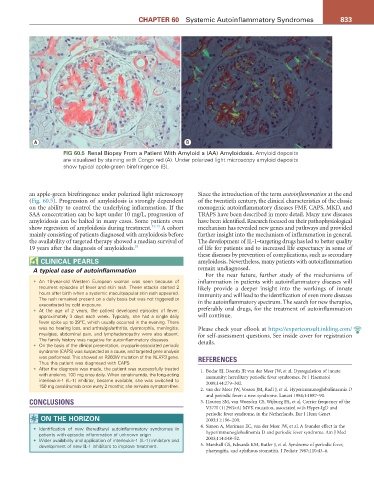
                      FIG 60.5  Renal Biopsy From a Patient With Amyloid a (AA) Amyloidosis. Amyloid deposits
                      are visualized by staining with Congo red (A). Under polarized light microscopy amyloid deposits
                      show typical apple-green birefringence (B).


           an apple-green birefringence under polarized light microscopy   Since the introduction of the term autoinflammation at the end
           (Fig.  60.5).  Progression  of  amyloidosis  is  strongly  dependent    of the twentieth century, the clinical characteristics of the classic
           on the ability to control the underlying inflammation. If the   monogenic autoinflammatory diseases FMF, CAPS, MKD, and
           SAA concentration can be kept under 10 mg/L, progression of   TRAPS have been described in more detail. Many new diseases
           amyloidosis can be halted in many cases. Some patients even   have been identified. Research focused on their pathophysiological
           show regression of amyloidosis during treatment. 31-34  A cohort   mechanism has revealed new genes and pathways and provided
           mainly consisting of patients diagnosed with amyloidosis before   further insight into the mechanism of inflammation in general.
           the availability of targeted therapy showed a median survival of   The development of IL-1–targeting drugs has led to better quality
           19 years after the diagnosis of amyloidosis. 33        of life for patients and to increased life expectancy in some of
                                                                  these diseases by prevention of complications, such as secondary
               CLINICaL PEarLS                                    amyloidosis. Nevertheless, many patients with autoinflammation
            A typical case of autoinflammation                    remain undiagnosed.
                                                                    For the near future, further study of the mechanisms of
            •  An 18-year-old Western European woman was seen because of   inflammation in patients with autoinflammatory diseases will
              recurrent episodes of fever and skin rash. These attacks started 2   likely provide a deeper insight into the workings of innate
              hours after birth when a systemic maculopapular skin rash appeared.   immunity and will lead to the identification of even more diseases
              The rash remained present on a daily basis but was not triggered or   in the autoinflammatory spectrum. The search for new therapies,
              exacerbated by cold exposure.
            •  At  the  age  of  2  years,  the  patient  developed  episodes  of  fever,   preferably oral drugs, for the treatment of autoinflammation
              approximately 3 days each week. Typically, she had a single daily   will continue.
              fever spike up to 39°C, which usually occurred in the evening. There
              was no hearing loss, and arthralgia/arthritis, dysmorphia, meningitis,   Please check your eBook at https://expertconsult.inkling.com/
              myalgias, abdominal pain, and lymphadenopathy were also absent.   for self-assessment questions. See inside cover for registration
              The family history was negative for autoinflammatory diseases.  details.
            •  On the basis of the clinical presentation, cryopyrin-associated periodic
              syndrome (CAPS) was suspected as a cause, and targeted gene analysis
              was performed. This showed an R260W mutation of the NLRP3 gene.   REFERENCES
              Thus this patient was diagnosed with CAPS.
            •  After the diagnosis was made, the patient was successfully treated   1.  Bodar EJ, Drenth JP, van der Meer JW, et al. Dysregulation of innate
              with anakinra, 100 mg once daily. When canakinumab, the long-acting   immunity: hereditary periodic fever syndromes. Br J Haematol
              interleukin-1 (IL-1) inhibitor, became available, she was switched to   2009;144:279–302.
              150 mg canakinumab once every 2 months; she remains symptom-free.
                                                                   2.  van der Meer JW, Vossen JM, Radl J, et al. Hyperimmunoglobulinaemia D
                                                                    and periodic fever: a new syndrome. Lancet 1984;1:1087–90.
           CONCLUSIONS                                             3.  Houten SM, van Woerden CS, Wijburg FA, et al. Carrier frequency of the
                                                                    V377I (1129G>A) MVK mutation, associated with Hyper-IgD and
                                                                    periodic fever syndrome, in the Netherlands. Eur J Hum Genet
               ON THE HOrIZON                                       2003;11:196–200.
                                                                   4.  Simon A, Mariman EC, van der Meer JW, et al. A founder effect in the
            •  Identification  of new (hereditary) autoinflammatory syndromes in
              patients with episodic inflammation of unknown origin  hyperimmunoglobulinemia D and periodic fever syndrome. Am J Med
            •  Wider availability and application of interleukin-1 (IL-1) inhibitors and   2003;114:148–52.
              development of new IL-1 inhibitors to improve treatment.  5.  Marshall GS, Edwards KM, Butler J, et al. Syndrome of periodic fever,
                                                                    pharyngitis, and aphthous stomatitis. J Pediatr 1987;110:43–6.

