


Page 882 - Clinical Immunology_ Principles and Practice ( PDFDrive )
P. 882
854          Part Seven  Organ-Specific Inflammatory Disease


           Antiplatelet antibody testing to specific platelet glycoproteins   TRAs. Initial dosing of eltrombopag should be reduced by 50%
        is not routinely recommended; the test is neither sensitive nor   in patients of Southeast Asian origin. Danazol is an attenuated
        specific for ITP. Routine testing for anticardiolipin antibodies   androgen administered orally and has been used, with some
        is not recommended in the absence of symptoms of antiphos-  success, as a steroid-sparing agent. Third-line therapy is reserved
        pholipid syndrome. DAT should be obtained if hemolytic anemia   for patients who are unresponsive to or ineligible for first- and
        is suspected and in patients in whom anti-D antiglobulin treat-  second-line therapies. These agents include cyclophosphamide,
        ment is considered. Blood group Rh(D) typing should be obtained   azathioprine, mycophenolate mofetil, cyclosporine, alemtuzumab,
        if anti-D antiglobulin treatment is considered.        and vinca alkaloids. One novel approach to ITP consists of
           Where a microangiopathic process is evident, especially with   blockade of the FcγIIIA receptors on macrophages in the spleen
        concomitant renal failure, fever, or cognitive impairment, measure-  that mediate uptake of antibody-bound platelets. Prior attempts
        ment of ADAMTS13 (ADintegrin-like And Metalloprotease with   at FcγIIIA receptor blockade to ameliorate ITP using mAbs to
        ThromboSpondin type 13 motifs) is warranted to rule out TTP.  FcγIIIA have improved platelet counts in half the patients refrac-
                                                               tory to other treatments but were abandoned because of nausea,
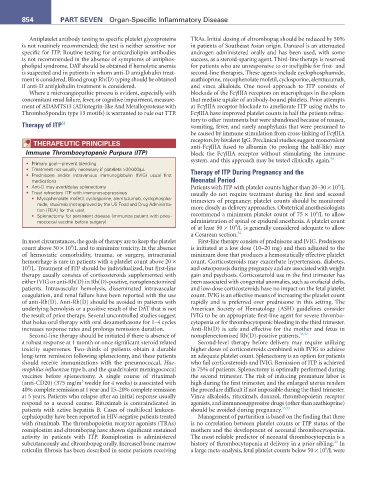
        Therapy of ITP 53                                      vomiting, fever, and rarely anaphylaxis that were presumed to
                                                               be caused by immune stimulation from cross-linking of FcγIIIA
            tHeraPeUtIC PrInCIPLeS                             receptors by bivalent IgG. Preclinical studies suggest monovalent
                                                               anti-FcγIIIA fused to albumin (to prolong the half-life) may
         Immune Thrombocytopenic Purpura (ITP)                 block the FcγIIIA receptor without stimulating the immune
                                                               system, and this approach may be tested clinically, again. 54
          •  Primary goal—prevent bleeding
          •  Treatment not usually necessary if platelets >30 000/µL  Therapy of ITP During Pregnancy and the
          •  Prednisone and/or  intravenous immunoglobulin (IVIG) usual  first
           medications                                         Neonatal Period
                                                                                                                9
          •  Anti-D may avert/delay splenectomy                Patients with ITP with platelet counts higher than 20–30 × 10 /L
          •  Treat refractory ITP with immunosuppressives      usually do not require treatment during the first and second
           •  Mycophenolate mofetil, cyclosporine, alemtuzumab, cyclophospha-  trimesters of pregnancy; platelet counts should be monitored
             mide, rituximab (not approved by the US Food and Drug Administra-
             tion [FDA] for this use)                          more closely as delivery approaches. Obstetrical anesthesiologists
                                                                                                        9
           •  Splenectomy for persistent disease (immunize patient with pneu-  recommend a minimum platelet count of 75 × 10 /L to allow
             mococcal vaccine before surgery)                  administration of spinal or epidural anesthesia. A platelet count
                                                                              9
                                                               of at least 50 × 10 /L is generally considered adequate to allow
                                                               a Cesarean section. 52
        In most circumstances, the goals of therapy are to keep the platelet   First-line therapy consists of prednisone and IVIG. Prednisone
                        9
        count above 30 × 10 /L and to minimize toxicity. In the absence   is initiated at a low dose (10–20 mg) and then adjusted to the
        of hemostatic comorbidity, trauma, or surgery, intracranial   minimum dose that produces a hemostatically effective platelet
        hemorrhage is rare in patients with a platelet count above 20 ×   count. Corticosteroids may exacerbate hypertension, diabetes,
          9
        10 /L. Treatment of ITP should be individualized, but first-line   and osteoporosis during pregnancy and are associated with weight
        therapy usually consists of corticosteroids supplemented with   gain and psychosis. Corticosteroid use in the first trimester has
        either IVIG or anti-Rh(D) in Rh(D)-positive, nonsplenectomized   been associated with congenital anomalies, such as orofacial clefts,
        patients. Intravascular hemolysis, disseminated intravascular   and low-dose corticosteroids have no impact on the fetal platelet
        coagulation, and renal failure have been reported with the use   count. IVIG is an effective means of increasing the platelet count
        of anti-Rh(D). Anti-Rh(D) should be avoided in patients with   rapidly and is preferred over prednisone in this setting. The
        underlying hemolysis or a positive result of the DAT that is not   American Society of Hematology (ASH) guidelines consider
        the result of prior therapy. Several uncontrolled studies suggest   IVIG to be an appropriate first-line agent for severe thrombo-
        that bolus oral therapy with oral dexamethasone for 1–4 cycles   cytopenia or for thrombocytopenic bleeding in the third trimester.
        increases response rates and prolongs remission duration.  Anti-Rh(D) is safe and effective for the mother and fetus in
           Second-line therapy should be initiated if there is absence of   nonsplenectomized Rh(D)-positive patients. 33,52
        a robust response at 1 month or once significant steroid related   Second-level therapy before delivery may require utilizing
        toxicity supervenes. Two-thirds of patients obtain  a durable   higher doses of corticosteroids combined with IVIG to achieve
        long-term remission following splenectomy, and these patients   an adequate platelet count. Splenectomy is an option for patients
        should  receive immunizations  with  the  pneumococcal,  Hae-  who fail corticosteroids and IVIG. Remission of ITP is achieved
        mophilus influenzae type b, and the quadrivalent meningococcal   in 75% of patients. Splenectomy is optimally performed during
        vaccines  before  splenectomy.  A  single  course  of  rituximab   the second trimester. The risk of inducing premature labor is
                            2
        (anti-CD20) (375 mg/m  weekly for 4 weeks) is associated with   high during the first trimester, and the enlarged uterus renders
        40% complete remission at 1 year and 15–20% complete remission   the procedure difficult if not impossible during the third trimester.
        at 5 years. Patients who relapse after an initial response usually   Vinca alkaloids, rituximab, danazol, thrombopoietin receptor
        respond to a second course. Rituximab is contraindicated in   agonists, and immunosuppressive drugs (other than azathioprine)
        patients with active hepatitis B. Cases of multifocal leukoen-  should be avoided during pregnancy. 33,52
        cephalopathy have been reported in HIV-negative patients treated   Management of parturition is based on the finding that there
        with rituximab. The thrombopoietin receptor agonists (TRAs)   is no correlation between platelet counts or ITP status of the
        romiplostim and eltrombopag have shown significant sustained   mothers and the development of neonatal thrombocytopenia.
        activity in patients with ITP. Romiplostim is administered   The most reliable predictor of neonatal thrombocytopenia is a
                                                                                                              33
        subcutaneously and eltrombopag orally. Increased bone marrow   history of thrombocytopenia at delivery in a prior sibling.  In
                                                                                                           9
        reticulin fibrosis has been described in some patients receiving   a large meta-analysis, fetal platelet counts below 50 × 10 /L were

