


Page 878 - Clinical Immunology_ Principles and Practice ( PDFDrive )
P. 878
850          Part Seven  Organ-Specific Inflammatory Disease


                                                               this antibody probably is not specific for neutropenia, since it is
                                                               also present in patients with autoimmune disease who do not
                                                               have neutropenia.
                                                               Patterns of Autoantibody Specificity
                                                               Isoimmune neonatal neutropenia is associated with maternal
                                                               IgG iso- or autoantibodies that can be generated in response to
                                                               each of the polymorphic alloantigens noted above, particularly
                                                               polymorphisms affecting FcγRIIIb.
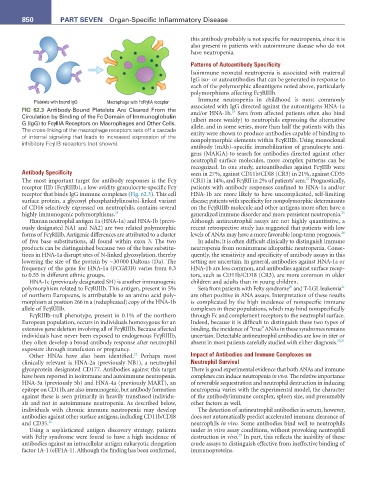
            Platelets with bound IgG   Macrophage with FcRγIIA receptor   Immune neutropenia in childhood is most commonly
        FIG 62.3  Antibody-Bound Platelets Are Cleared From the   associated with IgG directed against the autoantigens HNA-1a
                                                                             26
        Circulation by Binding of the Fc Domain of Immunoglobulin   and/or HNA-1b.  Sera from affected patients often also bind
        G (IgG) to FcγIIIA Receptors on Macrophages and Other Cells.   (albeit more weakly) to neutrophils expressing the alternative
        The cross-linking of the macrophage receptors sets off a cascade   allele, and in some series, more than half the patients with this
        of internal signaling that leads to increased expression of the   entity were shown to produce antibodies capable of binding to
        inhibitory FcγIIB receptors (not shown).               nonpolymorphic elements within FcγRIIIb. Using monoclonal
                                                               antibody (mAb)–specific immobilization of granulocyte anti-
                                                               gens (MAIGA) to search for antibodies directed against other
                                                               neutrophil surface molecules, more complex patterns can be
                                                               recognized. In one study, autoantibodies against FcγIIIb were
        Antibody Specificity                                   seen in 27%, against CD11b/CDI8 (CR3) in 21%, against CD35
                                                                                                     27
        The most important target for antibody responses is the Fcγ   (CR1) in 14%, and FcγRII in 2% of patients’ sera.  Prognostically,
        receptor IIIb (FcγRIIIb), a low-avidity granulocyte-specific Fcγ   patients with antibody responses confined to HNA-1a and/or
        receptor that binds IgG immune complexes (Fig. 62.3). This cell   HNA-1b are more likely to have uncomplicated, self-limiting
        surface protein, a glycosyl phosphatidylinositol-linked variant   disease; patients with specificity for nonpolymorphic determinants
        of CD16 selectively expressed on neutrophils, contains several   on the FcγRIIIb molecule and other antigens more often have a
                                                                                                                 26
        highly immunogenic polymorphisms. 24                   generalized immune disorder and more persistent neutropenia.
           Human neutrophil antigen 1a (HNA-1a) and HNA-1b (previ-  Although antineutrophil assays are not highly quantitative, a
        ously designated NA1 and NA2) are two related polymorphic   recent retrospective study has suggested that patients with low
        forms of FcγRIIIb. Antigenic differences are attributed to a cluster   levels of ANAs may have a more favorable long-term prognosis. 28
        of five base substitutions, all found within exon 3. The two   In adults, it is often difficult clinically to distinguish immune
        products can be distinguished because two of the base substitu-  neutropenia from nonimmune idiopathic neutropenia. Conse-
        tions in HNA-1a disrupt sites of N-linked glycosylation, thereby   quently, the sensitivity and specificity of antibody assays in this
        lowering the size of the protein by ~30 000 Daltons (Da). The   setting are uncertain. In general, antibodies against HNA-1a or
        frequency of the gene for HNA-1a (FCGR3B) varies from 0.3   HNA-1b are less common, and antibodies against surface recep-
        to 0.55 in different ethnic groups.                    tors, such as CD11b/CD18 (CR3), are more common in older
           HNA-1c (previously designated SH) is another immunogenic   children and adults than in young children.
                                                                                                20
                                                                                                                 21
        polymorphism related to FcγRIIIb. This antigen, present in 5%   Sera from patients with Felty syndrome  and T-LGL leukemia
        of northern Europeans, is attributable to an amino acid poly-  are often positive in ANA assays. Interpretation of these results
        morphism at position 266 in a (reduplicated) copy of the HNA-1b   is complicated by the high incidence of nonspecific immune
        allele of FcγRIIIb.                                    complexes in these populations, which may bind nonspecifically
           FcγRIIIb-null phenotype, present in 0.1% of the northern   through Fc and complement receptors to the neutrophil surface.
        European population, occurs in individuals homozygous for an   Indeed, because it is difficult to distinguish these two types of
        extensive gene deletion involving all of FcγRIIIb. Because affected   binding, the incidence of “true” ANAs in these syndromes remains
        individuals have never been exposed to endogenous FcγRIIIb,   uncertain. Detectable antineutrophil antibodies are low in titer or
        they often develop a broad antibody response after neutrophil   absent in most patients carefully studied with either diagnosis. 20,21
        exposure through transfusion or pregnancy.
                                             25
           Other  HNAs  have  also  been  identified.   Perhaps  most   Impact of Antibodies and Immune Complexes on
        clinically relevant is HNA-2a (previously NB1), a neutrophil   Neutrophil Survival
        glycoprotein designated CD177. Antibodies against this target   There is good experimental evidence that both ANAs and immune
        have been reported in isoimmune and autoimmune neutropenia.   complexes can induce neutropenia in vivo. The relative importance
        HNA-3a (previously 5b) and HNA-4a (previously MART), an   of reversible sequestration and neutrophil destruction in inducing
        epitope on CD11b, are also immunogenic, but antibody formation   neutropenia varies with the experimental model, the character
        against these is seen primarily in heavily transfused individu-  of the antibody/immune complex, spleen size, and presumably
        als and not in autoimmune neutropenia. As described below,   other factors as well.
        individuals with chronic immune neutropenia may develop   The detection of antineutrophil antibodies in serum, however,
        antibodies against other surface antigens, including CD11b/CDI8    does not automatically predict accelerated immune clearance of
        and CD35. 26                                           neutrophils in vivo. Some antibodies bind well to neutrophils
           Using a sophisticated antigen discovery strategy, patients   under in vitro assay conditions, without provoking neutrophil
                                                                               29
        with Felty syndrome were found to have a high incidence of   destruction in vivo.  In part, this reflects the inability of these
        antibodies against an intracellular antigen eukaryotic elongation   crude assays to distinguish effective from ineffective binding of
        factor 1A-1 (eEF1A-1). Although the finding has been confirmed,   immunoproteins.

