


Page 885 - Clinical Immunology_ Principles and Practice ( PDFDrive )
P. 885
CHaPter 62  Immunohematological Disorders              856.e1


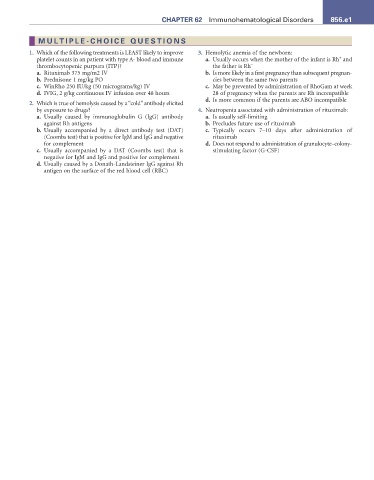
              MUL t IPL e -CHOIC e  QU e S t IO n S

           1.  Which of the following treatments is LEAST likely to improve   3.  Hemolytic anemia of the newborn:
                                                                                                                +
             platelet counts in an patient with type A- blood and immune    a.  Usually occurs when the mother of the infant is Rh  and
             thrombocytopenic purpura (ITP)?                           the father is Rh −
              a.  Rituximab 375 mg/m2 IV                             b.  Is more likely in a first pregnancy than subsequent pregnan-
              b.  Prednisone 1 mg/kg PO                                cies between the same two parents
              c.  WinRho 250 IU/kg (50 micrograms/kg) IV             c.  May be prevented by administration of RhoGam at week
              d.  IVIG, 2 g/kg continuous IV infusion over 48 hours    28 of pregnancy when the parents are Rh incompatible
                                                                     d.  Is more common if the parents are ABO incompatible
           2.  Which is true of hemolysis caused by a “cold” antibody elicited
             by exposure to drugs?                                4.  Neutropenia associated with administration of rituximab:
              a.  Usually caused by immunoglobulin G (IgG) antibody    a.  Is usually self-limiting
               against Rh antigens                                   b.  Precludes future use of rituximab
              b.  Usually accompanied by a direct antibody test (DAT)    c.  Typically  occurs  7–10  days after  administration  of
               (Coombs test) that is positive for IgM and IgG and negative   rituximab
               for complement                                        d.  Does not respond to administration of granulocyte–colony-
              c.  Usually accompanied by a DAT (Coombs test) that is   stimulating factor (G-CSF)
               negative for IgM and IgG and positive for complement
              d.  Usually caused by a Donath-Landsteiner IgG against Rh
               antigen on the surface of the red blood cell (RBC)

