


Page 888 - Clinical Immunology_ Principles and Practice ( PDFDrive )
P. 888
CHaPtEr 63  Bullous Diseases of the Skin and Mucous Membranes                   859


           and serum from patients with PF contains IgG antibodies, which   IgA deposition mainly in the upper epidermis. The IEN subtype
           bind to normal stratified squamous epithelium. Although the   is characterized by pustules deeper in the epidermis, with intercel-
           immunofluorescence patterns of PF and PV are virtually identical,   lular IgA deposition throughout the epidermis. Circulating IgA
           the antigenic targets of these autoantibodies are different (see   antibodies to intraepidermal structures are present in ~50% of
           below).                                                cases. Desmocollin 1 (a desmosomal cadherin) has been identified
                                                                  as a target autoantigen in most cases with the SPD phenotype.
           Paraneoplastic Pemphigus                               In some IEN-type cases, desmoglein-1 (Dsg1) and Dsg3 are
           Anhalt described a series of patients with severe oral erosions   autoantibody targets, but in most IEN cases the autoantigen
           and polymorphic skin lesions suggestive of coexistent PV and   remains unknown. Patients of both types commonly present
                            8
           erythema multiforme.  All these patients had associated malignan-  with flat pustules, often on a slightly erythematous base, which
           cies, which were mostly lymphoreticular, including lymphoma,   tend to coalesce to form annular patterns. IgA pemphigus mainly
           chronic lymphocytic leukemia, and thymoma. The histological   affects the trunk, axillae, and groin but not the mucosa. Histology
           features of the skin lesions in these patients resembled PV,   of  lesional  skin  reveals  subcorneal  or  intraepidermal  blisters,
           including suprabasilar blister formation, but with additional   with acantholytic cells and a neutrophilic infiltrate. 9
           keratinocyte cell necrosis as found in erythema multiforme. Skin
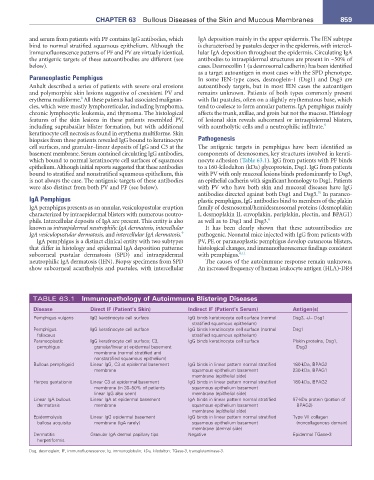
           biopsies from these patients revealed IgG bound to keratinocyte   Pathogenesis
           cell surfaces, and granular–linear deposits of IgG and C3 at the   The antigenic targets in pemphigus have been identified as
           basement membrane. Serum contained circulating IgG antibodies,   components of desmosomes, key structures involved in kerati-
           which bound to normal keratinocyte cell surfaces of squamous   nocyte adhesion (Table 63.1). IgG from patients with PF binds
           epithelium. Although initial reports suggested that these antibodies   to a 160-kilodalton (kDa) glycoprotein, Dsg1. IgG from patients
           bound to stratified and nonstratified squamous epithelium, this   with PV with only mucosal lesions binds predominantly to Dsg3,
           is not always the case. The antigenic targets of these antibodies   an epithelial cadherin with significant homology to Dsg1. Patients
           were also distinct from both PV and PF (see below).    with PV who have both skin and mucosal diseases have IgG
                                                                                                         10
                                                                  antibodies directed against both Dsg1 and Dsg3.  In paraneo-
           IgA Pemphigus                                          plastic pemphigus, IgG antibodies bind to members of the plakin
           IgA pemphigus presents as an annular, vesiculopustular eruption   family of desmosomal/hemidesmosomal proteins (desmoplakin
           characterized by intraepidermal blisters with numerous neutro-  I, desmoplakin II, envoplakin, periplakin, plectin, and BPAG1)
           phils. Intercellular deposits of IgA are present. This entity is also   as well as to Dsg1 and Dsg3. 8
           known as intraepidermal neutrophilic IgA dermatosis, intercellular   It has been clearly shown that these autoantibodies are
           IgA vesiculopustular dermatosis, and intercellular IgA dermatosis. 9  pathogenic. Neonatal mice injected with IgG from patients with
             IgA pemphigus is a distinct clinical entity with two subtypes   PV, PF, or paraneoplastic pemphigus develop cutaneous blisters,
           that differ in histology and epidermal IgA deposition patterns:   histological changes, and immunofluorescence findings consistent
           subcorneal pustular dermatosis (SPD) and intraepidermal   with pemphigus. 8,11
           neutrophilic IgA dermatosis (IEN). Biopsy specimens from SPD   The causes of the autoimmune response remain unknown.
           show subcorneal acantholysis and pustules, with intercellular   An increased frequency of human leukocyte antigen (HLA)-DR4


            TABLE 63.1  Immunopathology of autoimmune Blistering Diseases
            Disease            Direct IF (Patient’s Skin)      Indirect IF (Patient’s Serum)     antigen(s)
            Pemphigus vulgaris  IgG keratinocyte cell surface  IgG binds keratinocyte cell surface (normal   Dsg3, +/− Dsg1
                                                                stratified squamous epithelium)
            Pemphigus          IgG keratinocyte cell surface   IgG binds keratinocyte cell surface (normal   Dsg1
             foliaceus                                          stratified squamous epithelium)
            Paraneoplastic     IgG keratinocyte cell surface; C3,   IgG binds keratinocyte cell surface  Plakin proteins, Dsg1,
             pemphigus          granular/linear at epidermal basement                             Dsg3
                                membrane (normal stratified and
                                nonstratified squamous epithelium)
            Bullous pemphigoid  Linear IgG, C3 at epidermal basement   IgG binds in linear pattern normal stratified   180-kDa, BPAG2
                                membrane                        squamous epithelium basement     230-kDa, BPAG1
                                                                membrane (epithelial side)
            Herpes gestationis  Linear C3 at epidermal basement   IgG binds in linear pattern normal stratified   180-kDa, BPAG2
                                membrane (in 30–50% of patients   squamous epithelium basement
                                linear IgG also seen)           membrane (epithelial side)
            Linear IgA bullous   Linear IgA at epidermal basement   IgA binds in linear pattern normal stratified   97-kDa protein (portion of
             dermatosis         membrane                        squamous epithelium basement      BPAG2)
                                                                membrane (epithelial side)
            Epidermolysis      Linear IgG epidermal basement   IgG binds in linear pattern normal stratified   Type VII collagen
             bullosa acquisita  membrane (IgA rarely)           squamous epithelium basement      (noncollagenous domain)
                                                                membrane (dermal side)
            Dermatitis         Granular IgA dermal papillary tips  Negative                      Epidermal TGase-3
             herpetiformis
           Dsg, desmoglein; IF, immunofluorescence; Ig, immunoglobulin; kDa, kilodalton; TGase-3, transglutaminase-3.

