


Page 892 - Clinical Immunology_ Principles and Practice ( PDFDrive )
P. 892
CHaPtEr 63  Bullous Diseases of the Skin and Mucous Membranes                   863


           EPIDERMOLYSIS BULLOSA ACQUISITA                        in BP. Linear deposits of C3, IgM, IgA, and fibrinogen have also
                                                                              35
                                                                  been reported.  However, in EBA, these deposits are localized
           EBA is a chronic subepidermal blistering disease that typically   exclusively below the lamina lucida. Direct immunofluorescence
           presents in the fourth to sixth decades. There are two forms of   of saline-split perilesional skin shows IgG in the blister floor in
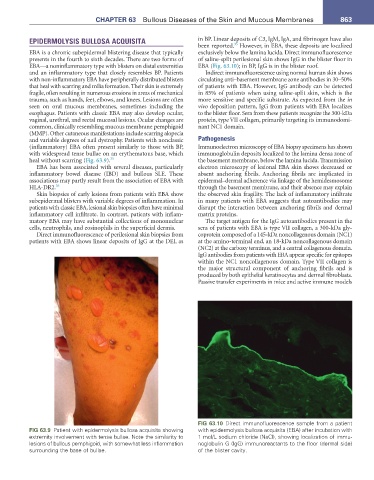
           EBA—a noninflammatory type with blisters on distal extremities   EBA (Fig. 63.10); in BP, IgG is in the blister roof.
           and an inflammatory type that closely resembles BP. Patients   Indirect immunofluorescence using normal human skin shows
           with non-inflammatory EBA have peripherally distributed blisters   circulating anti–basement membrane zone antibodies in 30–50%
           that heal with scarring and milia formation. Their skin is extremely   of patients with EBA. However, IgG antibody can be detected
           fragile, often resulting in numerous erosions in areas of mechanical   in 85% of patients when using saline-split skin, which is the
           trauma, such as hands, feet, elbows, and knees. Lesions are often   more sensitive and specific substrate. As expected from the in
           seen on oral mucous membranes, sometimes including the   vivo deposition pattern, IgG from patients with EBA localizes
           esophagus. Patients with classic EBA may also develop ocular,   to the blister floor. Sera from these patients recognize the 300-kDa
           vaginal, urethral, and rectal mucosal lesions. Ocular changes are   protein, type VII collagen, primarily targeting its immunodomi-
           common, clinically resembling mucous membrane pemphigoid   nant NC1 domain.
           (MMP). Other cutaneous manifestations include scarring alopecia
           and variable degrees of nail dystrophy. Patients with nonclassic   Pathogenesis
           (inflammatory) EBA often present similarly to those with BP,   Immunoelectron microscopy of EBA biopsy specimens has shown
           with widespread tense bullae on an erythematous base, which   immunoglobulin deposits localized to the lamina densa zone of
           heal without scarring (Fig. 63.9). 35                  the basement membrane, below the lamina lucida. Transmission
             EBA has been associated with several diseases, particularly   electron microscopy of lesional EBA skin shows decreased or
           inflammatory bowel disease (IBD) and bullous SLE. These   absent anchoring fibrils.  Anchoring fibrils are implicated in
           associations may partly result from the association of EBA with   epidermal–dermal adherence via linkage of the hemidesmosome
           HLA-DR2. 36                                            through the basement membrane, and their absence may explain
             Skin biopsies of early lesions from patients with EBA show   the observed skin fragility. The lack of inflammatory infiltrate
           subepidermal blisters with variable degrees of inflammation. In   in many patients with EBA suggests that autoantibodies may
           patients with classic EBA, lesional skin biopsies often have minimal   disrupt the interaction between anchoring fibrils and dermal
           inflammatory cell infiltrate. In contrast, patients with inflam-  matrix proteins.
           matory EBA may have substantial collections of mononuclear   The target antigen for the IgG autoantibodies present in the
           cells, neutrophils, and eosinophils in the superficial dermis.  sera of patients with EBA is type VII collagen, a 300-kDa gly-
             Direct immunofluorescence of perilesional skin biopsies from   coprotein composed of a 145-kDa noncollagenous domain (NC1)
           patients with EBA shows linear deposits of IgG at the DEJ, as   at the amino-terminal end, an 18-kDa noncollagenous domain
                                                                  (NC2) at the carboxy terminus, and a central collagenous domain.
                                                                  IgG antibodies from patients with EBA appear specific for epitopes
                                                                  within the NC1 noncollagenous domain. Type VII collagen is
                                                                  the major structural component of anchoring fibrils and is
                                                                  produced by both epithelial keratinocytes and dermal fibroblasts.
                                                                  Passive transfer experiments in mice and active immune models


                                                                  FIG 63.10  Direct immunofluorescence sample from a patient
           FIG 63.9  Patient with epidermolysis bullosa acquisita showing   with epidermolysis bullosa acquisita (EBA) after incubation with
           extremity involvement with tense bullae. Note the similarity to   1 mol/L sodium chloride (NaCl), showing localization of immu-
           lesions of bullous pemphigoid, with somewhat less inflammation   noglobulin G (IgG) immunoreactants to the floor (dermal side)
           surrounding the base of bullae.                        of the blister cavity.

