


Page 902 - Clinical Immunology_ Principles and Practice ( PDFDrive )
P. 902
872          Part SEVEN  Organ-Specific Inflammatory Disease


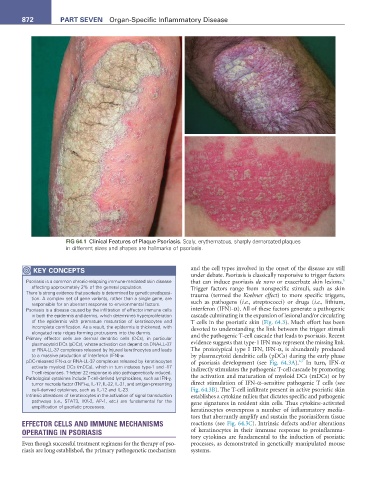
                       FIG 64.1  Clinical Features of Plaque Psoriasis. Scaly, erythematous, sharply demarcated plaques
                       in different sizes and shapes are hallmarks of psoriasis.


            KEY CONCEPtS                                       and the cell types involved in the onset of the disease are still
                                                               under debate. Psoriasis is classically responsive to trigger factors
          Psoriasis is a common chronic-relapsing immune-mediated skin disease   that can induce psoriasis de novo or exacerbate skin lesions.
                                                                                                                 6
           affecting approximately 2% of the general population.  Trigger factors range from nonspecific stimuli, such as skin
          There is strong evidence that psoriasis is determined by genetic predisposi-  trauma (termed the  Koebner effect) to more specific triggers,
           tion. A complex set of gene variants, rather than a single gene, are
           responsible for an aberrant response to environmental factors.  such as pathogens (i.e., streptococci) or drugs (i.e., lithium,
          Psoriasis is a disease caused by the infiltration of effector immune cells   interferon (IFN)-α). All of these factors generate a pathogenic
           in both the epidermis and dermis, which determines hyperproliferation   cascade culminating in the expansion of lesional and/or circulating
           of the epidermis with premature maturation of keratinocytes and   T cells in the psoriatic skin (Fig. 64.3). Much effort has been
           incomplete cornification. As a result, the epidermis is thickened, with   devoted to understanding the link between the trigger stimuli
           elongated rete ridges forming protrusions into the dermis.
          Primary effector cells are dermal dendritic cells (DCs), in particular   and the pathogenic T-cell cascade that leads to psoriasis. Recent
           plasmacytoid DCs (pDCs), whose activation can depend on DNA-LL-37   evidence suggests that type-1 IFN may represent the missing link.
           or RNA-LL-37 complexes released by injured keratinocytes and leads   The prototypical type I IFN, IFN-α, is abundantly produced
           to a massive production of interferon (IFN)-α.      by plasmacytoid dendritic cells (pDCs) during the early phase
          pDC-released IFN-α or RNA-LL-37 complexes released by keratinocytes   of psoriasis development (see  Fig. 64.3A).  In turn, IFN-α
                                                                                                   6,7
           activate myeloid DCs (mDCs), which in turn induces type-1 and -17   indirectly stimulates the pathogenic T-cell cascade by promoting
           T-cell responses. T-helper 22 response is also pathogenetically induced.
          Pathological cytokines include T-cell-derived lymphokines, such as IFN-γ,   the activation and maturation of myeloid DCs (mDCs) or by
           tumor necrosis factor (TNF)-α, IL-17, IL-22, IL-21, and antigen-presenting   direct stimulation of IFN-α–sensitive pathogenic T cells (see
           cell–derived cytokines, such as IL-12 and IL-23.    Fig. 64.3B). The T-cell infiltrate present in active psoriatic skin
          Intrinsic alterations of keratinocytes in the activation of signal transduction   establishes a cytokine milieu that dictates specific and pathogenic
           pathways (i.e., STAT3, IKK-2, AP-1, etc.) are fundamental for the   gene signatures in resident skin cells. Thus cytokine-activated
           amplification of psoriatic processes.
                                                               keratinocytes overexpress  a number of  inflammatory media-
                                                               tors that aberrantly amplify and sustain the psoriasiform tissue
        EFFECTOR CELLS AND IMMUNE MECHANISMS                   reactions (see Fig. 64.3C). Intrinsic defects and/or alterations
        OPERATING IN PSORIASIS                                 of keratinocytes in their immune response to proinflamma-
                                                               tory cytokines are fundamental to the induction of psoriatic
        Even though successful treatment regimens for the therapy of pso-  processes, as demonstrated in genetically manipulated mouse
        riasis are long established, the primary pathogenetic mechanism   systems.

