


Page 900 - Clinical Immunology_ Principles and Practice ( PDFDrive )
P. 900
CHaPtEr 63  Bullous Diseases of the Skin and Mucous Membranes                870.e1


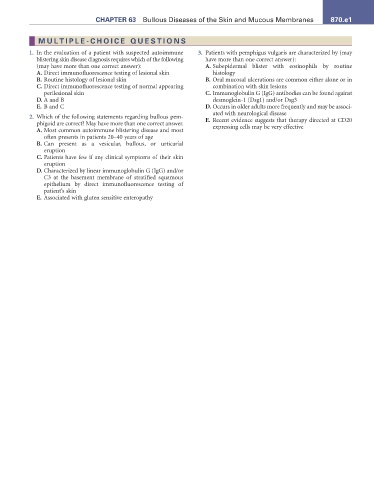
              MUL t IPLE-CHOICE QUES t IONS

           1.  In the evaluation of a patient with suspected autoimmune   3.  Patients with pemphigus vulgaris are characterized by (may
             blistering skin disease diagnosis requires which of the following   have more than one correct answer):
             (may have more than one correct answer):                A. Subepidermal blister with eosinophils by routine
              A. Direct immunofluorescence testing of lesional skin    histology
              B. Routine histology of lesional skin                  B. Oral mucosal ulcerations are common either alone or in
              C. Direct immunofluorescence testing of normal appearing   combination with skin lesions
               perilesional skin                                     C. Immunoglobulin G (IgG) antibodies can be found against
              D. A and B                                               desmoglein-1 (Dsg1) and/or Dsg3
              E.  B and C                                            D. Occurs in older adults more frequently and may be associ-
                                                                       ated with neurological disease
           2.  Which of the following statements regarding bullous pem-
             phigoid are correct? May have more than one correct answer.   E.  Recent evidence suggests that therapy directed at CD20
              A. Most common autoimmune blistering disease and most    expressing cells may be very effective
               often presents in patients 20–40 years of age
              B. Can present as a vesicular, bullous, or urticarial
               eruption
              C. Patients have few if any clinical symptoms of their skin
               eruption
              D. Characterized by linear immunoglobulin G (IgG) and/or
               C3 at the basement membrane of stratified squamous
               epithelium by direct immunofluorescence testing of
               patient’s skin
              E.  Associated with gluten sensitive enteropathy

