


Page 904 - Clinical Immunology_ Principles and Practice ( PDFDrive )
P. 904
874          Part SEVEN  Organ-Specific Inflammatory Disease


                                                                                         NF-NB         NF-NB
                                                                                          AP1           AP1
                                                                                         STAT1         STAT1
                                                                                STAT3         STAT3
                                                                                               p38
                     Trigger factors:                                            p38          Erk 1/2
                      Pathogens                                                 Erk 1/2
                        Drugs
                       Stress
                                                                                          PMN
                                                          PMN                      PMN PMN   PMN
             autoantigens                          PMN  PMN
             K17, K13        LL-37  LL-37                                                        growth signals
              LL-37/  ?viral antigens?                                                            TGF-α, KGF
                                                                                                  IL-19, IL-20
              DNA
                                              VEGF             CD8                                amphiregulin
                     DNA-LL-37                                                  Tc1
                       DNA-LL-37             Endothelium  TNF-α  CD8         HLA-DR                       IL-1
                        RNA-LL-37                     TNF-α                         Tc1
                              IFN-α                                                                    KGF, FGF10
                       pDC                 CX3CL1, CCL17                                                GM-CSF
            pDC                             ICAM-1, VCAM,  Th1  INF-γ        ICAM-1                      IL-36
                                             E-selectin
                                     RNA-LL-37          Th17  Th1   Th22       Tc1                     cytokines
                                       RNA-LL-37                Th1                         chemokines
                               pDC                 mDC      Th17  Th17 Th2                  CXCL10-9-11,  TGF-α, GM-CSF,
                  Chemerin             IFN-α                                     TNF-α, IFN-γ,         IL-1, IL-6,
                                       IFN-α                                      IL-17, IL-22  CCL2, CXCL8, IL-19, IL-20, IL-36
                                                                                              CCL20
           Fibroblasts                                               TIP-DC                 CCL5, CCL19
                             Endothelial cells                                    Th1 Th17
                                                                               Th17     Th2
                                                          PMN                       Th22
             Chemerin      Mast cell            mDC                            Th1       Th2
                                                       Th17                                           Fibroblasts
                        Chemerin                     Th1             Mast cell            Th1
            Fibroblasts                                   PMN         PMN              Th17            Endothelium
                                                   NK             PMN
                       Fibroblasts
                                                          SlanDC                                      ICAM-1, VCAM,
           A                               B                                 C          SlanDC          E-selectin
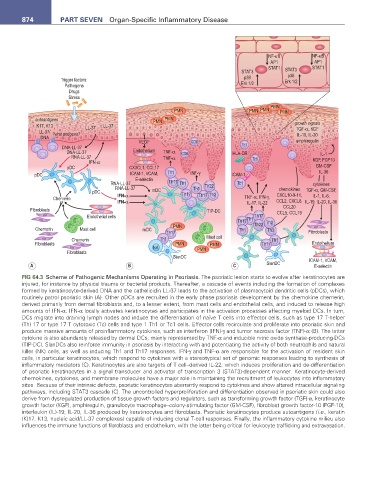
        FIG 64.3  Scheme of Pathogenic Mechanisms Operating in Psoriasis. The psoriatic lesion starts to evolve after keratinocytes are
        injured, for instance by physical trauma or bacterial products. Thereafter, a cascade of events including the formation of complexes
        formed by keratinocyte-derived DNA and the cathelicidin LL-37 leads to the activation of plasmacytoid dendritic cells (pDCs), which
        routinely patrol psoriatic skin (A). Other pDCs are recruited in the early phase psoriasis development by the chemokine chemerin,
        derived primarily from dermal fibroblasts and, to a lesser extent, from mast cells and endothelial cells, and induced to release high
        amounts of IFN-α. IFN-α locally activates keratinocytes and participates in the activation processes affecting myeloid DCs. In turn,
        DCs migrate into draining lymph nodes and induce the differentiation of naïve T cells into effector cells, such as type 17 T-helper
        (Th) 17 or type 17 T cytotoxic (Tc) cells and type 1 Th1 or Tc1 cells. Effector cells recirculate and proliferate into psoriatic skin and
        produce massive amounts of proinflammatory cytokines, such as interferon (IFN)-γ and tumor necrosis factor (TNF)-α (B). The latter
        cytokine is also abundantly released by dermal DCs, mainly represented by TNF-α and inducible nitric oxide synthase-producing-DCs
        (TIP-DC). SlanDCs also reinforce immunity in psoriasis by interacting with and potentiating the activity of both neutrophils and natural
        killer (NK) cells, as well as inducing Th1 and Th17 responses. IFN-γ and TNF-α are responsible for the activation of resident skin
        cells, in particular keratinocytes, which respond to cytokines with a stereotypical set of genomic responses leading to synthesis of
        inflammatory mediators (C). Keratinocytes are also targets of T cell–derived IL-22, which induces proliferation and de-differentiation
        of psoriatic keratinocytes in a signal transducer and activator of transcription 3 (STAT3)-dependent manner. Keratinocyte-derived
        chemokines, cytokines, and membrane molecules have a major role in maintaining the recruitment of leukocytes into inflammatory
        sites. Because of their intrinsic defects, psoriatic keratinocytes aberrantly respond to cytokines and show altered intracellular signaling
        pathways, including STAT3 cascade (C). The uncontrolled hyperproliferation and differentiation observed in psoriatic skin could also
        derive from dysregulated production of tissue growth factors and regulators, such as transforming growth factor (TGF)-α, keratinocyte
        growth factor (KGF), amphiregulin, granulocyte macrophage–colony-stimulating factor (GM-CSF), fibroblast growth factor-10 (FGF-10),
        interleukin (IL)-19, IL-20, IL-36 produced by keratinocytes and fibroblasts. Psoriatic keratinocytes produce autoantigens (i.e., keratin
        (K)17, K13, nucleic acid/LL-37 complexes) capable of inducing clonal T-cell responses. Finally, the inflammatory cytokine milieu also
        influences the immune functions of fibroblasts and endothelium, with the latter being critical for leukocyte trafficking and extravasation.

