


Page 920 - Clinical Immunology_ Principles and Practice ( PDFDrive )
P. 920
CHAPtER 65  Myasthenia Gravis              889


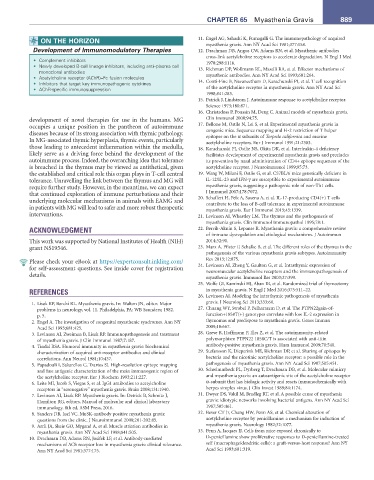
               ON tHE HORIZON                                     11.  Engel AG, Sahashi K, Fumagalli G. The immunopathology of acquired
                                                                    myasthenia gravis. Ann NY Acad Sci 1981;377:158.
            Development of Immunomodulatory Therapies             12.  Drachman DB, Angus CW, Adams RN, et al. Myasthenic antibodies
                                                                    cross-link acetylcholine receptors to accelerate degradation. N Engl J Med
            •  Complement inhibitors                                1978;298:1116.
            •  Newly developed B-cell lineage inhibitors, including anti–plasma cell   13.  Richman DP, Wollmann RL, Maselli RA, et al. Effector mechanisms of
              monoclonal antibodies
            •  Acetylcholine receptor (AChR)–Fc fusion molecules    myasthenic antibodies. Ann NY Acad Sci 1993;681:264.
            •  Inhibitors that target key immunopathogenic cytokines  14.  Conti-Fine B, Navaneetham D, Karachunski PI, et al. T cell recognition
            •  AChR-specific immunosuppression                      of the acetylcholine receptor in myasthenia gravis. Ann NY Acad Sci
                                                                    1998;841:283.
                                                                  15.  Patrick J, Lindstrom J. Autoimmune response to acetylcholine receptor.
                                                                    Science 1973;180:871.
                                                                  16.  Christadoss P, Poussin M, Deng C. Animal models of myasthenia gravis.
           development of novel therapies for use in the humans. MG   Clin Immunol 2000;94:75.
           occupies a unique position in the pantheon of autoimmune   17.  Bellone M, Ostile N, Lei S, et al. Experimental myasthenia gravis in
           diseases because of its strong association with thymic pathology.   congenic mice. Sequence mapping and H-2 restriction of T helper
                                                                    epitopes on the α subunits of Torpedo californica and murine
           In MG-associated thymic hyperplasia, thymic events, particularly   acetylcholine receptors. Eur J Immunol 1991;21:2303.
           those leading to antecedent inflammation within the medulla,   18.  Karachunski PI, Ostlie NS, Okita DK, et al. Interleukin-4 deficiency
           likely serve as a driving force behind the development of the   facilitates development of experimental myasthenia gravis and precludes
           autoimmune process. Indeed, the overarching idea that tolerance   its prevention by nasal administration of CD4+ epitope sequences of the
           is breached in the thymus may be viewed as antithetical, given   acetylcholine receptor. J Neuroimmunol 1999;95:73.
           the established and critical role this organ plays in T-cell central   19.  Wang W, Milani F, Ostlie G, et al. C57BL/6 mice genetically deficient in
           tolerance. Unravelling the link between the thymus and MG will   IL-12/IL-23 and IFN-γ are susceptible to experimental autoimmune
           require further study. However, in the meantime, we can expect   myasthenia gravis, suggesting a pathogenic role of non-Th1 cells.
           that continued exploration of immune perturbations and their   J Immunol 2007;178:7072.
           underlying molecular mechanisms in animals with EAMG and   20.  Schaffert H, Pelz A, Saxena A, et al. IL-17-producing CD4(+) T cells
                                                                    contribute to the loss of B-cell tolerance in experimental autoimmune
           in patients with MG will lead to safer and more robust therapeutic   myasthenia gravis. Eur J Immunol 2015;45:1339.
           interventions.                                         21.  Levinson AI, Wheatley LM. The thymus and the pathogenesis of
                                                                    myasthenia gravis. Clin Immunol Immunopathol 1995;78:1.
           ACKNOWLEDGMENT                                         22.  Berrih-Aknin S, Lepanse R. Myasthenia gravis: a comprehensive review
                                                                    of immune dysregulation and etiological mechanisms. J Autoimmun
           This work was supported by National Institutes of Health (NIH)   2014;52:90.
           grant NS19546.                                         23.  Marx A, Pfister F, Schalke B, et al. The different roles of the thymus in the
                                                                    pathogenesis of the various myasthenia gravis subtypes. Autoimmunity
           Please check your eBook at https://expertconsult.inkling.com/   Rev 2013;12:875.
           for self-assessment questions. See inside cover for registration   24.  Levinson AI, Zheng Y, Gaulton G, et al. Intrathymic expression of
                                                                    neuromuscular acetylcholine receptors and the immunopathogenesis of
           details.                                                 myasthenia gravis. Immunol Res 2003;27:399.
                                                                  25.  Wolfe GI, Kaminski HJ, Aban IB, et al. Randomized trial of thymectomy
           REFERENCES                                               in myasthenia gravis. N Engl J Med 2016;375:511–22.
                                                                  26.  Levinson AI. Modeling the intrathymic pathogenesis of myasthenia
           1.  Lisak RP, Barchi RL. Myasthenia gravis. In: Walton JN, editor. Major   gravis. J Neurolog Sci 2013;333:60.
             problems in neurology, vol. 11. Philadelphia, PA: WB Saunders; 1982.    27.  Chuang WY, Strobel P, Belharazem D, et al. The PTPN22gain-of-
             p. 5.                                                  function+1858T(+) genotypes correlate with low IL-2 expression in
           2.  Engel A. The investigation of congenital myasthenic syndromes. Ann NY   thymomas and predispose to myasthenia gravis. Genes Immun
             Acad Sci 1993;681:425.                                 2009;10:667.
           3.  Levinson AI, Zweiman B, Lisak RP. Immunopathogenesis and treatment   28.  Greve B, Hoffmann P, Illes Z, et al. The autoimmunity-related
             of myasthenia gravis. J Clin Immunol 1987;7:187.       polymorphism PTPN22 1858C/T is associated with anti-titin
           4.  Tindal RSA. Humoral immunity in myasthenia gravis: biochemical   antibody-positive myasthenia gravis. Hum Immunol 2009;70:540.
             characterization of acquired anti-receptor antibodies and clinical   29.  Stefansson K, Dieperink ME, Richman DP, et al. Sharing of epitopes by
             correlations. Ann Neurol 1981;10:437.                  bacteria and the nicotinic acetylcholine receptor: a possible role in the
           5.  Papadouli I, Sakarellos C, Tzartos SJ. High-resolution epitope mapping   pathogenesis of myasthenia gravis. Ann NY Acad Sci 1987;505:451.
             and fine antigenic characterization of the main immunogenic region of   30.  Schwimmbeck PL, Dyrberg T, Drachman DB, et al. Molecular mimicry
             the acetylcholine receptor. Eur J Biochem 1993;211:227.  and myasthenia gravis: an autoantigenic site of the acetylcholine receptor
           6.  Leite MI, Jacob S, Viegas S, et al. IgG1 antibodies to acetylcholine   α-subunit that has biologic activity and reacts immunochemically with
             receptors in “seronegative” myasthenia gravis. Brain 2008;131:1940.  herpes simplex virus. J Clin Invest 1989;84:1174.
           7.  Levinson AI, Lisak RP. Myasthenia gravis. In: Detrick B, Schmitz J,   31.  Dwyer DS, Vakil M, Bradleg RT, et al. A possible cause of myasthenia
             Hamilton RG, editors. Manual of molecular and clinical laboratory   gravis: idiotypic networks involving bacterial antigens. Ann NY Acad Sci
             immunology. 8th ed, ASM Press, 2016.                   1987;505:461.
           8.  Sanders DB, Juel VC. MuSK-antibody positive myasthenia gravis:   32.  Bever CT Jr, Chang HW, Penn AS, et al. Chemical alteration of
             questions from the clinic. J Neuroimmunol 2008;201-202:85.  acetylcholine receptor by penicillamine: a mechanism for induction of
           9.  Arrli JA, Skeie GO, Mygand A, et al. Muscle striation antibodies in   myasthenia gravis. Neurology 1982;32:1077.
             myasthenia gravis. Ann NY Acad Sci 1998;841:505.     33.  Penn A, Jacques JJ. Cells from mice exposed chronically to
           10.  Drachman DB, Adams RN, Josifek LF, et al. Antibody-mediated   D-penicillamine show proliferative responses to D-penicillamine-treated
             mechanisms of ACh receptor loss in myasthenia gravis: clinical relevance.   self (macrophage/dendritic cells): a graft-versus-host response? Ann NY
             Ann NY Acad Sci 1981;377:175.                          Acad Sci 1993;681:319.

