


Page 925 - Clinical Immunology_ Principles and Practice ( PDFDrive )
P. 925
CHaPter 66  Multiple Sclerosis            893


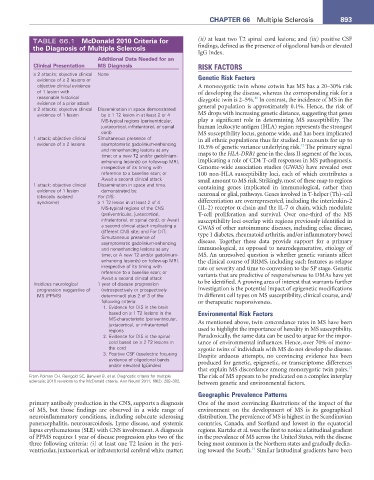
            TABLE 66.1  McDonald 2010 Criteria for                (ii) at least two T2 spinal cord lesions; and (iii) positive CSF
            the Diagnosis of Multiple Sclerosis                   findings, defined as the presence of oligoclonal bands or elevated
                                                                  IgG index.
                                 additional Data needed for an
            Clinical Presentation  MS Diagnosis                   RISK FACTORS
            ≥ 2 attacks; objective clinical  None
             evidence of ≥ 2 lesions or                           Genetic Risk Factors
             objective clinical evidence                          A monozygotic twin whose cotwin has MS has a 20–30% risk
             of 1 lesion with                                     of developing the disease, whereas the corresponding risk for a
             reasonable historical                                dizygotic twin is 2–5%.  In contrast, the incidence of MS in the
                                                                                    11
             evidence of a prior attack
            ≥ 2 attacks; objective clinical  Dissemination in space demonstrated   general population is approximately 0.1%. Hence, the risk of
             evidence of 1 lesion  by ≥ 1 T2 lesion in at least 2 or 4   MS drops with increasing genetic distance, suggesting that genes
                                  MS-typical regions (periventricular,   play a significant role in determining MS susceptibility. The
                                  juxtacortical, infratentorial, or spinal   human leukocyte antigen (HLA) region represents the strongest
                                  cord)                           MS susceptibility locus, genome wide, and has been implicated
            1 attack; objective clinical   Simultaneous presence of   in all ethnic populations thus far studied. It accounts for up to
             evidence of ≥ 2 lesions  asymptomatic gadolinium-enhancing   10.5% of genetic variance underlying risk.  The primary signal
                                                                                                   12
                                  and nonenhancing lesions at any
                                  time; or a new T2 and/or gadolinium-  maps to the HLA-DRB1 gene in the class II segment of the locus,
                                  enhancing lesion(s) on follow-up MRI,   implicating a role of CD4 T-cell responses in MS pathogenesis.
                                  irrespective of its timing with   Genome-wide association studies (GWAS) have revealed over
                                  reference to a baseline scan; or   100 non-HLA susceptibility loci, each of which contributes a
                                  Await a second clinical attack  small amount to MS risk. Strikingly, most of these map to regions
            1 attack; objective clinical   Dissemination in space and time,   containing genes implicated in immunological, rather than
             evidence of 1 lesion   demonstrated by:
             (clinically isolated   For DIS:                      neuronal or glial, pathways. Genes involved in T-helper (Th)–cell
             syndrome)           ≥ 1 T2 lesion in at least 2 of 4   differentiation are overrepresented, including the interleukin-2
                                  MS-typical regions of the CNS   (IL-2) receptor α chain and the IL-7 α chain, which modulate
                                  (periventricular, juxtacortical,   T-cell proliferation and survival. Over one-third of the MS
                                  infratentorial, or spinal cord); or Await   susceptibility loci overlap with regions previously identified in
                                  a second clinical attack implicating a   GWAS of other autoimmune diseases, including celiac disease,
                                  different CNS site; and For DIT:   type 1 diabetes, rheumatoid arthritis, and/or inflammatory bowel
                                  Simultaneous presence of
                                  asymptomatic gadolinium-enhancing   disease. Together these data provide support for a primary
                                  and nonenhancing lesions at any   immunological, as opposed to neurodegenerative, etiology of
                                  time; or A new T2 and/or gadolinium-  MS. An unresolved question is whether genetic variants affect
                                  enhancing lesion(s) on follow-up MRI,   the clinical course of RRMS, including such features as relapse
                                  irrespective of its timing with   rate or severity and time to conversion to the SP stage. Genetic
                                  reference to a baseline scan; or   variants that are predictive of responsiveness to DMAs have yet
                                  Await a second clinical attack
            Insidious neurological   1 year of disease progression   to be identified. A growing area of interest that warrants further
             progression suggestive of   (retrospectively or prospectively   investigation is the potential impact of epigenetic modifications
             MS (PPMS)            determined) plus 2 of 3 of the   in different cell types on MS susceptibility, clinical course, and/
                                  following criteria:             or therapeutic responsiveness.
                                   1. Evidence for DIS in the brain
                                     based on ≥ 1 T2 lesions in the   Environmental Risk Factors
                                     MS-characteristic (periventricular,
                                     juxtacortical, or infratentorial)   As mentioned above, twin concordance rates in MS have been
                                     regions                      used to highlight the importance of heredity in MS susceptibility.
                                   2. Evidence for DIS in the spinal   Paradoxically, the same data can be used to argue for the impor-
                                     cord based on ≥ 2 T2 lesions in   tance of environmental influences. Hence, over 70% of mono-
                                     the cord                     zygotic twins of individuals with MS do not develop the disease.
                                   3. Positive CSF (isoelectric focusing   Despite arduous attempts, no convincing evidence has been
                                     evidence of oligoclonal bands   produced for genetic, epigenetic, or transcriptome differences
                                     and/or elevated IgGindex)                                                     13
                                                                  that explain MS discordance among monozygotic twin pairs.
           From Polman CH, Reingold SC, Banwell B, et al. Diagnostic criteria for multiple   The risk of MS appears to be predicated on a complex interplay
           sclerosis: 2010 revisions to the McDonald criteria. Ann Neurol 2011; 69(2): 292–302.  between genetic and environmental factors.

                                                                  Geographic Prevalence Patterns
           primary antibody production in the CNS, supports a diagnosis   One of the most convincing illustrations of the impact of the
           of MS, but those findings are observed in a wide range of   environment on the development of MS is its geographical
           neuroinflammatory conditions, including subacute sclerosing   distribution. The prevalence of MS is highest in the Scandinavian
           panencephalitis, neurosarcoidosis, Lyme disease, and systemic   countries, Canada, and Scotland and lowest in the equatorial
           lupus erythematosus (SLE) with CNS involvement. A diagnosis   regions. Kurtzke et al. were the first to notice a latitudinal gradient
           of PPMS requires 1 year of disease progression plus two of the   in the prevalence of MS across the United States, with the disease
           three following criteria: (i) at least one T2 lesion in the peri-  being most common in the Northern states and gradually declin-
                                                                                   14
           ventricular, juxtacortical, or infratentorial cerebral white matter;   ing toward the South.  Similar latitudinal gradients have been

