


Page 975 - Clinical Immunology_ Principles and Practice ( PDFDrive )
P. 975
942          Part seven  Organ-Specific Inflammatory Disease


                                                    Pam3         E-selectin
                  HSVEC                             LTA          ICAM                  Caspase 3
                                                                 IL-8
                                              +                  ROS                   Caspase 7      Early
                                                    TLR        4h                   24h              stimulus
                                                     2
                                                                 VE-cadherin
                   PMN


                                          MPO/MMP
                                                              Hyaluronan Exposure       Apoptosis
                                              Late stimulus


                                                                      CD44
                                                    NET
                                                                  Thrombus
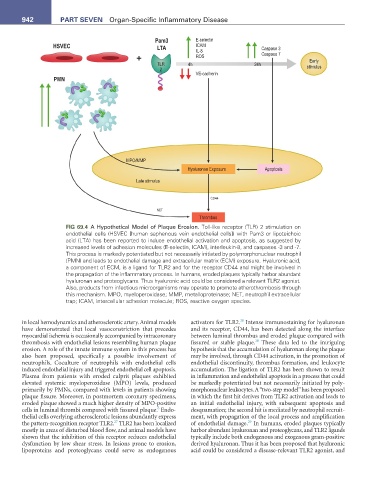
                       FIG 69.4  A Hypothetical Model of Plaque Erosion. Toll-like receptor (TLR) 2 stimulation on
                       endothelial cells (HSVEC [human saphenous vein endothelial cells]) with Pam3 or lipoteichoic
                       acid (LTA) has been reported to induce endothelial activation and apoptosis, as suggested by
                       increased levels of adhesion molecules (E-selectin, ICAM), interleukin-8, and caspases -3 and -7.
                       This process is markedly potentiated but not necessarily initiated by polymorphonuclear neutrophil
                       (PMN) and leads to endothelial damage and extracellular matrix (ECM) exposure. Hyaluronic acid,
                       a component of ECM, is a ligand for TLR2 and for the receptor CD44 and might be involved in
                       the propagation of the inflammatory process. In humans, eroded plaques typically harbor abundant
                       hyaluronan and proteoglycans. Thus hyaluronic acid could be considered a relevant TLR2 agonist.
                       Also, products from infectious microorganisms may operate to promote atherothrombosis through
                       this mechanism. MPO, myeloperoxidase; MMP, metalloproteinase; NET, neutrophil extracellular
                       trap; ICAM, intercellular adhesion molecule; ROS, reactive oxygen species.


                                                                                28
        in local hemodynamics and atherosclerotic artery. Animal models   activators for TLR2.  Intense immunostaining for hyaluronan
        have demonstrated that local vasoconstriction that precedes   and its receptor, CD44, has been detected along the interface
        myocardial ischemia is occasionally accompanied by intracoronary   between luminal thrombus and eroded plaque compared with
                                                                                    28
        thrombosis with endothelial lesions resembling human plaque   fissured or stable plaque.  These data led to the intriguing
        erosion. A role of the innate immune system in this process has   hypothesis that the accumulation of hyaluronan along the plaque
        also  been  proposed,  specifically  a  possible  involvement  of   may be involved, through CD44 activation, in the promotion of
        neutrophils. Coculture of neutrophils with endothelial cells   endothelial discontinuity, thrombus formation, and leukocyte
        induced endothelial injury and triggered endothelial cell apoptosis.   accumulation. The ligation of TLR2 has been shown to result
        Plasma from patients with eroded culprit plaques exhibited   in inflammation and endothelial apoptosis in a process that could
        elevated systemic myeloperoxidase (MPO) levels, produced   be markedly potentiated but not necessarily initiated by poly-
        primarily by PMNs, compared with levels in patients showing   morphonuclear leukocytes. A “two-step model” has been proposed
        plaque fissure. Moreover, in postmortem coronary specimens,   in which the first hit derives from TLR2 activation and leads to
        eroded plaque showed a much higher density of MPO-positive   an initial endothelial injury, with subsequent apoptosis and
                                                     6
        cells in luminal thrombi compared with fissured plaque.  Endo-  desquamation; the second hit is mediated by neutrophil recruit-
        thelial cells overlying atherosclerotic lesions abundantly express   ment, with propagation of the local process and amplification
                                                                                  29
                                      27
        the pattern-recognition receptor TLR2.  TLR2 has been localized   of endothelial damage.  In humans, eroded plaques typically
        mostly in areas of disturbed blood flow, and animal models have   harbor abundant hyaluronan and proteoglycans, and TLR2 ligands
        shown that the inhibition of this receptor reduces endothelial   typically include both endogenous and exogenous gram-positive
        dysfunction by low shear stress. In lesions prone to erosion,   derived hyaluronan. Thus it has been proposed that hyaluronic
        lipoproteins and proteoglycans could serve as endogenous   acid could be considered a disease-relevant TLR2 agonist, and

