


Page 970 - Clinical Immunology_ Principles and Practice ( PDFDrive )
P. 970
CHaPter 69  Inflammation and Atherothrombosis                 937


           responsible for coronary instability are multiple and insufficiently   the cause of coronary instability in all patients. However, about
           understood.                                            40% of ACS patients have low or very low levels of high-sensitivity
                                                                  C-reactive protein (hs-CRP), a very sensitive marker of inflam-
           ROLE OF INFLAMMATION IN THE PATHOGENESIS               mation.  Coronary angiography fails to demonstrate obstructive
                                                                        4
           OF ACUTE CORONARY SYNDROMES                            atherosclerosis in up to one-third of patients with symptoms
                                                                  suggestive of an ACS along with raised troponin levels and/or
           Experimental models of atherogenesis have provided a growing   ischemic-like ST segment changes, suggesting that functional
           body of information about molecular mechanisms of plaque   alterations of epicardial arteries and/or of coronary microcircula-
           growth; however, transition from coronary stability to instability   tion may also play an important pathogenetic role. 5
           is less well understood due to lack of animal models reflective   We have recently proposed a pathogenetic classification of
                         1
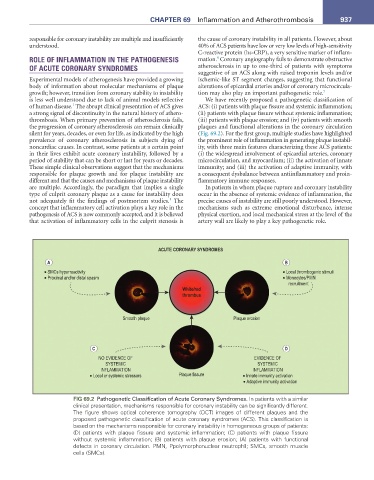
           of human disease.  The abrupt clinical presentation of ACS gives   ACS: (i) patients with plaque fissure and systemic inflammation;
           a strong signal of discontinuity in the natural history of athero-  (ii) patients with plaque fissure without systemic inflammation;
           thrombosis. When primary prevention of atherosclerosis fails,   (iii) patients with plaque erosion; and (iv) patients with smooth
           the progression of coronary atherosclerosis can remain clinically   plaques and functional alterations in the coronary circulation
           silent for years, decades, or even for life, as indicated by the high   (Fig. 69.2). For the first group, multiple studies have highlighted
           prevalence of coronary atherosclerosis in subjects dying of   the prominent role of inflammation in generating plaque instabil-
           noncardiac causes. In contrast, some patients at a certain point   ity, with three main features characterizing these ACS patients:
           in their lives exhibit acute coronary instability, followed by a   (i) the widespread involvement of epicardial arteries, coronary
           period of stability that can be short or last for years or decades.   microcirculation, and myocardium; (ii) the activation of innate
           These simple clinical observations suggest that the mechanisms   immunity; and (iii) the activation of adaptive immunity, with
           responsible for plaque growth and for plaque instability are   a consequent dysbalance between antiinflammatory and proin-
           different and that the causes and mechanisms of plaque instability   flammatory immune responses.
           are multiple. Accordingly, the paradigm that implies a single   In patients in whom plaque rupture and coronary instability
           type of culprit coronary plaque as a cause for instability does   occur in the absence of systemic evidence of inflammation, the
                                                        1
           not  adequately  fit  the  findings  of  postmortem  studies.   The   precise causes of instability are still poorly understood. However,
           concept that inflammatory cell activation plays a key role in the   mechanisms  such  as  extreme  emotional  disturbance, intense
           pathogenesis of ACS is now commonly accepted, and it is believed   physical exertion, and local mechanical stress at the level of the
           that activation of inflammatory cells in the culprit stenosis is   artery wall are likely to play a key pathogenetic role.


                                                     ACUTE CORONARY SYNDROMES

                 A                                                                            B
                • SMCs hyperreactivity                                                        • Local thrombogenic stimuli
                • Proximal and/or distal spasm                                                • Monocytes/PMN
                                                                                                   recruitment
                                                             White/red
                                                             thrombus


                                         Smooth plaque                       Plaque erosion


                               C                                                              D
                                 NO EVIDENCE OF                                     EVIDENCE OF
                                    SYSTEMIC                                         SYSTEMIC
                                  INFLAMMATION                                      INFLAMMATION
                              • Local or systemic stressors  Plaque fissure     • Innate immunity activation
                                                                                   • Adaptive immunity activation


                         FIG 69.2  Pathogenetic Classification of Acute Coronary Syndromes. In patients with a similar
                         clinical presentation, mechanisms responsible for coronary instability can be significantly different.
                         The figure shows optical coherence tomography (OCT) images of different plaques and the
                         proposed pathogenetic classification of acute coronary syndromes (ACS). This classification is
                         based on the mechanisms responsible for coronary instability in homogeneous groups of patients:
                         (D) patients with plaque fissure and systemic inflammation; (C) patients with plaque fissure
                         without systemic inflammation; (B) patients with plaque erosion; (A) patients with functional
                         defects in coronary circulation. PMN, Ppolymorphonuclear neutrophil; SMCs, smooth muscle
                         cells (SMCs).

