


Page 1152 - Hall et al (2015) Principles of Critical Care-McGraw-Hill
P. 1152
CHAPTER 86: Intracranial Pressure: Monitoring and Management  791


                    ICP monitoring or to consider other therapeutic maneuvers such as   depiction of CBF remaining constant over a wide range of arterial blood
                    surgical decompression.                                 pressures, at least in the normotensive noninjured brain, is presented in
                                                                          Fig. 86-7. In chronically hypertensive individuals, the autoregulatory
                        ■  CEREBRAL BLOOD FLOW AND CEREBRAL PERFUSION PRESSURE  threshold is shifted to the right. Relative blood pressure lowering within
                                                                          the autoregulatory range will be compensated by cerebral vasodilation
                    To appreciate the progressive detriment of elevated ICP, it is essential   and a resultant increase in cerebral blood volume (CBV). Conversely,
                    to understand the factors involved in determining and controlling   relative blood pressure elevations within an individual’s autoregulatory
                    cerebral blood flow (CBF). Neglecting, for a moment, that cerebral   range leads to cerebral vasoconstriction and a subsequent decrease in
                    arteries are rather flexible conduits, CBF could be compared to elec-  cerebral blood volume. The physiologic relationship between blood
                    tric current through a wire. Ohm described that this current (I) is   pressure, CBF, CPP, and CVR is unpredictable in damaged brain regions
                    proportional to the difference in the potential (ΔV) placed across     with impaired autoregulation. Both ischemia (regionally due to arterial
                    the ends of a wire and proportionally constant to the resistance (R) the   occlusion or globally as in ischemic encephalopathy following cardiac
                    current faces while traveling through the wire. That is, current  =     arrest) and CBV dysregulation (eg, hyperemia) are critical determinants
                    potential  difference/resistance  (I  =  ΔV/R)  or  (ΔV  =  IR).  Written   of ICP, especially in the noncompliant, autoregulatory-paralyzed brain
                    in flow dynamic terms, CBF depends on the perfusion pressure   already exposed to elevated ICPs from the primary injury. This practical
                    (CPP) divided by the vascular resistance (CVR) or CBF = CPP/CVR.   understanding of cerebral hemodynamics, and the concept that CBF in
                    As CPP is calculated by the difference between the mean arterial   the injured brain is almost entirely dependent on MAP, is critical for the
                      pressure (MAP) and the ICP, this equation can be rewritten as CBF =   development of a rational therapeutic plan for patients with brain injury
                    MAP − ICP/CVR. CVR is governed by precapillary, brain penetrat-  and intracranial hypertension.
                    ing arterioles and is tightly regulated by pressure autoregulation in a   Regional CBF normally averages 50 to 60 mL/100 g/min, about 15% of
                    normal patient to provide a steady CBF with normal MAP fluctua-  the cardiac output (about 700 mL/min). Assuming normal cellular meta-
                    tions. Autoregulation is a function of vasoactive mediators between   bolic rate, increased oxygen extraction from the blood compensates for
                    neighboring vascular endothelial cells, adjacent smooth muscle, and   reduced CBF until CBF reaches 50% of its baseline value, when the first
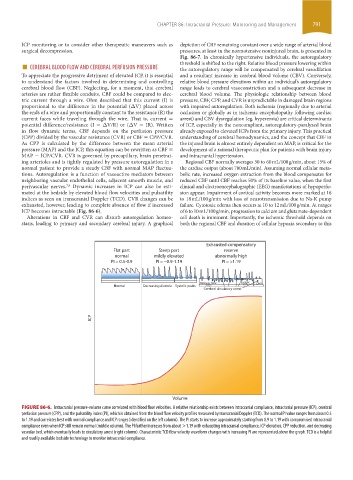
                    perivascular nerves.  Dynamic increases in ICP can also be esti-  clinical and electroencephalographic (EEG) manifestations of hypoperfu-
                                   7,8
                    mated at the bedside by elevated blood flow velocities and pulsatility   sion appear. Impairment of cortical activity becomes more marked at 16
                    indices as seen on transcranial Doppler (TCD). CVR changes can be   to 18 mL/100 g/min with loss of neurotransmission due to Na-K pump
                    exhausted, however, leading to complete absence of flow if increased   failure. Cytotoxic edema then occurs at 10 to 12 mL/100 g/min. At ranges
                    ICP becomes intractable (Fig. 86-6).                  of 6 to 10 mL/100 g/min, progression to calcium and  glutamate-dependent
                     Alterations in CBF and CVR can disturb autoregulation homeo-  cell death is imminent. Importantly, the ischemic threshold depends on
                    stasis,  leading  to  primary  and  secondary  cerebral  injury.  A  graphical   both the regional CBF and duration of cellular hypoxia secondary to this


                                                                                   Exhausted compensatory
                                                   Flat part      Steep part             reserve
                                                   normal        mildly elevated      abnormally high
                                                  PI = 0.5-0.9   PI = ~0.9-1.19         PI = >1.19


                                                                                 Biphasic flow  Systolic  Zero
                                                   Normal    Decreasing diastole Systolic peaks  ?????  ????
                                                                                  Cerebral circulatory arrest


                                           ICP


                                                                       Volume
                    FIGURE 86-6.  Intracranial pressure-volume curve correlated with blood flow velocities. A relative relationship exists between intracranial compliance, intracranial pressure (ICP), cerebral
                    perfusion pressure (CPP), and the pulsatility index (PI), which is obtained from the blood flow velocity profiles measured by transcranial Doppler (TCD). The normal PI value ranges from about 0.5
                    to 1.19 and correlates best with normal compliance and ICP ranges (identified on the left column). The PI starts to increase approximately starting from 0.9 to 1.19 with compromised intracranial
                    compliance even when ICP still remain normal (middle column). The PI further increases from about >1.19 with exhausting intracranial compliance, ICP elevation, CPP reduction, and decreasing
                    vascular bed, which eventually leads to circulatory arrest (right column). Characteristic TCD flow velocity waveform changes with increasing PI are represented above the graph. TCD is a helpful
                    and readily available bedside technology to monitor intracranial compliance.


            section06.indd   791                                                                                       1/23/2015   12:55:49 PM

