


Page 1155 - Hall et al (2015) Principles of Critical Care-McGraw-Hill
P. 1155
794     PART 6: Neurologic Disorders


                 of CPP within a targeted range of 50 to 70 mm Hg can therefore be an   compartmental parenchymal shifts in response to trajectories of increas-
                 important therapeutic strategy in providing a margin of “reserve” with   ing pressure differentials. The end result of untreated, progressive brain
                 which the brain can compensate for challenges of normal perfusion via   edema  is  herniation  and  ultimately  brain  death.  Despite  the  obvious
                 fluctuations in ICP or MAP.                           clinical importance of cerebral edema, the precise mechanisms of water
                   As pressure autoregulation and microcirculatory homeostasis may   transport and accumulation of excess water within the brain remain
                 be severely disrupted in the brain-injured patient, ischemia can result   unclear. A series of recent studies on cerebral edema focused on the
                 even in the presence of adequate ICP and CPP. Adjusting the target CPP   glial water protein channel aquaporin-4 (AQP4), among others, such as
                 in a particular patient based on the clinical situation, the underlying   AQP1 and AQP9, that have been shown to facilitate astrocyte  swelling
                 etiology of brain injury and the vasoreactive state is therefore necessary.   (“cytotoxic edema”) and also to be responsible for the reabsorption
                 Some studies support the concept of CPP targeting based on cerebral   of extracellular edema fluid (“vasogenic edema”). Therefore, AQP4
                 vasoreactivity monitoring. 11,12  In addition, improved tools for ICP mea-  modulation via pharmacologic interventions has become an interesting
                 surements  (ie,  via  minimal  invasive  intraparenchymal  devices)  with   potential therapeutic approach. 14-16  AQP4 knock-out, or disruption of
                 continuous CPP determinations and the ability to correlate additional   its polarized expression pattern, mitigates brain water accumulation and
                 brain monitoring parameters such as cerebral blood flow, oxygenation,   therefore decreases associated ischemia, water intoxication, and hypona-
                 and  chemical  profiling  allow  multimodal,  real-time  pathophysiologic   tremia in animal models. 17
                 analysis of brain injury at the bedside.                The most common types of cerebral edema are cytotoxic edema from
                     ■  PLATEAU WAVES                                  cellular injury and swelling, and vasogenic edema from breakdown
                                                                       of the blood-brain barrier and interstitial fluid extravasation. Other
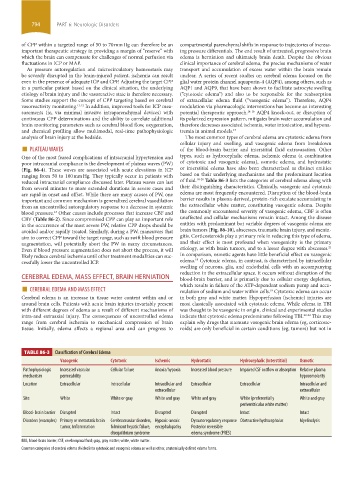
                 One of the most feared complications of intracranial hypertension and   types, such as hydrocephalic edema, ischemic edema (a combination
                 poor intracranial compliance is the development of plateau waves (PW)   of cytotoxic and vasogenic edema), osmotic edema, and hydrostatic
                 (Fig. 86-4). These waves are associated with acute elevations in ICP   or interstitial edema have also been characterized as distinct entities
                 ranging from 50 to 100 mm Hg. They typically occur in patients with   based on their underlying mechanisms and the predominant location
                 reduced intracranial compliance discussed later. Plateau waves can last   of fluid. 18-20  Table 86-3 lists the categories of cerebral edema along with
                 from several minutes to more extended durations in severe cases and   their distinguishing characteristics. Clinically, vasogenic and cytotoxic
                 are rapid in onset and offset. While there are many causes of PW, one   edema are most frequently encountered. Disruption of the blood-brain
                 important and common mechanism is generalized cerebral vasodilation   barrier results in plasma-derived, protein-rich exudate accumulating in
                 from an uncontrolled autoregulatory response to a decrease in systemic   the extracellular white matter, constituting vasogenic edema. Despite
                 blood pressure.  Other causes include processes that increase CBF and   the commonly encountered severity of vasogenic edema, CBF is often
                            13
                 CBV (Table 86-2). Since compromised CPP can play an important role   unaffected and cellular mechanisms remain intact. Among the disease
                 in the occurrence of the most severe PW, relative CPP drops should be   entities with predominant but variable degrees of vasogenic edema are
                 avoided and/or rapidly treated. Similarly, during a PW, maneuvers that   brain tumors (Fig. 86-10), abscesses, traumatic brain injury, and menin-
                 aim to correct CPP toward the target range, such as swift blood pressure   gitis. Corticosteroids play a primary role in reducing this type of edema,
                 augmentation, will potentially abort the PW in many circumstances.   and their effect is most profound when vasogenicity is the primary
                                                                                                                          21
                 Even if blood pressure augmentation does not abort the process, it will   etiology, as with brain tumors, and to a lesser degree with abscesses.
                 likely reduce cerebral ischemia until other treatment modalities can suc-  In comparison, osmotic agents have little beneficial effect on vasogenic
                                                                            18
                 cessfully lower the uncontrolled ICP.                 edema.  Cytotoxic edema, in contrast, is characterized by intracellular
                                                                       swelling of neurons, glia, and endothelial cells with an accompanying
                                                                       reduction in the extracellular space. It occurs without disruption of the
                 CEREBRAL EDEMA, MASS EFFECT, BRAIN HERNIATION         blood-brain barrier, and is primarily due to cellular energy depletion,
                     ■  CEREBRAL EDEMA AND MASS EFFECT                 which results in failure of the ATP-dependent sodium pump and accu-
                                                                       mulation of sodium and water within cells.  Cytotoxic edema can occur
                                                                                                      18
                 Cerebral edema is an increase in tissue water content within and or   in both gray and white matter. Hypoperfusion (ischemic) injuries are
                 around brain cells. Patients with acute brain injuries invariably  present   most classically associated with cytotoxic edema. While edema in TBI
                 with different degrees of edema as a result of different mechanisms of   was thought to be vasogenic in origin, clinical and experimental studies
                 intra-and extraaxial injury. The consequences of uncontrolled edema   indicate that cytotoxic edema predominates following TBI. 22-24  This may
                 range from cerebral ischemia to mechanical compression of brain   explain why drugs that attenuate vasogenic brain edema (eg, corticoste-
                 tissue. Initially, edema affects a regional area and can progress to   roids) are only beneficial in certain conditions (eg, tumors) but not in


                   TABLE 86-3    Classification of Cerebral Edema
                              Vasogenic         Cytotoxic      Ischemic    Hydrostatic      Hydrocephalic (Interstitial)  Osmotic
                  Pathophysiologic   Increased vascular   Cellular failure  Anoxia/hypoxia  Increased blood pressure  Impaired CSF outflow or absorption Relative plasma
                  mechanism     permeability                                                                    hypoosmolarity
                  Location    Extracellular     Intracellular  Intracellular and   Extracellular  Extracellular  Intracellular and
                                                               extracellular                                    extracellular
                  Site        White             White or gray  White and gray  White and gray  White (preferentially   White and gray
                                                                                              periventricular white matter)
                  Blood- brain barrier Disrupted  Intact       Disrupted   Disrupted        Intact              Intact
                  Disorders (examples) Primary or metastatic brain  Cerebrovascular disorders,  Hypoxic-anoxic   Dysautoregulatory response Obstructive hydrocephalus  Myelinolysis
                              tumor, Inflammation  fulminant hepatic failure,  encephalopathy  Posterior reversible
                                                disequilibrium syndrome    edema syndrome (PRES)
                 BBB, blood-brain barrier; CSF, cerebrospinal fluid; gray, gray matter; white, white matter.
                 Common categories of cerebral edema divided into cytotoxic and vasogenic edema as well as other, anatomically defined edema forms.


            section06.indd   794                                                                                       1/23/2015   12:55:51 PM

