


Page 1156 - Hall et al (2015) Principles of Critical Care-McGraw-Hill
P. 1156
CHAPTER 86: Intracranial Pressure: Monitoring and Management  795


                    A                           B                         tissue, whether CSF outlets are obstructed, and whether the volume of
                                                                          the space-occupying lesion causing tissue shift is large enough to over-
                                                                          come compensatory mechanisms. Regional mass effect can cause brain
                                                                          damage through local effects on brain perfusion and exertion of direct
                                                                          mechanical injury to tissue in the absence of globally elevated ICP. Brain
                                                                          tissue displacement can cause depressed consciousness through distor-
                                                                          tion of key anatomical structures responsible for arousal and attention
                                                                          (diencephalon and brainstem) in the absence of global increases in ICP.
                                                                          Similarly, while reduced consciousness can be the result of elevated ICP
                                                                          secondary to tissue displacement and herniation, it may be seen as a late
                                                                          sign following earlier symptoms relevant to the direct compression of
                                                                          underlying structures. For example, autonomic changes can occur early
                                                                          with evolving BTD, and their recognition can serve as a  warning sign
                                                                          of impending herniation.  The clinical consequences of BTD depend
                                                                                            27
                                                                          on the etiology, location, size of the lesion, and duration of the pro-
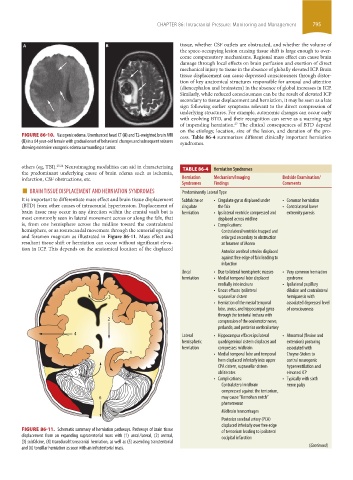
                    FIGURE 86-10.  Vasogenic edema. Unenhanced head CT (A) and T2-weighted brain MRI   cess.  Table 86-4 summarizes different clinically important herniation
                    (B) in a 64 year-old female with gradual onset of behavioral changes and subsequent seizures   syndromes.
                    showing extensive vasogenic edema surrounding a tumor.


                    others (eg, TBI). 25,26  Neuroimaging modalities can aid in characterizing     TABLE 86-4    Herniation Syndromes
                    the predominant underlying cause of brain edema such as ischemia,
                    infarction, CSF obstructions, etc.                    Herniation   Mechanism/Imaging     Bedside Examination/
                        ■  BRAIN TISSUE DISPLACEMENT AND HERNIATION SYNDROMES  Predominantly Lateral Type
                                                                                                             Comments
                                                                                     Findings
                                                                          Syndromes
                    It is important to differentiate mass effect and brain tissue displacement   Subfalcine or  •  Cingulate gyrus displaced under   •  Common herniation
                    (BTD) from other causes of intracranial hypertension. Displacement of   cingulate  the falx  •  Contralateral lower
                    brain tissue may occur in any direction within the cranial vault but is   herniation  •  Ipsilateral ventricle compressed and     extremity paresis
                    most commonly seen in lateral movement across or along the falx, that   displaced across midline
                    is, from one hemisphere across the midline toward the contralateral   •  Complications:
                    hemisphere, or as rostrocaudal movement through the tentorial opening   Contralateral ventricle trapped and
                    and foramen magnum as illustrated in Figure 86-11. Mass effect and   enlarged secondary to obstruction
                    resultant tissue shift or herniation can occur without significant eleva-  at foramen of Monro
                    tion in ICP. This depends on the anatomical location of the displaced   Anterior cerebral arteries  displaced
                                                                                        against free edge of falx leading to
                                                                                        infarction
                                                                          Uncal      •  Due to lateral hemispheric masses  •  Very common herniation
                                                                          herniation  •  Medial temporal lobe displaced   syndrome
                                                                                       medially into incisura  •  Ipsilateral pupillary
                                                                                     •  Uncus effaces ipsilateral     dilation and  contralateral
                                                 3                                       suprasellar cistern  hemiparesis with
                                                                                     •  Herniation of the mesial temporal     associated depressed level
                                                                                       lobe, uncus, and hippocampal gyrus   of consciousness
                                                                                       through the tentorial incisura with
                                                 2                                     compression of the oculomotor nerve,
                                                                                       peduncle, and posterior cerebral artery
                                     4                                    Lateral    •  Hippocampus effaces ipsilateral   •  Abnormal (flexion and
                                                                          hemispheric  quadrigeminal cistern displaces and   extension) posturing
                                                                          herniation   compresses midbrain      associated with
                                                        1                            •  Medial temporal lobe and temporal   Cheyne-Stokes to
                                                                                       horn displaced inferiorly into upper   central neurogenic
                                                                                       CPA cistern, suprasellar cistern   hyperventilation and
                                      5                                                obliterates            elevated ICP
                                                                                     •  Complications:       •  Typically with sixth
                                                                                        Contralateral midbrain   nerve palsy
                                                                                          compressed against the tentorium,
                                              6                                         may cause “Kernohan notch”
                                                                                          phenomenon
                                                                                        Midbrain hemorrhages
                                                                                        Posterior cerebral artery (PCA)
                                                                                        displaced inferiorly over free edge
                    FIGURE 86-11.  Schematic summary of herniation pathways. Pathways of brain tissue   of tentorium leading to ipsilateral
                    displacement from an expanding supratentorial mass with (1) uncal/lateral, (2) central,    occipital infarction
                    (3) subfalcine, (4) transdural/transcranial herniation, as well as (5) ascending transtentorial
                    and (6) tonsillar  herniation as seen with an infratentorial mass.                                (Continued)


            section06.indd   795                                                                                       1/23/2015   12:55:53 PM

