


Page 1162 - Hall et al (2015) Principles of Critical Care-McGraw-Hill
P. 1162
CHAPTER 86: Intracranial Pressure: Monitoring and Management  801


                    the above findings as ICP is either normalized or worsens. As a result,     TABLE 86-7    Conditions Often Requiring ICP Monitoring
                    frequent reexamination is necessary to assess the patient’s response to
                    therapeutic measures. Increasing downward pressure leads to dysfunc-  Conditions
                    tion first at the level of the diencephalon (ie, thalami), next affecting   •  Comatose patient, unexplained and/or with abnormal imaging findings
                    the upper and middle sections of the brainstem (midbrain and pons),   •  Clinical symptoms of elevated ICP
                    and ultimately impeding medullary function. In summary of the above   •  In TBI, normal CT scan with more than two of the following features noted at admission:
                    examination methods, assessment of clinical signs tracks the descend-  age >40 y/o, unilateral or bilateral motor posturing, or systolic blood pressure <90 mm Hg.
                    ing progression of injury in evolving intracranial hypertension. The first   •  Diffuse brain edema
                    is assessment of the respiratory pattern. Respiration patterns become   •  Extensive hemispheric brain edema (eg, large MCA infarct)
                    progressively more abnormal depending on the level of injury, evolving   •  Intracerebral hemorrhage with edema causing significant mass effect (clinical and radiographic)
                    from a Cheyne-Stokes pattern to ataxic respirations and then eventu-  •  Contusion and edema especially with bifrontal and temporal involvement
                    ally to apnea. The pupils become increasingly more abnormal, initially   •  Radiographic evidence of ventriculomegaly with clinical evidence of hydrocephalus
                    with some early constriction, then increasing dilation and diminished
                    reactivity, to ultimately becoming fixed, unreactive, and middilated    CT, cranial tomography; ICP, intracranial pressure; MCA, middle cerebral artery; TBI, traumatic brain
                                                                          injury. Common conditions that may necessitate direct ICP monitoring.
                    (Fig. 86-14). Reflex eye movements (ie, doll’s eye maneuver) are even-
                    tually lost (pontine compromise) (Fig. 86-14 and Table 86-5). Motor
                    responses evolve from localizing to nonlocalizing withdrawal followed
                    by decorticate and then decerebrate posturing and finally flaccidity of   Regarding  appropriate  selection  of  patients  for  invasive  ICP
                    all extremities (Table 86-5). The end result of untreated, progressive     monitoring, the best ICP guidelines are found in the latest Brain Trauma
                    rostrocaudal brain herniation is brain death with loss of all cranial nerve   Foundation recommendations (level II evidence). These guidelines
                    reflexes and no respiration in the setting of elevated CO . 2  indicate the use of ICP monitoring in patients with TBI who remain
                     Depending on the level of coma or sedation, the patient may not   comatose after resuscitation and if the admission CT reveals intracranial
                    react to any stimulus, or may respond to noxious or painful stimuli by   pathology such as hematoma, contusions, or brain edema.  Generally
                                                                                                                     32
                    grimacing, grabbing, or withdrawing the stimulated body part. Patients   accepted indications for monitor insertion are processes associated
                    should be stimulated in all extremities to compare the response on both   with progressive elevation of ICP such as rapidly expanding intracranial
                    sides in order to attempt to localize the etiology of brain dysfunction. If   masses secondary to ischemia, hematoma, hemorrhagic tumor, obstruc-
                    a patient’s response is equivalent throughout all extremities, it is likely   tive and nonobstructive hydrocephalus, or diffuse axonal injury (DAI).
                    that the etiology is a global insult. If there is a focal response, this finding   In  all  of  these  forms  of  brain  injury,  treatment  demands  active  pres-
                    can help refine the anatomic location of the injury as discussed above.   ervation of stable CPP and ICP to maintain adequate brain  perfusion.
                    Sensory stimuli may be delivered by pinching a small skin area at the   Neuroimaging studies assist in determining the indication for ICP
                    mediolateral forearm or inner thigh; sometimes, however, nail bed pres-  monitoring. For example, identification of midline shift, effacement of
                    sure is needed. These maneuvers should be avoided in patients with a   the basal cisterns, or extensive edema helps narrow the differential diag-
                    coagulopathy; as an alternative, pressure applied over the supraorbital   nosis to a process involving elevated ICP. Significant ICP elevations may
                    notch, bilateral mastoids, or cervicospinal muscles can be used. Most   occur without, or with only subtle, brain imaging findings. Therefore,
                    elegantly, some patients respond strongly and reproducibly to intranasal   imaging studies should always be interpreted together with the clinical
                    stimulations with a cotton swab.                      findings and brain monitoring information. ICP monitoring indications
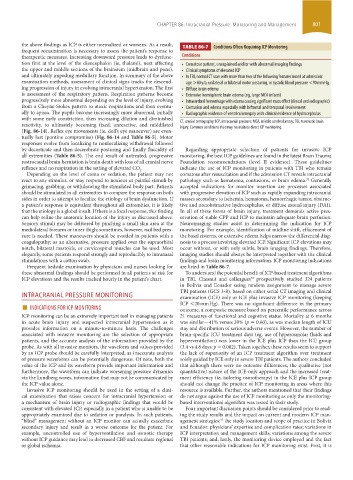
                     Frequent bedside examination by physicians and nurses looking for   are listed in Table 86-7.
                    these abnormal findings should be performed in all patients at risk for   To understand the potential benefit of ICP-based treatment  algorithms
                    ICP elevations and the results tracked hourly in the patient’s chart.  in TBI, Chesnut and colleagues  prospectively studied 324 patients
                                                                                                  33
                                                                          in Bolivia and Ecuador using random assignment to manage severe
                                                                          TBI patients (GCS 3-8), based on either serial CT imaging and clinical
                    INTRACRANIAL PRESSURE MONITORING                      examination (ICE) only or ICE plus invasive ICP monitoring (keeping
                        ■  INDICATIONS FOR ICP MONITORING                 ICP <20 mm Hg). There was no significant difference in the primary
                                                                          outcome, a composite measure based on percentile performance across
                    ICP monitoring can be an extremely important tool in managing patients     21 measures of functional and cognitive status. Mortality at 6 months
                    in  acute  brain  injury  and  suspected  intracranial  hypertension  as  it   was similar—41% versus 39% (p = 0.60), as was median length of ICU
                    provides  information  on  a  minute-to-minute  basis.  The  challenges   stay and distribution of serious adverse events. However, the number of
                    associated with invasive monitoring are the selection of appropriate   brain-specific ICU treatment days (eg, use of hyperosmolar fluids and
                    patients, and the accurate analysis of the information provided by the   hyperventilation) was lower in the ICE plus ICP than the ICE group
                    probe. As with all invasive monitors, the waveform and values provided   (3.4 vs 4.8 days; p = 0.002). Taken together, these results seem to support
                    by an ICP probe should be carefully interpreted, as inaccurate analysis   the lack of superiority of an ICP treatment algorithm over treatment
                    of pressure waveforms can be potentially dangerous. Of note, both the   solely guided by ICE only in severe TBI patients. The authors concluded
                    value of the ICP and its waveform provide important information and   that although there were no outcome differences, the qualitative (not
                    furthermore, the waveform can indicate worsening pressure dynamics   quantitative) nature of the ICE-only approach and the increased treat-
                    via the Lundberg waves, information that may not be communicated by   ment efficiency (ie, tailoring osmotherapy) in the ICE plus ICP group
                    the ICP value alone.                                  should not change the practice of ICP monitoring in areas where this
                     Invasive ICP monitoring should be used in the setting of a clini-  resource is available. Further, the authors mentioned that their findings
                    cal examination that raises concern for intracranial hypertension or   do not argue against the use of ICP monitoring as only the monitoring-
                    a mechanism of brain injury or radiographic findings that would be   based interventional algorithm was tested in their study.
                    consistent with elevated ICP, especially in a patient who is unable to be   Four important discussion points should be considered prior to read-
                    appropriately examined due to sedation or paralysis. In such patients,   ing the study results and the impact on current and modern ICP man-
                    “blind” management without an ICP monitor can actually exacerbate   agement strategies:  the study location and scope of practice in Bolivia
                                                                                       37
                    secondary injury and result in a worse outcome for the patient. For   and Ecuador; physicians’ expertise and complication rates; variations in
                    example,  uncontrolled  use  of  hyperventilation  and  osmotic  therapy   ICP interpretation and management skills; variations among the severe
                    without ICP guidance may lead to decreased CBF and resultant regional   TBI patients; and, lastly, the monitoring device employed and the fact
                    or global ischemia.                                   that other reasonable indications for ICP monitoring exist. First, it is


            section06.indd   801                                                                                       1/23/2015   12:56:02 PM

