


Page 1164 - Hall et al (2015) Principles of Critical Care-McGraw-Hill
P. 1164
CHAPTER 86: Intracranial Pressure: Monitoring and Management  803


                    CSF. Placement of these devices, however, is associated with morbidity   abnormal ICP waveforms can be helpful in predicting and preventing
                    as with any invasive device. There is a risk of intracranial or intraven-  malignant elevations in ICP as the noncompliant brain is often intolerant
                    tricular hemorrhage at the insertion site as well as a risk of infection that   of additional volume within the intracranial contents without brisk eleva-
                    can range from 6% to 11%. 39-41  Infection risk increases over time and the   tions in ICP (Fig. 86-4, Area B). For example, when a patient has fulminant
                    consequences can be associated with significant morbidity and mortality   hepatic failure, observation of these subtle changes in the ICP waveform can
                    if ventriculitis develops.                            signal the evolution of brain swelling before it is clinically apparent or before
                        ■  MONITORING OF ABNORMAL ICP                     the ICP has increased.
                                                                           ICP elevation can also be predicted imperfectly through brain imag-
                    The clinical course of ICP elevation is variable and largely determined by   ing studies. Nevertheless, when the ICP from any monitor type is either
                    the etiology of the intracranial hypertension. Certain causes of elevated   much lower or higher than expected based on clinical or radiographic
                    ICP are more progressive than others. In this setting of TBI, intracra-  findings, steps should be taken to determine the accuracy of the  monitor.
                    nial hypertension often occurs early, within 72 hours. It may, however,   At times this may require rezeroing or replacing the monitor, and rarely
                    develop late or follow a bimodal pattern, and as many as 25% of patients   inserting a new monitor in a new position or location. When there is
                    experience their highest ICP after 5 days. Therefore, it is important to   significant discrepancy between the ICP and clinical presentation and
                    recall that ICP elevations show a temporal heterogeneity within the first   imaging results, replacement or rezeroing of the monitor should be
                    2 weeks of injury, creating another strong argument for continuous ICP   considered. It is important to realize that ICP is not homogeneous due
                    monitoring.                                           to compartmentalization of intracranial structures.
                    form temporally associated with the systemic blood pressure. Certain   ■  MONITORING CEREBRAL AUTOREGULATION
                     As illustrated in  Figure 86-3, ICP monitors provide a ballistic wave-
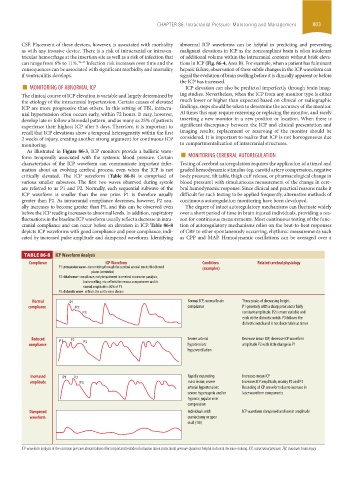
                    characteristics of the ICP waveform can communicate important infor-  Testing of cerebral autoregulation requires the application of a timed and
                    mation about an evolving cerebral process, even when the ICP is not   graded hemodynamic stimulus (eg, carotid artery compression, negative
                    critically elevated. The ICP waveform (Table 86-8) is comprised of   body pressure, tilt table, thigh cuff release, or pharmacological change in
                    various smaller subwaves. The first two waves observed during systole   blood pressure) with simultaneous measurement of the change in cere-
                    are  referred  to  as  P1  and  P2.  Normally,  each  sequential  subwave  of  the   bral hemodynamic response. Since clinical and practical reasons make it
                    ICP waveform is smaller than the one prior. P1 is therefore usually   difficult for such testing to be applied frequently, alternative methods of
                    greater than P2. As intracranial compliance decreases, however, P2 usu-  continuous autoregulation monitoring have been developed.
                    ally increases to become greater than P1, and this can be observed even   The degree of intact autoregulatory mechanisms can fluctuate widely
                    before the ICP reading increases to abnormal levels. In addition, respiratory   over a short period of time in brain injured individuals, providing a rea-
                    fluctuations in the baseline ICP waveform usually reflect a decrease in intra-  son for continuous measurements. Most continuous testing of the func-
                    cranial compliance and can occur before an elevation in ICP. Table 86-8   tion of autoregulatory mechanisms relies on the beat-to-beat responses
                    depicts ICP waveforms with good compliance and poor compliance, indi-  of CBF to other spontaneously occurring, rhythmic measurements such
                    cated by increased pulse amplitude and dampened waveform. Identifying   as CPP and MAP. Hemodynamic oscillations  can be averaged over a


                      TABLE 86-8    ICP Waveform Analysis
                      Compliance                ICP Waveform                     Conditions         Related cerebral physiology
                                P1: percussion wave–transmitting through the cerebral arterial tree to the choroid  (examples)
                                         plexus (ventricles)
                                P2: tidal wave–compliance; early impairment in cerebral vasomotor paralysis,
                                       brain swelling, etc; reflects the venous compartment and its
                                       normal amplitude is 80% of P1
                                P3: dichrotic wave–reflects the aortic valve closure
                       Normal       P1                                      Normal ICP, normal brain  Three peaks of decreasing height.
                      compliance      P2                                    compliance         P1 generally with a sharp peak and a fairly
                                        P3                                                     constant amplitude. P2 is more variable and
                                                                                               ends at the dichrotic notch. P3 follows the
                                                                                               dichrotic notch and is not discernable at times

                       Reduced  P1  P2                                      Severe arterial    Decrease mean ICP; decrease ICP waveform
                      compliance         P3                                 hypotension;       amplitude P2 with little change in P1
                                                                            hyperventilation


                       Increased  P1  P2                                    Rapidly expanding  Increases mean ICP
                      amplitude        P3                                   mass lesion; severe  Increases ICP amplitude, mainly P2 and P3
                                                                            arterial hypertension;  Rounding of ICP waveform due to increase in
                                                                            severe hypercapnia and/or  later waveform components
                                                                            hypoxia; jugular vein
                                                                            compression
                      Dampened                                              Individuals with   ICP waveform dampened and low in amplitude
                      waveform                                              craniectomy or open
                                                                            skull (TBI)


                    ICP waveform analysis of the common pressure abnormalities offers important bedside information about intracranial pressure dynamics helpful in clinical decision-making. ICP, intracranial pressure; TBI, traumatic brain injury


            section06.indd   803                                                                                       1/23/2015   12:56:05 PM

