


Page 1163 - Hall et al (2015) Principles of Critical Care-McGraw-Hill
P. 1163
802     PART 6: Neurologic Disorders


                 very likely that the scope of clinical practice depends on location, and   Third, the degree of brain injury among the study patients may already
                 more decentralized areas within South America are likely to be dissimi-  have been severe enough that potential improvements based on ICP mon-
                 lar to those found in North America and Western Europe. De Silva et al   itoring would not impact outcome. Future research could focus on iden-
                 showed that 6-month outcome among severe traumatic brain injuries   tifying distinct subgroups of severe TBI patients who are likely to benefit
                 was associated with a higher (51%)  mortality in low- and middle-  from multimodal brain monitoring with optimizing ICP and other brain
                 income countries compared to the mortality in high-income countries   parameters. Lastly, the device  used to  measure pressure in the study
                 (30%). 36,37  Important treatment differences between continents as well     participants was the intraparenchymal ICP monitor, unlike the external
                 as between individual South American centers and among patients (eg,   ventricular drains used in many American and European NeuroICU set-
                 quality of prehospital stabilization efforts) may have induced significant   tings. Ventricular drains not only allow CSF drainage to reduce ICP, but
                 bias in addition to contributing to worse overall outcomes. Furthermore,   also measure ICP in the center of the skull, closer to important brainstem
                 initial  hospital  emergency  care  and  access  to  rehabilitation  were  not   and diencephalic structures, reducing artifact and missed ICP elevations
                 considered in the study.                              more commonly seen with the more superficial hemispheric measure-
                   Second, even though the intensivists treating the study participants   ments of intraparenchymal monitors. In this study, all efforts were directed
                 would routinely manage severe TBI patients, there was a lack of prior   toward lowering pressure within the cranium, but clinical outcome in
                 experience and skills in inserting ICP monitors, dealing with ICP     survivors also reflects involvement of specific areas of compression, nota-
                 equipment, interpreting and trending the ICP values, understanding   bly, the upper midbrain, thalamus, and reticular activating system.
                 ICP waveform morphologies, and correlating ICP findings with imag-  Other  recent  systematic  reviews  on  ICP  monitoring   emphasize
                                                                                                                 34
                 ing and clinical results. Furthermore, the time from primary injury to   that the outcome of severe TBI patients depends on guideline-driven
                 placement of ICP monitor was not considered, and some patients may   management integrating various monitoring elements, and demon-
                 therefore have already suffered from secondary brain injury on inclu-  strates that utilizing an ICP monitor alone does not result in better
                 sion in the study. In addition, there is variability in the decision-making   clinical outcome. In comparison, a study by Barmparas et al  showed
                                                                                                                    35
                 process and surgical management of elevated ICP, that is, immediate   that decreased use of ICP monitoring in trauma patients was associated
                 surgical decompression via hemicraniectomy versus isolated placement   with  increased  mortality.  An  explanation  for  these  variable  results  is
                 of intracranial pressure monitor. Importantly, the trial did not integrate   that alteration of a single parameter (eg, ICP) may not be expected to
                 brain tissue oxygen tension, cerebral blood flow monitoring, brain tem-  significantly impact overall outcome. We recommend that ICP should
                 perature modulation, and other treatment modalities commonly used   be treated as an important vital sign but that its values must be care-
                 in modern neurocritical care units to treat severe TBI patients. Also,   fully integrated into the moment-to-moment clinical and coparameter
                 monitoring for vasospasm in the setting of subarachnoid hemorrhage    settings. The concept of managing patients focused on “one ICP value
                                                                    38
                 or contusion was not performed. As many as one-third of all severe TBI   fits all” may only be a part of a more complex strategy in dealing with
                 patients can develop arterial vasospasm detected on TCD or CTA, and   complicated cases such as acute brain injuries; therefore, management
                 its incidence and risk for ischemia can readily abolish an ICP treatment   should be tailored to the specific requirements of the individual patient
                 efficacy given the rather small study sample. In addition, the use of a   making use of other multimodal monitoring. 38
                 universal, absolute ICP treatment threshold may not be of such great
                 CPP-targeted therapy (ie, between 60 and 70 mm Hg) has been shown   ■  PLACING ICP MONITORING DEVICES
                 importance as integrating the ICP values to obtain optimal CPP. Of note,
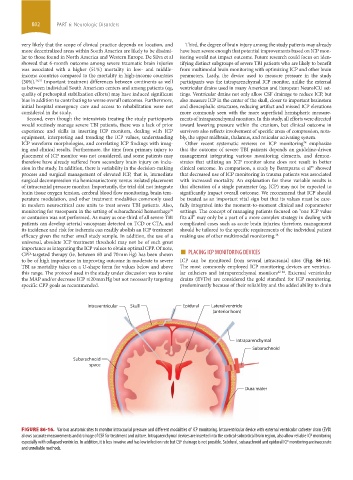
                 to be of high importance in improving outcome in moderate to severe   ICP  can  be  monitored  from  several  intracranial  sites  (Fig. 86-16).
                 TBI as mortality takes on a U-shape form for values below and above   The most commonly employed ICP monitoring devices are ventricu-
                 this range. The protocol used in the study under discussion was to raise   lar catheters and intraparenchymal monitors 42-44 . External ventricular
                 the MAP and/or decrease ICP ≤20 mm Hg but not necessarily targeting   drains (EVDs) are considered the gold standard for ICP monitoring,
                 specific CPP goals as recommended.                    predominantly because of their reliability and the added ability to drain


                                        Intraventricular  Skull         Epidural  Lateral ventricle
                                                                                  (anterior horn)


                                                                                          Intraparenchymal
                                                                                                Subarachnoid
                                   Subarachnoid
                                        space


                                                                                             Dura mater


                 FIGURE 86-16.  Various anatomic sites to monitor intracranial pressure and different modalities of ICP monitoring. Intraventricular device with external ventricular catheter drain (EVD)
                 allows accurate measurements and drainage of CSF for treatment and culture. Intraparenchymal devices are inserted into the cortical-subcortical brain region, also allow reliable ICP monitoring
                 especially with collapsed ventricles. In addition, it is less invasive and has low infection rate but CSF drainage is not possible. Subdural, subarachnoid and epidural ICP monitoring are inaccurate
                 and unreliable methods.


            section06.indd   802                                                                                       1/23/2015   12:56:04 PM

