


Page 1238 - Hall et al (2015) Principles of Critical Care-McGraw-Hill
P. 1238
CHAPTER 90: Bleeding Disorders  845


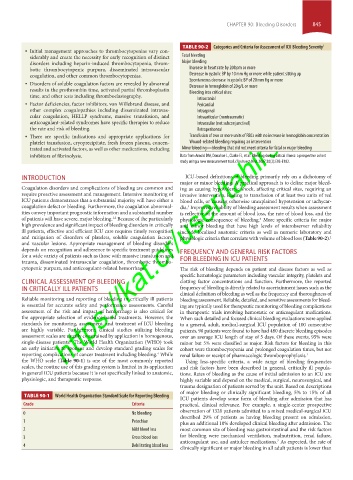
                                                                            TABLE 90-2    Categories and Criteria for Assessment of ICU Bleeding Severity 1
                        • Initial management approaches to thrombocytopenias vary con-
                      siderably and create the necessity for early recognition of distinct   Fatal bleeding
                      disorders including heparin-induced thrombocytopenia, throm-  Major bleeding
                      botic thrombocytopenic purpura, disseminated intravascular   Increase in heart rate by 20 bpm or more
                      coagulation, and other common thrombocytopenias.       Decrease in systolic BP by 10 mm Hg or more while patient sitting up
                        • Disorders of soluble coagulation factors are revealed by abnormal   Spontaneous decrease in systolic BP of 20 mm Hg or more
                                                                             Decrease in hemoglobin of 20 g/L or more
                      results in the prothrombin time, activated partial thromboplastin   Bleeding into critical sites:
                      time, and other tests including thromboelastography.     Intracranial
                        • Factor deficiencies, factor inhibitors, von Willebrand disease, and   Pericardial
                                  https://kat.cr/user/tahir99/
                      other  complex  coagulopathies  including disseminated intravas-  Intraspinal
                      cular coagulation, HELLP syndrome, massive transfusion, and   Intraarticular (nontraumatic)
                      anticoagulant-related syndromes have specific therapies to reduce   Intraocular (not subconjunctival)
                      the rate and risk of bleeding.                           Retroperitoneal
                        • There are specific indications and appropriate applications for   Transfusion of two or more units of RBCs with no increase in hemoglobin concentration
                      platelet transfusion, cryoprecipitate, fresh frozen plasma, concen-  Wound-related bleeding requiring an intervention
                      trated and activated factors, as well as other medications, including   Minor bleeding—bleeding that did not meet criteria for fatal or major bleeding
                      inhibitors of fibrinolysis.                         Data from Arnold DM, Donahoe L, Clarke FJ, et al. Bleeding during critical illness: a prospective cohort
                                                                          study using a new measurement tool. Clin Invest Med. 2007;30(2):E93-E102.


                    INTRODUCTION                                           ICU-based definitions of bleeding primarily rely on a dichotomy of
                                                                          major or minor bleeding. A practical approach is to define major bleed-
                    Coagulation disorders and complications of bleeding are common and   ing as causing hypovolemic shock, affecting critical sites, requiring an
                    require proactive assessment and management. Intensive monitoring of   invasive intervention, leading to transfusion of at least two units of red
                    ICU patients demonstrates that a substantial majority will have either a   blood cells, or causing otherwise unexplained hypotension or tachycar-
                    coagulation defect or bleeding. Furthermore, the coagulation abnormal-  dia.  Improved reliability of bleeding assessment results when assessment
                                                                            5
                    ities convey important prognostic information and a substantial number   is reflective of the amount of blood loss, the rate of blood loss, and the
                    of patients will have severe, major bleeding.  Because of the particularly   physiologic consequence of bleeding.  More specific criteria for major
                                                   1,2
                                                                                                     6
                    high prevalence and significant impact of bleeding disorders in critically   and minor bleeding that have high levels of interobserver reliability
                    ill patients, effective and efficient ICU care requires timely recognition   include localized anatomic  criteria as well as numeric laboratory  and
                    and mitigation of disorders of platelets, soluble coagulation factors,   physiologic criteria that correlate with volume of blood loss (Table 90-2). 1
                    and vascular lesions. Appropriate  management of  bleeding  disorders
                    depends on recognition and adherence to specific treatment guidelines   FREQUENCY AND GENERAL RISK FACTORS
                    for a wide variety of patients such as those with massive transfusion and
                    trauma, disseminated intravascular coagulation, thrombotic thrombo-  FOR BLEEDING IN ICU PATIENTS
                    cytopenic purpura, and anticoagulant-related hemorrhage.  The risk of bleeding depends on patient and disease factors as well as
                                                                          specific hematologic parameters including vascular integrity, platelets and
                    CLINICAL ASSESSMENT OF BLEEDING                       clotting  factor  concentrations  and  function.  Furthermore,  the  reported
                    IN CRITICALLY ILL PATIENTS                            frequency of bleeding is directly related to ascertainment issues such as the
                                                                          clinical definition of bleeding as well as the frequency and thoroughness of
                    Reliable monitoring and reporting of bleeding in critically ill patients   bleeding assessment. Reliable, detailed, and sensitive assessments for bleed-
                    is essential for accurate safety and performance assessments. Careful   ing are typically used for therapeutic monitoring of bleeding complications
                    assessment of the risk and impact of hemorrhage is also critical for   in therapeutic trials involving hemostatic or anticoagulant medications.
                    the  appropriate  selection  of  evidence-based  treatments.  However,  the   When such detailed and focused clinical bleeding evaluations were applied
                    standards for monitoring, assessment, and treatment of ICU bleeding   to a general, adult, medical-surgical ICU population of 100 consecutive
                    are highly variable. Furthermore, clinical studies  utilizing bleeding   patients, 90 patients were found to have had 480 discrete bleeding episodes
                    assessment scales are usually constrained by application in homogenous,   over an average ICU length of stay of 5 days. Of these events, 95% were
                    single-disease patients.  The World Health Organization (WHO) took   minor but 5% were classified as major. Risk factors for bleeding in this
                                    3
                    an early initiative to sponsor and develop standard grading scales for   cohort were thrombocytopenia and prolonged coagulation times, but not
                    reporting complications of cancer treatment including bleeding.  While   renal failure or receipt of pharmacologic thromboprophylaxis. 1
                                                                  4
                    the WHO scale (Table 90-1) is one of the most commonly reported   Using less-specific criteria, a wide range of bleeding frequencies
                    scales, the routine use of this grading system is limited in its application   and risk factors have been described in general, critically ill popula-
                    in general ICU patients because it is not specifically linked to anatomic,   tions. Rates of bleeding as the cause of initial admission to an ICU are
                    physiologic, and therapeutic response.                highly variable and depend on the medical, surgical, neurosurgical, and
                                                                          trauma designation of patients served by the unit. Based on descriptions
                                                                          of major bleeding or clinically significant bleeding, 5% to 15% of all
                      TABLE 90-1    World Health Organization Standard Scale for Reporting Bleeding
                                                                          ICU patients develop some form of bleeding after admission that has
                    Grade                                Criteria         practical, clinical relevance. For example, a single-center prospective
                                                                          observation of 1328 patients admitted to a mixed medical-surgical ICU
                    0                                    No bleeding
                                                                          described 29% of patients as having bleeding present on admission,
                    1                                    Petechiae        plus an additional 10% developed clinical bleeding after admission. The
                    2                                    Mild blood loss  most common site of bleeding was gastrointestinal and the risk factors
                    3                                    Gross blood loss  for bleeding were mechanical ventilation, malnutrition, renal failure,
                                                                                                           7
                                                                          anticoagulant use, and antiulcer medications.  As expected, the rate of
                    4                                    Debilitating blood loss
                                                                          clinically significant or major bleeding in all adult patients is lower than


            section07.indd   845                                                                                       1/21/2015   7:42:41 AM

