


Page 1241 - Hall et al (2015) Principles of Critical Care-McGraw-Hill
P. 1241
848     PART 7: Hematologic and Oncologic Disorders


                 prolonged thrombin time (eg, heparin, bivalirudin, argatroban, high
                 concentrations of serum proteins in multiple myeloma). A similar test,                    Torsion force
                 the reptilase time (RT), uses snake venom enzyme similar to thrombin                      measurement
                 which cleaves fibrinogen but is not sensitive to heparin and thus distin-
                 guishes hypofibrinogenemia from heparin anticoagulation.
                     ■  ACTIVATED WHOLE BLOOD CLOTTING TIME


                 The activated clotting time (ACT) is performed by adding negatively
                 charged particles (celite, kaolin) to a sample of freshly drawn whole
                 blood and measuring the formation of clot. The ACT is influenced
                 by both the soluble coagulation factors as well as the platelets present
                 in  blood  sample.  Although  the  test  closely  resembles  the  aPTT,  it  is
                 clinically less sensitive to the effects of heparin and hence is used for
                 monitoring coagulation in the setting of high heparin infusions such as
                 coronary artery bypass surgery, percutaneous vascular procedures, and
                 extracorporeal membrane oxygenation.
                     ■  FIBRIN DEGRADATION PRODUCTS AND D-DIMER


                 Plasmin breaks down both fibrin as well as fibrinogen into degradation               Whole blood and
                 products (FDP) that are recognized by fibrin degradation assays. Plasma              coagulation activator
                 D-dimer is only found in the degradation of cross-linked fibrin from a
                 clot. Increases in FDP and D-dimer may indicate active fibrinolysis in   Thromboelastography
                 patients with substantial intravascular clot burden and disseminated
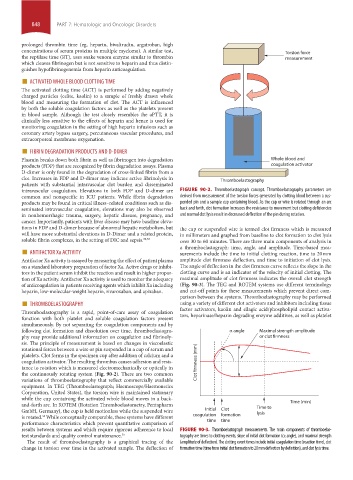
                 intravascular coagulation. Elevations in both FDP and D-dimer are   FIGURE 90-2.  Thromboelastograph concept.  Thromboelastography parameters are
                 common and nonspecific in ICU patients. While fibrin degradation   derived from measurement of the torsion forces generated by clotting blood between a sus-
                 products may be found in critical illness–related conditions such as dis-  pended pin and a sample cup containing blood. As the cup or wire is rotated through an arc
                 seminated intravascular coagulation, elevations may also be observed   back and forth, clot formation increases the resistance to movement but clotting deficiencies
                 in nonhemorrhagic trauma, surgery, hepatic disease, pregnancy, and   and normal clot lysis result in decreased deflection of the pin during rotation.
                 cancer. Importantly, patients with liver disease may have baseline eleva-
                 tions in FDP and D-dimer because of abnormal hepatic metabolism, but   the cup or suspended wire is termed clot firmness which is measured
                 will have more substantial elevations in D-Dimer and a related protein,   in  millimeters and graphed from baseline to clot formation to clot lysis
                 soluble fibrin complexes, in the setting of DIC and sepsis. 32,33  over 30 to 60 minutes. There are three main components of analysis in
                     ■  ANTIFACTOR Xa ACTIVITY                         a thromboelastograph: time, angle, and amplitude. Time-based mea-
                                                                       surements include the time to initial clotting reaction, time to 20 mm
                 Antifactor Xa activity is assayed by measuring the effect of patient plasma   amplitude clot firmness deflection, and time to initiation of clot lysis.
                 on a standard laboratory preparation of factor Xa. Active drugs or inhibi-  The angle of deflection in the clot firmness curve reflects the slope in the
                 tors in the patient serum inhibit the reaction and result in higher propor-  clotting curve and is an indicator of the velocity of initial clotting. The
                 tion of Xa activity. Antifactor Xa activity is used to monitor the adequacy   maximal amplitude of clot firmness indicates the overall clot strength
                 of anticoagulation in patients receiving agents which inhibit Xa including   (Fig. 90-3). The TEG and ROTEM systems use different terminology
                 heparin, low-molecular-weight heparin, rivaroxaban, and apixaban.  and cut-off points for these measurements which prevent direct com-
                     ■  THROMBOELASTOGRAPHY                            parison between the systems. Thromboelastography may be performed
                                                                       using a variety of different clot activators and inhibitors including tissue
                 Thromboelastography is a rapid, point-of-care assay of coagulation   factor activators, kaolin and ellagic acid/phospholipid contact activa-
                                                                       tors, heparinase/heparin degrading enzyme additives, as well as platelet
                   function with both platelet and soluble coagulation factors present
                 simultaneously. By not separating the coagulation components and by
                 following clot formation and dissolution over time, thromboelastogra-  α angle   Maximal strength amplitude
                 phy may provide additional information on coagulation and fibrinoly-             or clot firmness
                 sis. The principle of measurement is based on changes in viscoelastic
                   rotational forces between a wire or pin suspended in a cup of serum and
                 platelets. Clot forms in the specimen cup after addition of calcium and a
                 coagulation activator. The resulting thrombus causes adhesion and resis-  Clot firmness (mm)
                 tance to rotation which is measured electromechanically or optically in
                 the continuously rotating system (Fig. 90-2). There are two common
                 variations of thromboelastography that reflect commercially available
                 equipment. In TEG (Thromboelastograph; Haemoscope/Haemonetics
                 Corporation, United States), the torsion wire is maintained stationary
                 while the cup containing the activated whole blood moves in a back-
                 and-forth arc. In ROTEM (Rotation Thromboelastometry, Pentapharm                            Time (min)
                 GmbH, Germany), the cup is held motionless while the suspended wire   Initial  Clot  Time to
                                                                                                 lysis
                 is rotated.  While conceptually comparable, these systems have different   coagulation  formation
                        34
                 performance characteristics which prevent quantitative comparison of   time  time
                 results between systems and which require rigorous adherence to local   FIGURE 90-3.  Thromboelastograph measurements.  The main components of thromboelas-
                 test standards and quality control maintenance. 35    tography are times to clotting events, slope of initial clot formation (α angle), and maximal strength
                   The  result of  thromboelastography  is a  graphical tracing  of  the   (amplitude of deflection). The clotting event times include initial coagulation time (reaction time), clot
                 change in torsion over time in the activated sample. The deflection of   formation time (time from initial clot formation to 20 mm deflection by definition), and clot lysis time.


            section07.indd   848                                                                                       1/21/2015   7:42:43 AM

