


Page 1243 - Hall et al (2015) Principles of Critical Care-McGraw-Hill
P. 1243
850     PART 7: Hematologic and Oncologic Disorders


                                                                       history (eg, cancer, alcohol ingestion, medications, dietary habits,
                   TABLE 90-4    Etiologies of Thrombocytopenia
                                                                       chemotherapy, or radiation), and concurrent red blood cell and white
                  Spurious                                             blood cell abnormalities (eg, leukopenia, microcytic, or macrocytic
                  Decreased platelet production                        anemia). If suspected, specific viral infections including HIV, Epstein-
                    Infection                                          Barr virus, parvovirus, and varicella may be diagnosed by history and
                    •  Epstein Barr virus                              serologic testing.
                    •  HIV                                             Dilution and Distributional Thrombocytopenia:  Dilutional thrombocyto-
                    •  Parvovirus                                      penia reflects inadequate preservation of platelet concentration when
                    •  Varicella                                       intravascular volume is rapidly replaced with platelet-poor solutions
                    Drugs and toxins                                   and crystalloid. For practical purposes, this only occurs in settings
                    •  Alcohol                                         of massive blood loss and massive transfusion (see massive transfu-
                    •  Cancer chemotherapy                             sion below). Distributional thrombocytopenia occurs in patients with
                    •  Heparin-Induced thrombocytopenia                splenomegaly from portal hypertension and reflects removal and
                    •  Antiepileptics and sedatives                    sequestration of platelets from the circulation. However, patients with
                    •  Antibiotics                                     advanced portal hypertension and splenomegaly are also likely to have
                    •  Salicylates and glycoprotein IIb/IIIa inhibitors  decreased thrombopoietin production associated with cirrhotic liver
                    •  Histamine 2 receptor blockers                   disease and may have alcohol-related bone marrow suppression. 54,55
                    Nutritional deficiency
                    •  Vitamin B 12                                    Drug and Medication-Induced Thrombocytopenia:  Hundreds of drugs,
                    •  Folate                                          supplements, and foods have been causally associated with thrombo-
                    •  Iron                                            cytopenia. While specialized laboratory testing may be available to
                    Myelodysplastic syndromes                          confirm the diagnosis of drug and medication-induced thrombocyto-
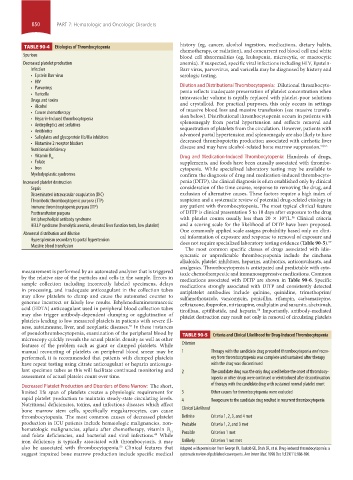
                  Increased platelet destruction                       penia (DITP), the clinical diagnosis is often established only by clinical
                    Sepsis                                             consideration of the time course, response to removing the drug, and
                    Disseminated intravascular coagulation (DIC)       exclusion of alternative causes. These factors require a high index of
                    Thrombotic thrombocytopenic purpura (TTP)          suspicion and a systematic review of potential drug-related etiology in
                    Immune thrombocytopenic purpura (ITP)              any patient with thrombocytopenia. The most typical clinical feature
                    Posttransfusion purpura                            of DITP is clinical presentation 5 to 10 days after exposure to the drug
                                                                                                             56
                                                                                                           9
                    Antiphospholipid antibody syndrome                 with platelet counts usually less than 20  × 10 /L.  Clinical criteria
                    HELLP syndrome (hemolytic anemia, elevated liver function tests, low platelet)  and a scoring scale for the likelihood of DITP have been proposed.
                                                                       One commonly applied scale assigns probability based only on clini-
                  Abnormal distribution and dilution                   cal information of exposure and response to removal of exposure and
                    Hypersplenism secondary to portal hypertension     does not require specialized laboratory testing evidence (Table 90-5). 57
                    Massive blood transfusion
                                                                         The most common  specific classes of  drugs associated  with idio-
                                                                       syncratic or unpredictable thrombocytopenia include the cinchona
                                                                       alkaloids, platelet inhibitors, heparins, antibiotics, anticonvulsants, and
                                                                       analgesics. Thrombocytopenia is anticipated and predictable with cyto-
                   measurement is performed by an automated analyzer that is triggered   toxic chemotherapeutic and immunosuppressive medications. Common
                 by the relative size of the particles and cells in the sample. Errors in   medications associated with DITP are shown in  Table 90-6. Specific
                 sample  collection  including  incorrectly labeled  specimens, delays   medications strongly associated with DITP  and consistently detected
                 in processing, and inadequate anticoagulant in the collection tubes   antiplatelet antibodies include quinine, quinidine, trimethoprim/
                 may allow platelets to clump and cause the automated counter to   sulfamethoxazole, vancomycin, penicillin, rifampin, carbamazepine,
                 generate incorrect or falsely low results. Ethylenediaminetetraacetic   ceftriaxone, ibuprofen, mirtazapine, oxaliplatin and suramin, abciximab,
                 acid (EDTA) anticoagulant used in peripheral blood collection tubes   tirofiban, eptifibatide, and heparin.  Importantly, antibody-mediated
                                                                                                  58
                 may also trigger antibody-dependent clumping or agglutination of   platelet destruction may result not only in removal of circulating  platelets
                 platelets leading to low measured platelets in patients with severe ill-
                 ness, autoimmune, liver, and neoplastic diseases.  In these instances
                                                      52
                 of pseudothrombocytopenia, examination of the peripheral blood by     TABLE 90-5    Criteria and Clinical Likelihood for Drug-Induced Thrombocytopenia
                 microscopy quickly reveals the actual platelet density as well as other
                 features of the problem such as giant or clumped platelets. While   Criterion
                 manual recounting of platelets on peripheral blood smear may be   1  Therapy with the candidate drug preceded thrombocytopenia and recov-
                 performed, it is recommended that patients with clumped platelets   ery from thrombocytopenia was complete and sustained after therapy
                 have repeat testing using citrate anticoagulant or heparin anticoagu-  with the drug was discontinued
                 lant specimen tubes as this will facilitate continued monitoring and   2  The candidate drug was the only drug used before the onset of thrombocy-
                 assessment of actual platelet count over time.                   topenia or other drugs were continued or reintroduced after discontinuation
                 Decreased Platelet Production and Disorders of Bone Marrow:  The short,   of therapy with the candidate drug with sustained normal platelet count
                 limited life span of platelets creates a physiologic requirement for   3  Other causes for thrombocytopenia were excluded
                 rapid platelet production to maintain steady-state circulating levels.   4  Reexposure to the candidate drug resulted in recurrent thrombocytopenia
                 Nutritional deficiencies, toxins, and infectious diseases which affect
                 bone  marrow  stem  cells,  specifically  megakaryocytes,  can  cause   Clinical Likelihood
                 thrombocytopenia.  The  most  common  causes  of  decreased  platelet   Definite  Criteria 1, 2, 3, and 4 met
                 production in ICU patients include hematologic malignancies, non-  Probable  Criteria 1, 2, and 3 met
                 hematologic malignancies, aplasia after chemotherapy, vitamin B
                                                                    12
                 and folate deficiencies, and bacterial and viral infections.  While   Possible  Criterion 1 met
                                                              49
                 iron deficiency is typically associated with thrombocytosis, it may   Unlikely  Criterion 1 not met
                 also be associated with thrombocytopenia.  Clinical features that   Adapted with permission from George JN, Raskob GE, Shah SR, et al. Drug-induced thrombocytopenia: a
                                                   53
                 suggest impaired bone marrow production include specific medical   systematic review of published case reports. Ann Intern Med. 1998 Dec 1;129(11):886-890.


            section07.indd   850                                                                                       1/21/2015   7:42:43 AM

