


Page 1240 - Hall et al (2015) Principles of Critical Care-McGraw-Hill
P. 1240
CHAPTER 90: Bleeding Disorders  847


                      TABLE 90-3    Essential Events of Coagulation Cascade
                    Step                 Consequence               Direct Mediator(s)    Mechanism
                     1.  Activation of prothrombin to    Conversion of fibrinogen to fibrin  Activated factor V  Tissue factor and calcium bind to factor VII, resulting in activation.
                      thrombin                                                           Activated VII activates factor X, factor Xa activates prothrombin
                     2.  Conversion of fibrinogen    Formation of insoluble fibrin multimers    Thrombin  Activation of prothrombin to thrombin
                      to fibrin          and cross-linking/aggregation of platelets
                     3.  Propagation and amplification   Rapid burst of fibrin formation  Thrombin  Thrombin itself activates factor V to Va, factor VII to VIIIa and
                      of thrombin production                                             mediates conversion of XI to XIa
                     4.  Termination of thrombin   Cessation of fibrin formation  Antithrombin, Thrombomodulin,    Antithrombin neutralizes thrombin, Xa, IXa, XIIa, and XIa.
                        activation and removal of active           protein C, protein S, tissue factor    Thrombomodulin binds thrombin to inhibit platelet activation
                      thrombin                                     pathway inhibitor (TFPI)  and cleavage of fibrinogen. Proteins C and S inactivate factor Va
                                                                                         and VIIIa. TFPI inhibits Xa
                     5.  Fibrinolysis    Cleavage of polymerized fibrin and release   Plasmin, tissue-type plasminogen    Plasminogen and tissue plasminogen activator form complex
                                         of fibrin degradation products  activator, urokinase  with fibrin leading to active proteolytic plasmin


                    understanding of common laboratory tests including prothrombin time   coagulation), severe inflammatory states (eg, sepsis, trauma), and inhi-
                    and activated partial thromboplastin time (see “Laboratory Testing of   bition of activity in autoimmune disease (eg, antibody inhibitors).
                    Coagulation Function” below). 27
                     The common pathway describes the final steps in fibrin production
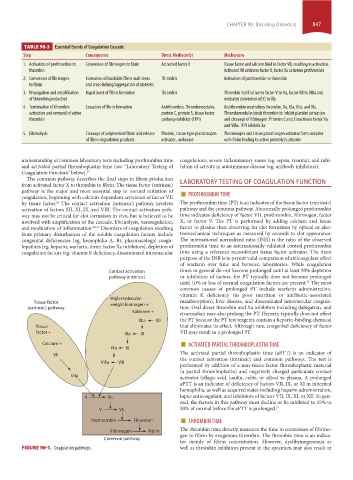
                    from activated factor X to thrombin to fibrin. The tissue factor (extrinsic)    LABORATORY TESTING OF COAGULATION FUNCTION
                    pathway is the major and most essential step in normal initiation of     ■
                    coagulation, beginning with calcium-dependent activation of factor VII   PROTHROMBIN TIME
                    by  tissue factor.   The contact activation  (intrinsic)  pathway involves   The prothrombin time (PT) is an indicator of the tissue factor (extrinsic)
                               28
                    activation of factors XII, XI, IX, and VIII. The contact activation path-  pathway and the common pathway. Abnormally prolonged prothrombin
                    way may not be critical for clot formation in vivo, but is believed to be   time indicates deficiency of factor VII, prothrombin, fibrinogen, factor
                    involved with amplification of the cascade, fibrinolysis, vasoregulation,   X, or factor V. The PT is performed by adding calcium and tissue
                    and modulation of inflammation. 29-31  Disorders of coagulation resulting   factor to plasma then observing for clot formation by optical or elec-
                    from  primary  disturbances  of  the  soluble  coagulation  factors  include   tromechanical techniques as measured by seconds to clot appearance.
                    congenital deficiencies (eg, hemophilia A, B), pharmacologic coagu-  The international normalized ratio (INR) is the ratio of the observed
                    lopathies (eg, heparin, warfarin, direct factor Xa inhibitors), depletion of   prothrombin time to an internationally validated control prothrombin
                    coagulation factors (eg, vitamin K deficiency, disseminated  intravascular   time  using a  reference  recombinant  tissue  factor activator. The  main
                                                                          purpose of the INR is to permit valid comparison of anticoagulant effect
                                                                          of  warfarin  over  time and  between  laboratories.  While  coagulation
                                                 Contact activation       times in general do not become prolonged until at least 50% depletion
                                                 pathway (intrinsic)      or inhibition of factors, the PT typically does not become prolonged
                                                                          until 10% or less of normal coagulation factors are present.  The most
                                                                                                                     27
                                                                          common causes of prolonged PT include warfarin administration,
                                                                          vitamin K deficiency (in poor nutrition or antibiotic-associated
                                                  High-molecular-
                        Tissue factor             weight kininogen +      malabsorption), liver disease, and disseminated intravascular coagula-
                      (extrinsic) pathway                                 tion. Oral direct thrombin and Xa inhibitors including dabigatran, and
                                                         Kallikrein +     rivaroxaban may also prolong the PT. Heparin typically does not affect
                                                           XIIa  XII      the PT because the PT test reagents contain a heparin-binding chemical
                        Tissue                                            that eliminates its effect. Although rare, congenital deficiency of factor
                        factor +                       XIa  XI            VII may result in a prolonged PT.
                           Calcium +                                          ■  ACTIVATED PARTIAL THROMBOPLASTIN TIME
                                                  IXa  IX
                              Vll                                         The activated partial thromboplastin time (aPTT) is an indicator of
                                                                          the contact activation (intrinsic) and common pathways. The test is
                                               Vllla  Vlll
                                                                          performed by addition of a non-tissue-factor thromboplastic material
                                                                          (a  partial  thromboplastin)  and  negatively  charged  particulate  contact
                                    Vlla                                  activator (ellagic acid, kaolin, celite, or silica) to plasma. A prolonged
                                                                          aPTT is an indicator of deficiency of factors VII, IX, or XI in inherited
                                                                          hemophilia, as well as acquired states including heparin administration,
                                         X       Xa                       lupus anticoagulant, and inhibitors of factors VII, IX, XI, or XII. In gen-
                                                                          eral, the factors in this pathway must decline or be inhibited to 15% to
                                              V      Va                   30% of normal before the aPTT is prolonged. 27
                                                                              ■
                                           Prothrombin    Thrombin          THROMBIN TIME
                                                                          The thrombin time directly measures the time to conversion of fibrino-
                                                  Fibrinogen   Fibrin
                                                                          gen to fibrin by exogenous thrombin. The thrombin time is an indica-
                                                Common pathway
                                                                          tor mainly of fibrin concentration. However, dysfibrinogenemia as
                    FIGURE 90-1.  Coagulation pathways.                   well as thrombin inhibitors present in the specimen may also result in


            section07.indd   847                                                                                       1/21/2015   7:42:42 AM

